


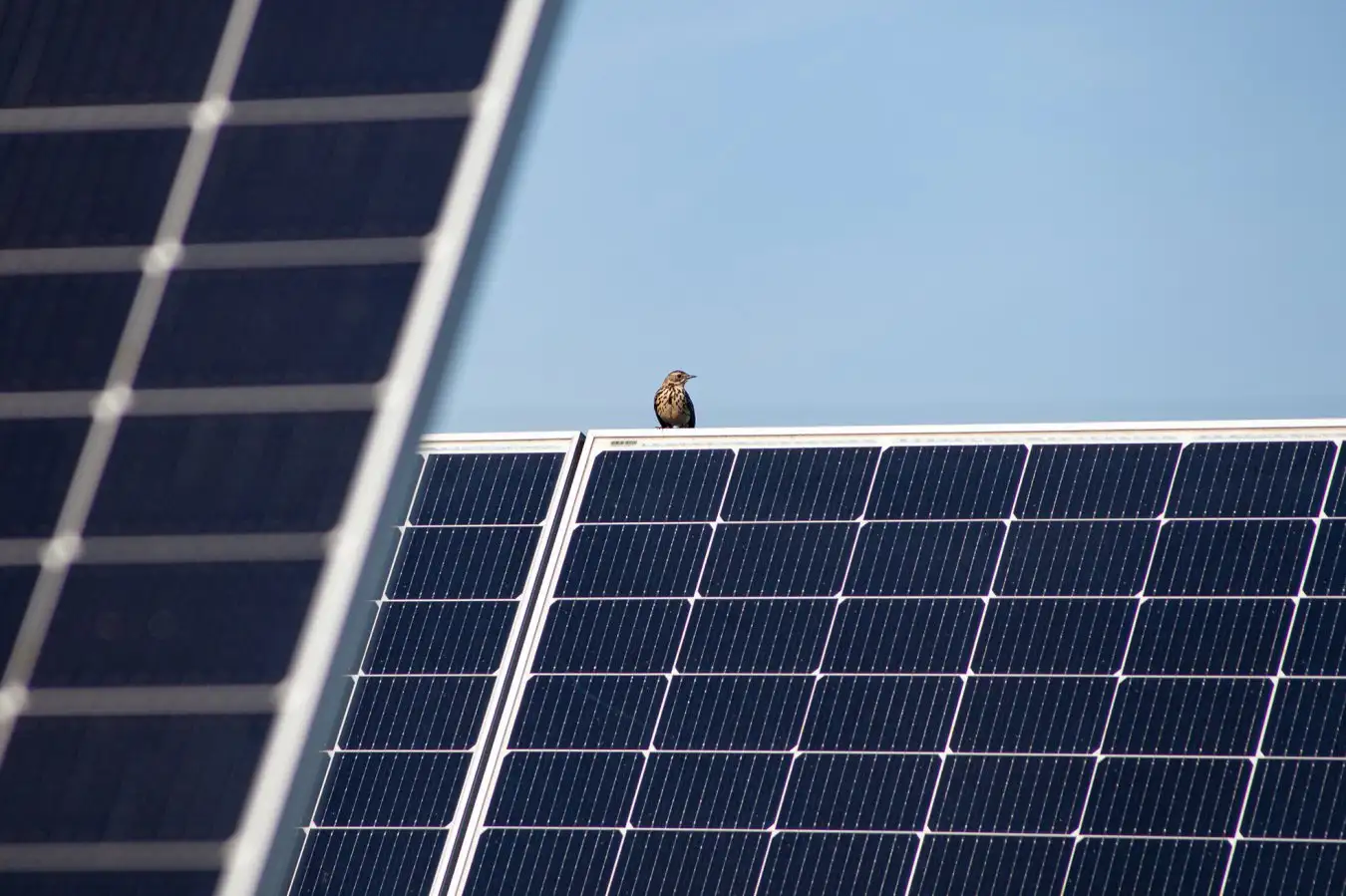
Meadow Pipit in Solar Park on Peatland in Northern Germany
Watt Manufacturer
Solar farms on rewetted peatlands host a greater diversity of bird species compared to nearby dry farmlands, indicating that renewable energy projects can benefit both landowners and biodiversity by sequestering carbon while enhancing wildlife habitats.
Peatlands, recognized as the largest carbon reservoirs on Earth, store twice the carbon of all the world’s forests. Unfortunately, extensive areas are being drained for agriculture or harvested for horticultural materials. In Germany, 95% of peatlands are degraded, while the UK faces an 80% degradation rate.
When peatlands are drained using ditches or pumps, microorganisms break down ancient carbon, releasing CO2 over prolonged periods.
A new research initiative in Germany is investigating whether solar farms can expedite the recovery of these vital ecosystems.
Hannah Ray Martens, a researcher at the University of Greifswald in Germany, asserts, “We can’t simply press reset and revert to conservation. Many people depend on these lands for their livelihoods.”
At the study site, the solar energy firm, Watt Manufacturing, began constructing a sand and gravel road in 2020, obstructing drainage ditch flow and allowing water to pool on farmland, thus facilitating the return of moisture to the peatland.
Mertens highlighted that this study is the first to examine the impact of solar installations on rewetted peatlands, revealing positive outcomes for biodiversity.
“Concerns of habitat destruction are unfounded,” she explains. “New habitats are forming for various species, including endangered and wetland species, which contribute to overall landscape diversity.”
The species richness observed within the 30-hectare solar park was comparable to that of two adjacent hayfields. However, audio monitoring revealed that the solar park was inhabited by both wetland and woodland bird species, while the hayfields predominantly featured grassland species such as the European goldfinch.
Notable wetland species, including the white wagtail, great bunting, and blue heron, were recorded in the solar park, alongside forest species like the white wagtail and sparrow. Solar panels provided perches for birds of prey like buzzards and kestrels, aiding in their hunting activities.
The researchers captured images of the meadow pipit, a small brown-striped grassland bird that is classified as endangered in Germany.
Mertens posits that rewetting peat, the strategic installation of solar panels for perching, and reduced mowing practices are attracting a variety of birds. However, further investigation is essential to compare the park’s biodiversity against rewetted peatlands without solar installations. Katherine Waite from Cambridge University emphasizes, “Peatland PV could be an effective method for rejuvenating heavily degraded agricultural peat, but we must be cautious about deploying on healthy peatlands elsewhere.”
In the UK, approximately 2,500 square kilometers of peatland have been restored, though this accounts for only one-tenth of the damaged area. Germany has similarly restored an even smaller portion. Moreover, emissions from drained peatlands can persist for years; therefore, some of the 165 solar power installations on degraded peatlands in Germany inadvertently generate more greenhouse gases than the renewable energy they produce.
Contrary to agricultural energy generation, where crops coexist around solar installations, peatland solar power currently only yields income through electricity sales. The Watt Manufacturing Solar Park is among only five sites established on wet peatland. Developers often encounter additional expenses, as they must install deeper foundations and wait for the dry season to begin construction.
Since 2023, Germany has prohibited solar power installations on degraded peatlands from receiving guaranteed minimum electricity prices; however, developers are not always required to disclose whether their projects are on drained lands.
Waite advocates for enhanced government incentives to foster peatland solar development. “To effectively tackle global warming, the biodiversity crisis, and agricultural challenges, we must manage land to achieve multiple benefits,” she urges. “We need a win-win solution.”
Topics:
Source: www.newscientist.com