


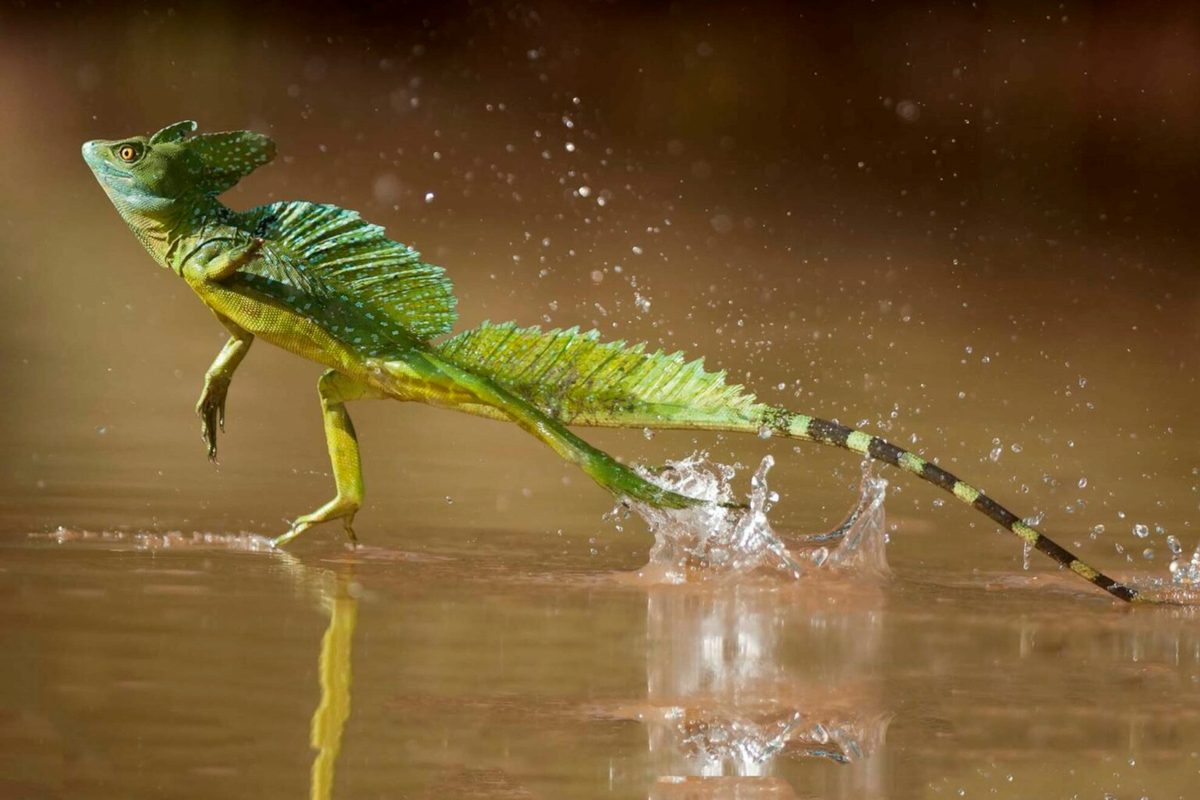
If you haven’t seen it yet, check out this captivating video of the basilisk, famously known as the “Jesus Christ Lizard,” effortlessly running on water.
The spectacle you’re witnessing mimics a Looney Tunes scene—this incredible feat is performed by a lizard instead of the Road Runner, seemingly defying the laws of physics.
The common basilisk is native to Central and South America and typically lives near rivers and streams in lush rainforests. These relatively small lizards feature large tails that exceed twice their body length.
Males reach lengths of around 75 cm (about 30 inches) and possess three distinctive sail-like crests—one on the head, one on the back, and one on the tail—helping to establish dominance and attract smaller females.
Notably, their unique ability to run on water is a natural skill, allowing them to evade predators. Basilisk hatchlings already possess this remarkable ability.
Over short distances of up to 20 m (66 ft), adult basilisks can achieve speeds of approximately 5 km/h (3 mph), while younger, lighter individuals can run even faster.
Researchers are intrigued by this behavior, as the lizards run predominantly on their hind legs, flapping their front legs like Kermit the Frog.
Biologist Tonia Shea explored this phenomenon during her Ph.D. at Harvard University in 2003, utilizing a high-speed camera to analyze 30 videos of basilisks running on water within a 4.6 m (15 ft) aquarium. She compared their speed to lizards running on solid ground.
The common basilisk exhibits a highly specialized movement technique when traversing water. They swing their legs wide and stretch them back, while maintaining a stiff posture and forcefully striking the water like a piston.
A follow-up study conducted the following year indicated that each footstep generates sufficient force to support the basilisk’s weight and propel it forward.
The maximum force occurs during the initial phase of each stride when the foot descends vertically into the water. This “slamming” action displaces water downward and outward, creating an air pocket around the temporarily submerged foot, which reduces resistance.
This unique technique allows the basilisk to lift its feet out of the water and keep moving efficiently.
While basilisks are champions of hydrodynamics, they have also evolved various physical adaptations over time. Their hind legs are long and muscular, featuring large feet with scaly fringes along the third, fourth, and fifth toes.
When the lizard is on land, these flaps fold against the toes, but in water, they extend to enhance the foot’s surface area.
In summary, the lizard often dubbed the Jesus Christ Lizard is a fascinating marvel of nature.
While other animals, such as pond skaters, fishing spiders, and certain grebes (diving birds), can move across water, none demonstrate the unique flair of the basilisk.
If you have any questions, please reach out to us at: [email protected] or send us a message Facebook, Twitter or Instagram (please include your name and location).
Discover our ultimate fun facts and explore more incredible science pages!
Read more:
Source: www.sciencefocus.com