


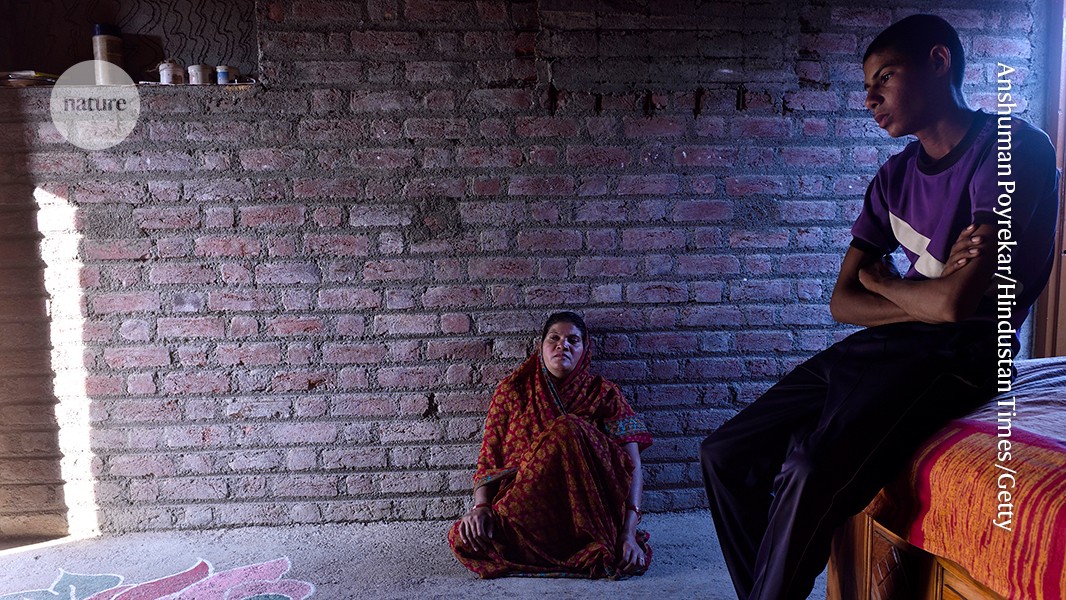
Families are left devastated after relatives die by suicide following exposure to hazardous pesticides.
Credit: Anshuman Poyrekar/Hindustan Times via Getty
Mental health is a fundamental part of global health and sustainable development. It is influenced by personal experiences, access to healthcare and wider social, environmental and economic conditions. Laws, public policies, governance systems and institutions determine how environmental hazards, services and natural resources are distributed, shaping people’s livelihoods, safety, opportunities and overall quality of life1.
Children and adolescents are especially vulnerable to environmental risks because exposure can occur during critical stages of physical, cognitive and emotional development. Early contact with mercury, lead and persistent organic pollutants can affect brain development, impair behaviour and increase the likelihood of mental-health problems later in life.

Why measuring well-being matters: lessons from a global survey
For adults and older people, exposure to heavy metals, air pollution, contaminated water and degraded environments can reduce well-being and contribute to depression and anxiety. People whose lives and livelihoods depend on natural resources may also experience poor mental-health outcomes when biodiversity declines, ecosystems are damaged or traditional ways of life are disrupted2.
Despite these links, international treaties and policy frameworks often address mental health and environmental protection as separate issues. Mental-health considerations are rarely included in the reporting requirements, national action plans, funding criteria or accountability systems of environmental conventions.
Environmental change is also generally described in treaties as a factor that can influence health, rather than as a central issue for mental-health governance. The World Health Organization’s mental-health action plan for 2013–2030 recognizes that climate stability, healthy ecosystems, pollution reduction and sustainable land use help create the conditions needed for people to live, work and maintain good health3. However, environmental and mental-health planning and monitoring systems remain largely disconnected. The Sustainable Development Goals also lack sufficient indicators that measure environmental and mental-health outcomes together.
This separation means that environmental treaties are seldom considered tools for preventing mental-health conditions. At the same time, mental-health outcomes are rarely used to evaluate environmental policies. A stronger policy connection is needed, including shared indicators, targeted financing, practical implementation guidance and accountability mechanisms that link environmental governance with mental-health prevention.
Environmental treaties such as the United Nations Framework Convention on Climate Change should therefore be recognized as upstream policy instruments. By shaping exposure to environmental risks, social disruption and economic insecurity, these agreements can influence mental health and psychosocial well-being before clinical treatment becomes necessary4. The UN high-level political declaration on the global burden of non-communicable diseases, including mental-health conditions, could provide an important foundation for further action5.
To clarify these connections, we propose a tiered policy framework. The framework groups environmental conventions according to their relevance to mental health and the extent to which their outcomes can currently be evaluated using measurable indicators. Further details are provided in the Supplementary information.
Connecting environmental policy and mental health
To assess how global environmental conventions relate to mental health, we examined treaties across six areas: chemicals and waste, biodiversity, climate and land, atmospheric protection, disaster-risk reduction and human rights.
Each convention was assessed across five dimensions: its governance objectives and regulatory tools; the pathways through which it could affect mental-health outcomes; the feasibility of measuring progress with existing mental-health and Sustainable Development Goal indicators; its level of institutional development; and the effectiveness of ratification and implementation.
We then organized the conventions into three tiers based on how closely their mandates align with mental-health outcomes and opportunities for policy action. A fourth, cross-cutting tier focuses on human rights.
The purpose of this framework is to help policymakers, programme designers and researchers identify where mental-health integration into environmental governance is immediately practical, and where more evidence, monitoring tools and accountability systems are required.
Tier 1: chemicals and hazardous waste. Treaties covering chemicals and hazardous waste have the most direct connection to mental health. They regulate neurotoxic substances, hazardous pesticides and toxic waste, all of which can affect neurodevelopment, cognitive function and suicide risk.
Tier 1 includes the Stockholm Convention on Persistent Organic Pollutants, the Minamata Convention on Mercury, the Rotterdam Convention on hazardous chemicals and pesticides, and the Basel Convention on the Control of Transboundary Movements of Hazardous Wastes and Their Disposal.
Eco-anxiety is rising as scientists examine the mental-health effects of climate change
Reducing exposure to mercury, lead, persistent organic pollutants and hazardous waste can protect children’s developing brains. Over time, this protection may improve mental health, cognitive function and developmental outcomes6. Restricting access to highly hazardous pesticides can also reduce the availability of lethal means for self-poisoning. Research suggests that pesticide bans and restrictions can lower the number of pesticide-related suicides7,8.
Tier 1 agreements are relatively well established and widely ratified. Their implementation mechanisms include bans, phase-outs, emissions limits and hazardous-waste management requirements. There is also strong potential to develop linked indicators for mental health and chemical safety. Suicide mortality, hospital admissions for poisoning, developmental delays and neurodevelopmental disabilities are already measured in many countries and could help assess treaty progress, provided that data quality, attribution and comparability are maintained.
Tier 2: Rio conventions and disaster-risk reduction. These agreements address climate change, biodiversity loss and land degradation. Their effects on mental health are generally less direct than those associated with chemical exposure, but their population-wide consequences can be substantial.
Climate change, drought, land degradation, biodiversity loss and ecosystem disruption can damage mental health by increasing exposure to disasters, chronic stress, food insecurity, forced migration and livelihood loss. Communities often value the natural world for more than its economic benefits. Cultural identity, sacred places, human rights, health and ecological integrity may all be tied to local environments9. Among children and adolescents, environmental disruption can interrupt education, place pressure on families and caregivers, increase child-protection risks, displace communities, weaken peer networks and restrict access to healthcare and social services.

Reducing pollution can support the mental and physical health of children throughout their lives.
Credit: Ling Jin/Getty
Tier 2 is built around the three Rio conventions: the Paris Agreement, the UN Convention to Combat Desertification and the Convention on Biological Diversity. It also includes the Sendai Framework for Disaster Risk Reduction. These agreements influence mental health mainly through psychosocial, social and livelihood-related pathways. Although the evidence base is substantial, it is more varied than the evidence linking hazardous chemicals directly to health outcomes.
The Rio conventions have broad international legitimacy and high levels of ratification, but implementation is uneven. Their commitments create opportunities for action through Nationally Determined Contributions for emissions reduction, national adaptation plans, strategies to combat desertification, and national biodiversity strategies and action plans. However, countries differ considerably in ambition, resources and follow-through4.
The potential for linked environmental and mental-health indicators is moderate. Many relevant outcomes are already included in health and social datasets, but they are not routinely connected to environmental governance. Some indicators may also be more useful for evaluating programmes and learning than for directly measuring progress under an international treaty.
Tier 3: atmospheric protection. Atmospheric-protection agreements affect mental health more indirectly and over longer time periods. By protecting the ozone layer and supporting climate stability, the Vienna Convention and Montreal Protocol may contribute to better mental health through improved physical health, greater environmental security and more stable social and economic conditions.
These benefits are rarely expressed as mental-health outcomes, and existing indicators do not yet make it easy to attribute them to atmospheric-protection policies. Initial efforts to establish these connections are emerging, but further research and better monitoring methods are needed.
Cross-cutting tier: human rights and mental-health protection. Conventions on the rights of children and people with disabilities provide an accountability framework for addressing environmental drivers of mental-health conditions. They can support equitable access to healthcare, psychosocial support and social protection while safeguarding rights to development, participation in decision-making, education, health and freedom from discrimination.
This rights-based approach is particularly important for children, adolescents, older people, people with disabilities, communities displaced by disasters or conflict, and populations exposed to overlapping environmental and social risks. Integrating mental health into environmental treaties and human-rights frameworks can help governments prevent harm, reduce inequality and build healthier, more resilient communities.
Source: www.nature.com