


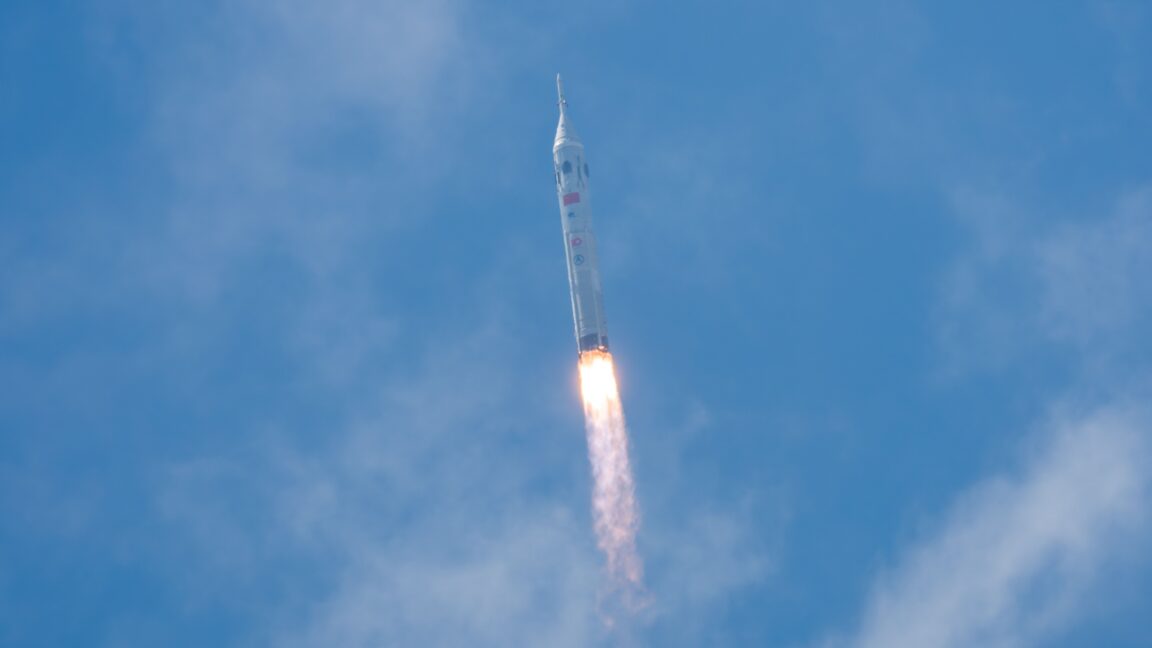
The United States faces major uncertainty in its effort to return astronauts to the Moon, while China is making steady progress toward its own crewed lunar landing. Delays in developing lunar landers for NASA’s Artemis program could push the U.S. landing to 2030 or later, increasing pressure on NASA to accelerate its plans as China prepares upcoming tests.
China advances its lunar lander program
Outsiders have very limited visibility into the technological milestones achieved by China’s space program. However, the country appears to be making reliable progress toward reaching the Moon.
In August 2025, the China Manned Space Administration successfully tested a high-fidelity mockup of the 26-ton Lanyue lunar lander. The test used a giant tether to simulate lunar gravity. The vehicle fired its main engine and precisely controlled its thrusters to land on a cratered surface and take off from a site near Beijing.
A Mengzhou spacecraft intended for tests in 2027 was recently mounted on a Long March 10A rocket and arrived at the Wenchang Space Launch Site in China’s Hainan province.
NASA seeks to accelerate Artemis
The U.S. government’s assessment of China’s space program has been limited, but lawmakers are clearly treating the country’s progress as a serious strategic challenge. Over the past 12 months, Congress and the White House have given NASA Administrator Jared Isaacman broad authority to streamline the Artemis program and land humans on the Moon.
Isaacman moved quickly to cancel the Lunar Gateway space station and plan upgrades to the Space Launch System rocket. Last week, he also announced plans to help Blue Origin develop its lunar lander by finding a way to propel the Orion spacecraft into low lunar orbit.
However, major questions remain about the development of the lunar modules being built by SpaceX and Blue Origin under multibillion-dollar development agreements. Depending on the progress of those projects, the U.S. lunar landing could be delayed until 2030 or even later.
“We have the mission, the resources and the support from our stakeholders to get the job done, and that’s what we’re going to do,” Isaacman said at the time.
A long-term competition at the lunar south pole
In recent years, it has become clear that China has made a major commitment to landing astronauts on the Moon, ideally before the United States returns, as a way to achieve a significant geopolitical victory.
Beyond the immediate competition, NASA and China’s space program are both developing the capabilities needed to establish a long-term presence at the Moon’s south pole. As part of the next phase of the competition, Isaacman committed NASA to developing a lunar base within the next 10 years.
Source: arstechnica.com