


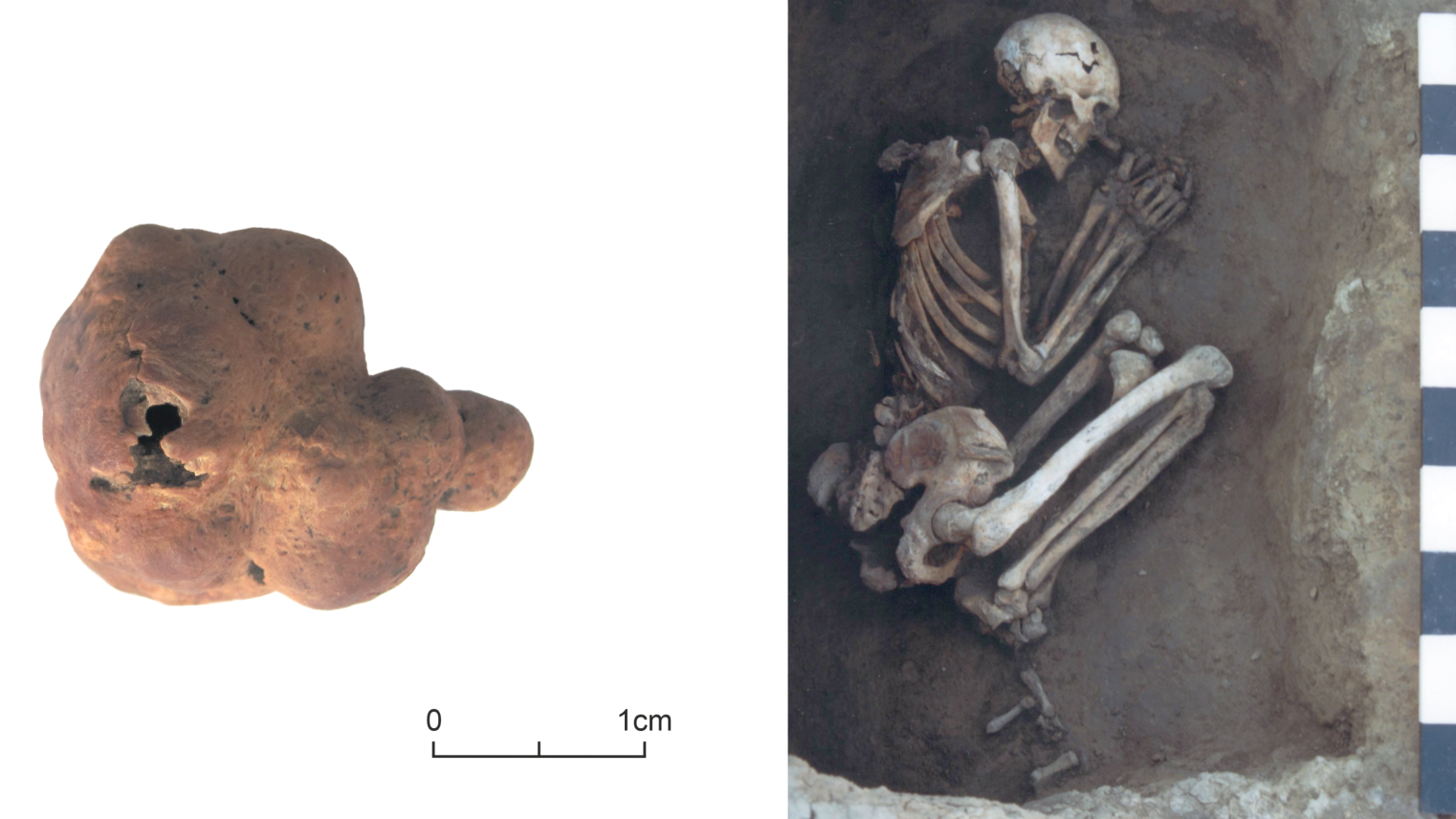
A man buried in a monumental tomb near Russia’s Black Sea coast may have died more than 5,000 years ago after suffering complications from a chronic urinary tract infection (UTI), a new study suggests. Archaeologists found grape-sized mineral objects consistent with kidney or bladder stones in the burial of a man who was about 40 years old when he died roughly 5,300 years ago.
A rare mineral in an ancient burial
Study lead author Natalia Berezina, an anthropologist at Lomonosov Moscow State University, said the man “was living with a chronic urogenital infection.”
“It wasn’t a short event,” Berezina told Live Science in an email. “His later years were probably marked by considerable and more or less constant pain.”
Berezina and her colleagues examined small, stone-like objects recovered from an Early Bronze Age burial site in the Stavropol Highlands of southwestern Russia. Their findings were published in Archaeology and Anthropology on September 30.
The burial was part of a Kurgan cemetery, an ancient steppe tradition in which a large mound of earth was built over a grave. Excavation of the mound revealed a catacomb containing the man’s skeleton. Researchers also found a flint arrowhead near his pelvis.
During laboratory analysis, researchers noticed an unusual object among the bones of the man’s hands. The brownish, rounded object had several protrusions and measured about 0.8 inches (2.1 centimeters) across — approximately the size of a grape. A small crack exposed a crystal-like structure inside.
X-ray fluorescence analysis showed that the object was composed mainly of calcium and phosphorus. The researchers then used powder X-ray diffraction to determine its crystal structure.
The analysis identified several common minerals as well as whitlockite, a rare calcium salt known to occur in kidney, bladder and prostate stones. These hard mineral deposits are collectively called concretions. Although kidney and bladder stones can contain similar compounds, they form in different organs and can differ in their formation mechanisms and chemical composition.
Evidence of chronic infection
The researchers concluded that the presence of whitlockite was strongly associated with a bacterial infection in the body. They wrote that a chronic or recurrent upper urinary tract infection was the most likely cause of the stones.
UTIs can contribute to kidney-stone formation by changing the acidity of urine, making it easier for minerals to accumulate. However, the researchers do not know why the man developed urinary tract problems or whether the condition contributed to his death.
It is also unclear where the stone was located in his body when he died. Kidney stones can move into the bladder, and a stone blocking the ureter — one of the two tubes connecting the kidneys to the bladder — can cause kidney swelling, a secondary infection or sepsis. Before antibiotics were invented, such conditions were often fatal.
Stones can also result from bacterial infections of the prostate or from sexually transmitted infections.
“This person had a painful and debilitating chronic urogenital infection, and this condition would have had a significant impact on his quality of life,” the researchers wrote.
A physically demanding life
The man may have traveled frequently within Early Bronze Age steppe society, according to the researchers. His skeleton suggests that he lived a physically demanding life: His bones showed substantial muscle development, along with degenerative joint disease in his spine, shoulders, hips, hands and feet.
Several fractures in his right shoulder, ribs and forearm had healed before his death.
“These were people who were working in open fields with cattle and heavy carts, and the resulting injuries are the ones we found,” Berezina said. In previous research at a nearby cemetery, Berezina and her colleagues found the skeleton of a man who had been hit by a van several years before his death.
“Given that background, our man’s four healed fractures seem unremarkable,” Berezina said.
The study is cited as: Berezina, N. Ya., Statkus, MA, Kalmykov, AA, Abdrasitova, IV, Kolesnik, IV, Platonov, VB, Shashurin, DA, Garmay, AV, Korobkova, VV, Ryleeva, VS, and Gresky, J. (2026). “Urolithiasis in the North Caucasian Early Bronze Age: A paleopathological case study and insights into ancient lifestyles.” Archaeology and Anthropology 18(10), 209.
Source: www.livescience.com