


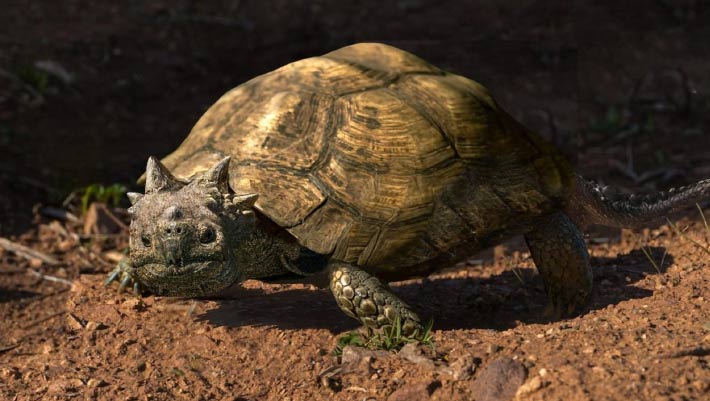
Paleontologists have discovered a new species of Maioraniformes turtle, named Patagoniaemys aeschyli, that inhabited northern Patagonia, Argentina, during the Maastrichtian era, just before the catastrophic asteroid event that led to the extinction of non-avian dinosaurs.
Artist’s impression of Patagoniaemys aeschyli. Image credit: Nawel Vazquez / Museo Argentino de Ciencias Naturales ‘Bernardino Rivadavia’ / CONICET.
This newly identified turtle species thrived in what is now Patagonia during the Late Cretaceous, approximately 72 to 67 million years ago.
Known as Patagoniaemys aeschyli, it belongs to a rare lineage of turtles that includes some of the most unusual species ever documented.
The Maioraniformes are distinguished by their robust, armored bodies and, in certain species, horned skulls.
“Maioraniformes represent a group of turtles that includes the well-known horned species like Nicolamia argentina (Patagonia) and Meiolania platypus (Australia),” explained lead author Dr. Federico Agnolin, a paleontologist at the Bernardino Rivadavia Museum of Natural Sciences and Maimonides University.
“The extensive fossil record of Maioraniformes ranges from the Lower Cretaceous to the Pleistocene across southern continents, including South America, Australia, and New Caledonia.”
The fossilized remains of Patagoniaemys aeschyli were excavated from the Los Alamitos Formation in Rio Negro, Argentina. The specimen includes the base of a skull, shell fragments, vertebrae, and a limb bone, making it one of the most informative meioraniids discovered in the area.
Paleontologists estimate that the carapace of Patagoniaemys aeschyli measured about 80 centimeters (2.6 feet) long, characterized by a wide and relatively low shell, contrasting with the more domed shells of its later relatives.
“The shell features a thick base at the marginal plate, adorned with tough ridges, particularly at the rear,” the researchers noted. “Its external surface displays small holes and grooves.”
In addition to identifying a new turtle species, scientists explored how various turtle lineages survived the end-Cretaceous mass extinction 66 million years ago.
Upon examining fossil diversity in Patagonia, they unearthed evidence indicating that certain turtle lineages persisted through the boundary separating the Cretaceous and Paleogene periods.
The discovery of Patagoniaemys aeschyli confirms the presence of at least two Maioraniformes during the late Cretaceous in southern South America. The remarkable taxonomic continuity between Maastrichtian and Danian populations indicates that the end-Cretaceous extinction event had a limited impact on Patagonian turtles, suggesting a scenario of lineage persistence with minimal turnover among southern Chelonians.
A detailed description of this groundbreaking discovery was published in the journal Acta Paleontologica Polonica on March 26, 2026. Read the paper here.
_____
Federico L. Agnolin et al. 2026. A new species of Maioraniformes turtle from the Maastrichtian region of northern Patagonia, Argentina. Acta Paleontologica Polonica 71 (1): 173-184; doi: 10.4202/app.01268.2025
Source: www.sci.news