


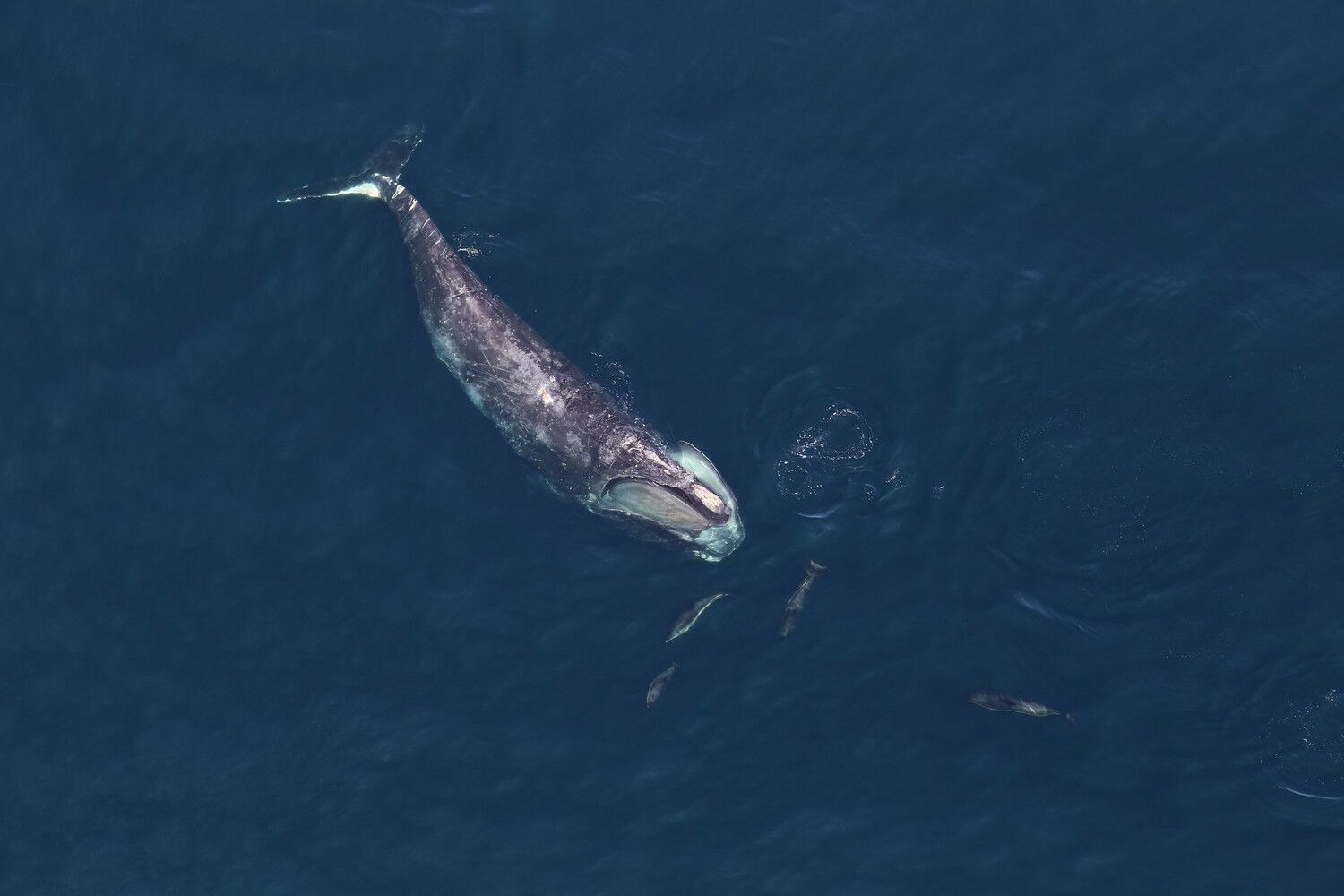
Since 2008, regulations mandating ships to reduce speed to protect North Atlantic right whales have significantly lowered mortality rates. However, NOAA is now reevaluating these regulations, raising concerns for the future of these endangered mammals.
Although large, North Atlantic right whales are surprisingly discreet underwater. Regina Asmutis Sylvia, executive director of the North American Whale and Dolphin Conservancy, underscores the challenges of locating whales and preventing collisions.
While navigating her research vessel, Asmutis Sylvia seeks ripples or spouts of water that indicate whale presence. However, whale behavior can be unpredictable.
“They’re not aware of surroundings,” she explains. “Whales foraging for food are often clueless about their surroundings.”
Recently, while conducting research with the Woods Hole Oceanographic Institution in Massachusetts, Asmutis Sylvia faced a near-miss with a North Atlantic right whale just 30 feet away. “Such behavior is common for right whales,” she added. “These whales act as they please.”
Thanks to her slow speed, she managed to avert a collision, but many incidents are less fortunate. Ship strikes have become increasingly frequent along the East Coast, exacerbated by growing shipping traffic. Fatal vessel collisions have been estimated to result in the deaths of around 20,000 whales annually. Recent cases of dead whales washed ashore in New York and Delaware highlight the damaging impacts on the coastal ecology.
Since 2008, NOAA has enforced speed regulations in select East Coast areas to protect the endangered North Atlantic right whale. Mother-calf pairs are often sighted close to each other along 40 miles of New England’s coast, where shipping lanes and whale migration paths intersect, heightening collision risks. Research indicates that reducing ship speed is among the most effective ways to mitigate such accidents.
[Rare Footage] Swim with right whales and their calves
![[Rare Footage] Swim with right whales and their calves](https://th-thumbnailer.cdn-si-edu.com/05j7coL4ZiusgO7dn6Dt0AkloYA=/1072x603/https://tf-cmsv2-smithsonianmag-media.s3.amazonaws.com/embedly/Screenshot_2026-06-26_at_12.02.18PM.png)
NOAA oversees laws in waters extending 230 miles off the U.S. coast, yet the necessity of current speed regulations is under review. The agency is investigating whether existing whale detection technologies are adequate to prevent vessel strikes.
While some conservationists advocate for improved detection technology, there’s apprehension that scaling back current speed limits could heighten risks for these endangered creatures. Brett Hartle, director of government affairs at the Center for Biological Diversity, notes that relaxing protections poses “extreme danger to the survival of the species.”
Every whale loss is significant.
The North Atlantic right whale is among the planet’s most endangered species, with only approximately 380 individuals remaining. While vessel strikes affect other species, they have notably influenced the regulations crafted by NOAA.
Documented ship strikes involving right whales haven’t increased in frequency, yet they remain a consistent threat, according to Jessica Redfern, vice president of marine conservation science at the New England Aquarium. “The ongoing loss of whales is not sustainable and jeopardizes the species’ survival,” Redfern states.
According to Redfern, the diminishing reproductive capacity of each whale, particularly females, is crucial. For instance, a female right whale named Wart, known for having birthed seven calves since 1982, has indirectly contributed to the population of at least 31 whales. However, female right whales are particularly susceptible to ship strikes as they often swim near the surface while foraging for their young. Their lack of a dorsal fin makes them even harder to spot from vessels.
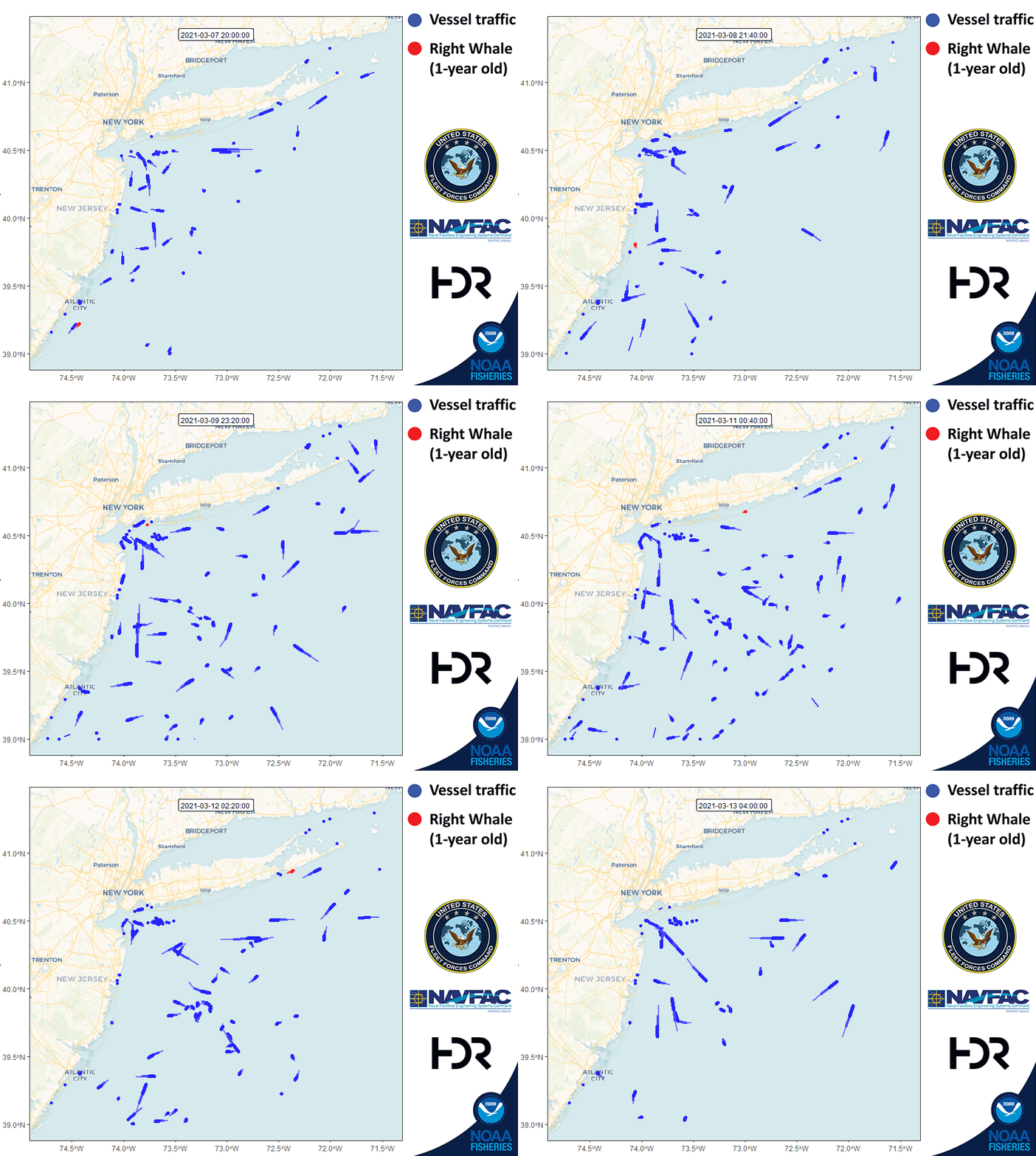
Collisions with vessels pose risks not only to whales but also to small boats. Asmutis Sylvia warns that if a deer can cause significant damage to a car, an 80,000-pound whale can do even more to smaller boats.
Her research team only operates under ideal weather conditions, avoiding windy, foggy, or dark conditions. Even with clear skies, “these animals can be incredibly elusive,” she notes, stressing that detection remains challenging even in optimal conditions.
Though the North Atlantic right whale population has seen slight growth in recent years, 2026 marked the best calving season since 2009. Nevertheless, such progress is precarious, as the International Fund for Animal Welfare warns of the ongoing unusual mortality events caused primarily by vessel strikes and entanglements.
Given these ongoing threats, a successful calving year does not guarantee the species’ survival. In the 2023-2024 calving season, about a quarter of the newly born calves perished. As expressed by Amy Warren, a science program officer at the New England Aquarium, there is concern that “we’re on the brink of a population decline that we can’t recover from.”
Importance of Speed Regulations
Since 2017, vessel collisions have killed at least 15 North Atlantic right whales, with three serious injuries recorded, alongside an additional nine whales experiencing health declines.
While these casualties have occurred despite existing speed limits, experts affirm that the rules have contributed to the overall reduction in fatal ship strikes. A 2013 study noted that lowering ship speeds can decrease whale fatalities from collisions by up to 90 percent, allowing for timely reactions from both the whales and the ship operators. “Speed reductions are vital,” Hartle emphasized.
/https://tf-cmsv2-smithsonianmag-media.s3.amazonaws.com/filer_public/06/55/06557b17-bbf4-4714-98a6-72ca5d8fba42/ezgif-78c5944654eccaff.jpg)
/https://tf-cmsv2-smithsonianmag-media.s3.amazonaws.com/filer_public/6c/54/6c546dfe-67f4-4c59-9a14-aaf3272a94c0/11468719096_f7acc916b7_k.jpg)
Established as temporary measures in 2008, the current vessel speed regulations mandate that ships over 65 feet travel at under 10 knots (approximately 11.5 mph) within designated management zones along the East Coast during key whale activity seasons. NOAA data reveals that most vessels comply with these regulations, which carry fines ranging from $11,000 to $100,000.
In 2022, NOAA proposed amendments to lower the vessel size threshold to 35 feet, but the agency withdrew this proposal last year.
In March 2026, NOAA’s National Marine Fisheries Service solicited public input to help refine existing speed regulations, acknowledging that slowing vessels is merely “one approach” to preventing whale strikes.
Rachel Hager, a NOAA Fisheries spokesperson, confirmed that the existing vessel speed limits have been effective
, but did express an interest in exploring ways to “reduce unnecessary regulatory and economic burdens, all while maintaining conservation efforts for endangered North Atlantic right whales.”
/https://tf-cmsv2-smithsonianmag-media.s3.amazonaws.com/filer_public/95/ee/95eeb58c-ab4f-4a9a-8954-40a1ebaa6ff0/small_boat-2.jpg)
Hartle noted that shipping and recreational boating sectors have long lobbied for easing vessel speed regulations. The National Marine Manufacturers Association, representing recreational boaters, argued that by 2024, advancements in monitoring and detection technologies will sufficiently safeguard whales without necessitating speed limits. Hager noted, “Technology holds the potential to offer innovative solutions for preventing species extinction while promoting the sustainability of marine industries.”
Some proposed technologies may potentially replace speed regulations altogether. Aerial surveys and acoustic monitoring are already employed to track whales. As stated by NOAA, these tools can alert ship operators of whale proximities. Current developments aim to enhance detection speed and accuracy. However, once whales are identified, ships must adjust accordingly.
If tracking tools detect three or more whales, a voluntary Dynamic Management Area is declared, prompting vessels to slow down, though compliance is not mandatory.
Advocates for speed regulations argue that voluntary measures lack the efficacy of mandates. The initial speed limits established in 2008 included a voluntary compliance tracking system, showing minimal vessel cooperation, making the risk mitigation associated with dynamic management areas negligible.
“What conservation value does solely relying on detection technology offer? That’s the frustration,” Asmutis Sylvia maintains. She argues for the necessity of enforcement measures to ensure ship operators adhere to regulations. “What actions would you take if you learned there were whales in the vicinity?”
NOAA is accepting public comments until June 2nd regarding potential changes. The agency will review feedback and determine whether to propose a formal regulation change, initiating another comment period. Accordingly, any changes are unlikely to materialize for several months, according to Asmutis Sylvia.
While monitoring technologies play a crucial role in protecting right whales, conservationists emphasize the need to maintain existing speed regulations. “Implementing effective protective measures like speed limits together with funding to develop alternative approaches is not mutually exclusive,” Redfern asserts.
“We cannot abandon our most effective protective tools,” Hartle concludes. “With endangered species facing threats from so few individuals, every loss is profoundly impactful, and there is no margin for error… We must utilize every possible technique to ensure their survival.”
Source: www.smithsonianmag.com