


A newly discovered genus and species of Masopodan sauropodomorph, named Kounryu Hōmei, has been identified from a partial skeleton found in southwestern China, dating back to the early Jurassic period. This remarkable dinosaur represents a crucial link between early herbivores and the massive four-legged sauropods that would later dominate the Mesozoic Era.
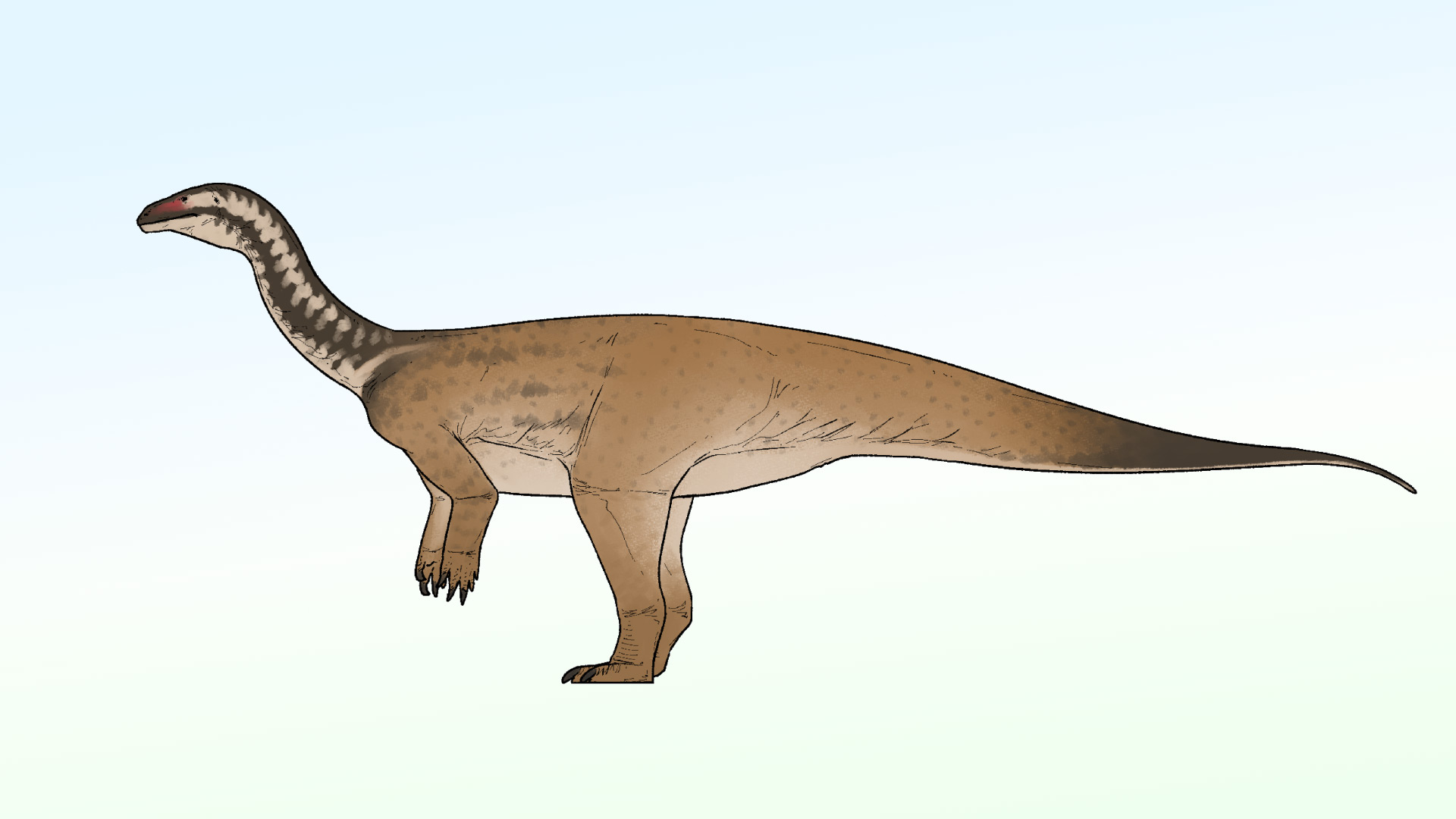
Artist’s impression of Kounryu Hōmei. Image credit: Connor Ashbridge / CC BY 4.0.
Kounryu Hōmei inhabited what is now China approximately 190 million years ago during the early Jurassic period.
Fossil evidence suggests that this dinosaur measured about 9 to 10 meters (30 to 33 feet) in length, making it one of the largest known early-branching sauropods unearthed in China.
This species belongs to the Masopodan group, which existed from the Late Triassic to the Late Cretaceous.
“The Early Jurassic was a key era in dinosaur evolution, marking the diversification and emergence of sauropod dominance in terrestrial ecosystems,” stated Dr. Ya-Ming Wang from the China Museum of Geology and colleagues.
“Within this group, non-sauropod Masopoda sauropods played a significant role in the evolutionary trajectory leading to the distinctive large body shapes associated with sauropods.”
“Therefore, understanding the anatomy, diversity, and paleobiogeography of these early-diverging sauropods is essential for unraveling the origins of one of the most successful dinosaur clades, the sauropods.”
The partial skeleton of Kounryu Hōmei was discovered in the Fengjiahe Formation located in Luming Town, Yunnan Province, China.
The specimen consists of the neck, back, tail vertebrae, and part of the hip joint.
Analysis of these fossils revealed an unusual combination of traits, indicating an alternative evolutionary path. Notably, it had a strong, elongated tail rather than the long neck typically associated with large dinosaurs.
Despite its relatively short neck for its body size, the tail may have played a balancing role, enabling this dinosaur to stand on its hind legs and feed.
Through phylogenetic analysis, researchers found that Kounryu Hōmei occupies a pivotal evolutionary position between early sauropods and more advanced forms closer to true sauropods.
“The discovery of this new specimen greatly enriches the known Early Jurassic dinosaur fauna of southwestern China,” the authors remarked.
“This provides essential new anatomical features that enhance our understanding of morphological differences and evolutionary patterns among early-diverging sauropods.”
The findings were published in the Royal Society Open Science on March 25th.
_____
Hu Shaobin et al. 2026. A neosauropod dinosaur discovered from the Lower Jurassic Fengjiahe Formation in Dali, Yunnan Province, China. R Soc Open Science 13 (3): 252219; doi: 10.1098/rsos.252219
Source: www.sci.news