


A continent-like shelf beneath Mars’ surface indicates that a vast ocean may have once covered up to one-third of the planet, reigniting a long-standing debate about Mars’ watery past.

Artist’s impression of Mars as it appeared around 4 billion years ago. Credit: M. Kornmesser / ESO.
While it is widely accepted that Mars had some liquid water on its surface, the existence of long-lasting oceans remains uncertain. It’s debated whether water existed solely in lakes and streams or whether significant oceans formed during Mars’ history.
Previous Mars missions have identified geological features resembling coastlines, but their subtlety and varying elevations complicate their interpretation.
Real coastlines would exhibit consistent elevation across the globe, similar to Earth’s sea level. However, observations suggest otherwise.
“If Mars had an ocean, it likely dried up billions of years ago, more than half of Mars’ age,” states Michael Lamb, a professor at the California Institute of Technology.
“Earth has very few features that are billions of years old, especially after continuous erosion and disturbances over time,” he adds.
“We sought terrain that could provide stronger evidence of such an ancient ocean.”
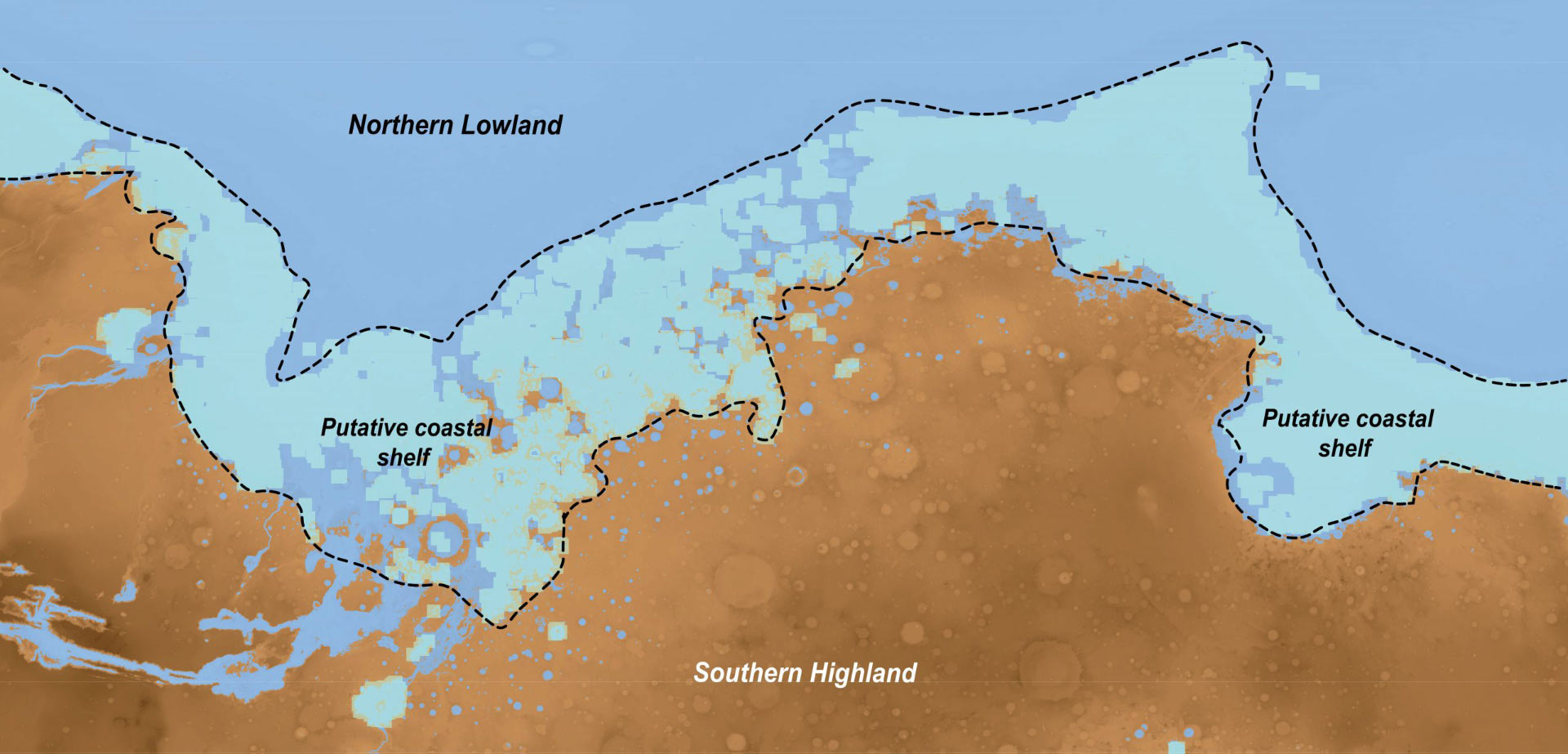
Illustration from orbiter data showing the coastal shelf region of Mars, a hallmark of global oceans formed over extended periods. Image credit: A. Zaki.
Professor Lamb and Dr. Abdallah Zaki from the California Institute of Technology and the University of Texas at Austin analyzed Earth’s geological features to find indicators of past oceans.
Using computer simulations, they drained ocean models to assess the remaining terrain.
The simulations revealed that a distinct flat landmass, known as the continental shelf, surrounds the region where land meets sea, akin to a ring left by a drained bathtub.
While sea levels have fluctuated on Earth, continental shelves have remained stable, which supports the hypothesis of an ancient Martian ocean.
The researchers utilized topography data from Mars orbiters, discovering similar shelf formations in the northern hemisphere, hinting at an ocean covering a significant portion of the planet.
Such landforms take considerable time to form and are rare in lake environments, supporting the theory of a stable ocean existing for millions of years.
Additionally, evidence of river deltas and coastal features known as “bathtubbling” shelves were observed.
“The discovery of the shelf is a vital observation that consolidates the evidence for a Martian coastal zone,” Dr. Zaki commented.
“This previously overlooked aspect strengthens the case for a northern ocean on Mars, leading to further studies on deposits and satellite data.”
For further details, refer to the publication in Nature.
_____
Zaki, A. & Ram, M.P. Identifying topographical features of the early Martian ocean. Nature, published online April 15, 2026. doi: 10.1038/s41586-026-10381-2
Source: www.sci.news