


Stunning new images from the NASA/ESA Hubble Space Telescope showcase the rapid evolution of the Trifid Nebula, a dynamic stellar nursery where newborn stars are actively shaping gas and dust on human timescales.
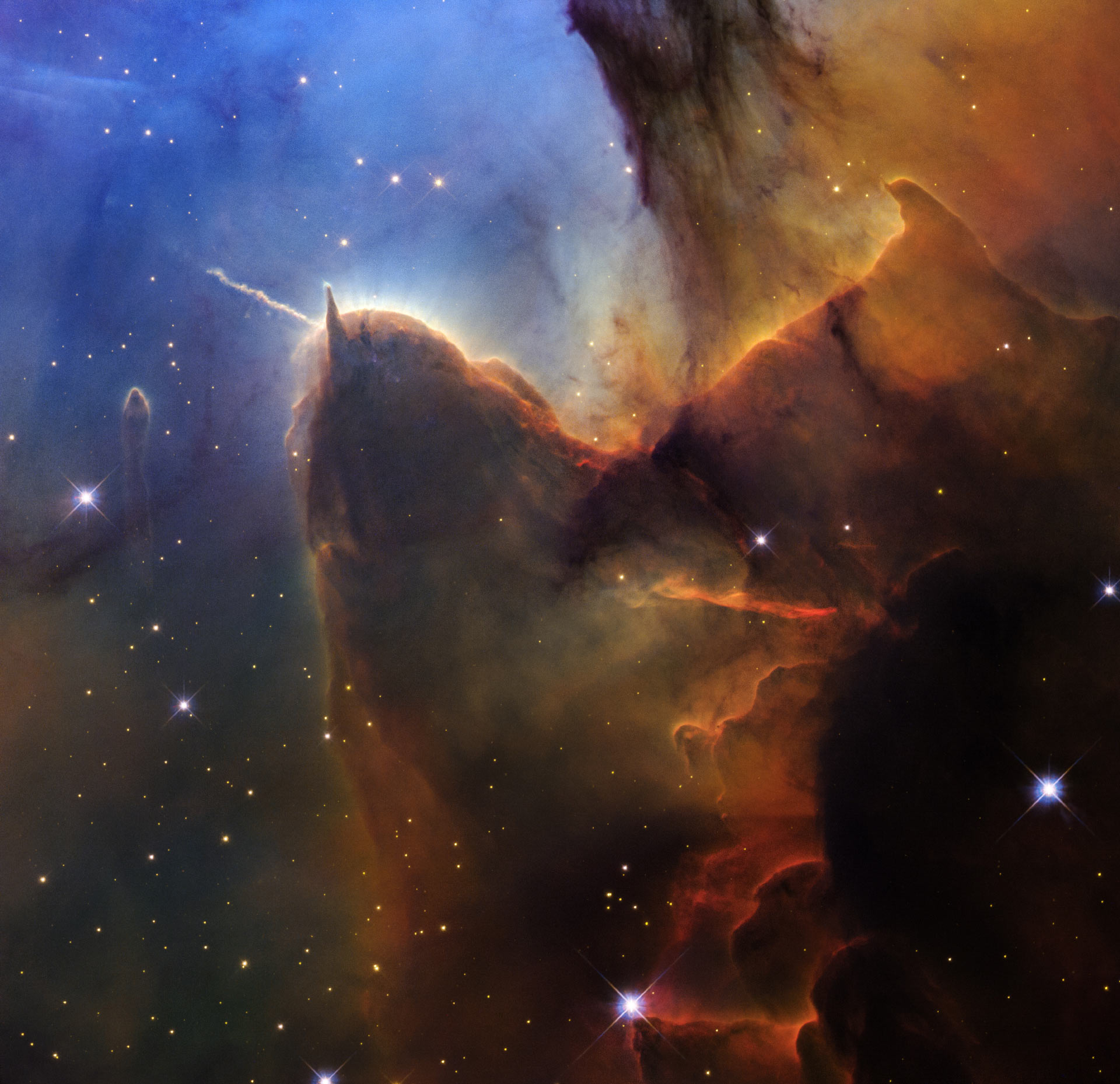
Hubble’s detailed view of the Trifid Nebula. Image credit: NASA/ESA/STScI/J. DePasquale, STScI.
The Trifid Nebula, also known as Messier 20 or NGC 6514, was discovered by the French astronomer Charles Messier on June 5, 1764. This stunning nebula resides in the constellation Sagittarius.
Distance estimates to the Trifid Nebula vary, ranging from 2,200 to 9,000 light-years away.
According to Hubble astronomers, “The vibrant colors in this region of star formation evoke an underwater tableau of fine sediments drifting through the deep ocean.”
“Massive stars beyond this image have been sculpting this spectacular area for at least 300,000 years,” they noted.
“Their intense ultraviolet winds are still reshaping the environment, creating bubbles that compress gas and dust, subsequently sparking fresh star formation.”
“This isn’t Hubble’s first look at the Trifid Nebula,” they added. “The telescope revisited this cosmic site 29 years after its first observation in 1997, effectively documenting changes within the nebula on human timescales.”
“Why return to the same view? Beyond tracking time-related changes, Hubble has been upgraded with an improved camera that offers a wider field of view and enhanced sensitivity from its fourth servicing mission.”
In this latest view, Hubble captures the Trifid Nebula’s “head” and flowing “body,” resembling a cosmic sea lemon gliding through the universe.
“The ‘horn’ of the Cosmic Sea Lemon is part of Herbig Halo 399, a periodic plasma jet ejected by a young protostar embedded within,” the astronomers explained.
“These observed changes help scientists measure outflow rates and gauge the energy injected by the protostar into its environment.”
“Such measurements provide valuable insights into how newly formed stars interact with their surroundings.”
“Evidence of a counterjet can be seen below and to the right, marked by a jagged line of orange and red running across the dust.”
“To the right of the head, at the endpoint of a dimmer triangular ‘horn,’ lies another young star.”
“A green arc hovering above a faint red point, accompanied by a small jet, suggests that a nearby massive star is eroding the circumstellar disk with its intense ultraviolet radiation.”
“As the region around this protostar clarifies, it implies that its formation might be nearing completion.”
“Just to the left of the Cosmic Sea Lemon is a faint pillar; the densest material remains at the top, while most of the gas and dust has been blown away.”
“Distinct stripes and sharp lines provide further clues about the activities of other young stars.”
“Look for wavy diagonal lines that transition from bright orange to fiery red for an illustrative example.”
“At the pinnacle of the Cosmic Sea Lemon’s head, bright yellow gas ascends, showcasing ultraviolet light illuminating the dark brown dust and breaking it down.”
“Many ridges of dark material will persist for millions of years as the star’s ultraviolet radiation gradually erodes the gas.”
“Dense regions harbor protostars, which remain hidden in visible light.”
“The far right corner appears nearly pitch black, suggesting high-density dust where stars may not belong to this star-forming region but rather be foreground objects.”
“Search for bright orange orbs; these represent fully formed stars, surrounded by empty space.”
“In the coming millions of years, the gas and dust constituting the nebula will vanish, leaving only the newly formed stars behind.”
Source: www.sci.news