


The Dark Energy Camera, an advanced 570-megapixel imaging device mounted on NSF’s Victor M. Blanco 4-meter telescope at the Cerro Tololo Inter-American Observatory in Chile, has captured the stunning Sombrero Galaxy in unparalleled detail. This image reveals a faint stream of stars and a radiant halo, hinting at a dynamic history shaped by galaxy mergers.
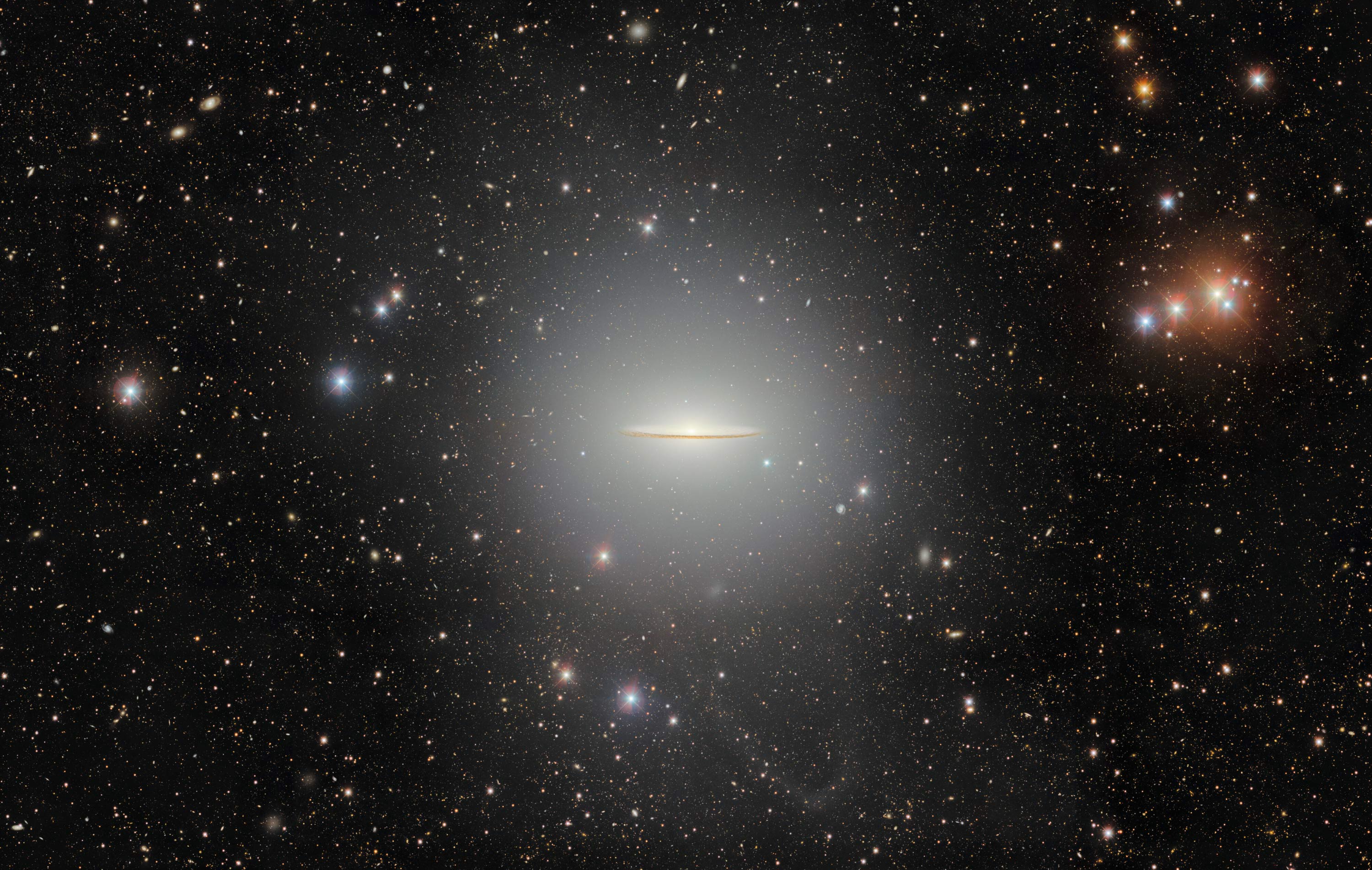
The DECam image of the Sombrero Galaxy, a target of interest for both amateur astronomers and scientific research. Image credits: CTIO / NOIRLab / DOE / NSF / AURA / TA University of Alaska Anchorage Chancellor and NSF’s NOIRLab / D. de Martin and M. Zamani, NSF’s NOIRLab.
The Sombrero Galaxy, located about 28 million light-years away in the constellation Virgo, is a striking astronomical object.
Also known as Messier 104, M104, or NGC 4594, the galaxy was first discovered by French astronomer Pierre Méchain on May 11, 1781.
With a diameter of approximately 49,000 light-years—about half that of the Milky Way—the Sombrero Galaxy possesses a distinct structure.
This galaxy uniquely combines characteristics of both spiral and elliptical galaxies, featuring prominent disks and spiral arms alongside a large, luminous central bulge that gives it a hybrid appearance.
The view showcases the Sombrero Galaxy head-on, at a 6-degree angle south of its plane, highlighting its dark, dusty lanes.
“The Sombrero Galaxy is a galactic masterpiece that captivates both scientists and astronomy enthusiasts,” stated NOIRLab astronomers.
“Its complex globular cluster system offers insights into star populations, and astronomers are particularly interested in the supermassive black hole at its core.”
“The galaxy’s unique visual features and relative brightness make it a favorite among amateur stargazers.”
“The rich discovery history, involving three renowned astronomers, has cemented its place among the most significant deep-sky objects.”
“Today, the Sombrero Galaxy stands as one of the most iconic celestial bodies visible in the night sky.”
The latest high-resolution image of the Sombrero Galaxy was captured using the advanced DECam instrument.
“DECam’s outstanding resolution highlights the remarkable features of the Sombrero Galaxy,” the astronomers noted.
“At its center lies a brilliant core, encircled by approximately 2,000 globular clusters.”
A dark band of cold dust and hydrogen gas outlines the disk where star formation predominantly occurs.
This image also accentuates the galaxy’s vast glowing halo, which appears to extend over three times the width of the sombrero itself.
“This could be the first time such a halo has been captured in such detail and scale.”
DECam’s exceptional sensitivity has also revealed a vast stream of stars extending from the southern region of the galaxy.
These halos and stellar streams are composed of stars torn from their original galaxies, suggesting a history of galactic mergers involving the Sombrero and smaller partner galaxies.
Source: www.sci.news