


Have you ever considered how geologists uncover the mysteries of ancient beaches and shallow oceans? From identifying paleoenvironments and ancient fauna to understanding seasonal weather patterns and the preservation of ancient landscapes, the key lies in microbial mats—structures formed by sand particles bound together by microorganisms.
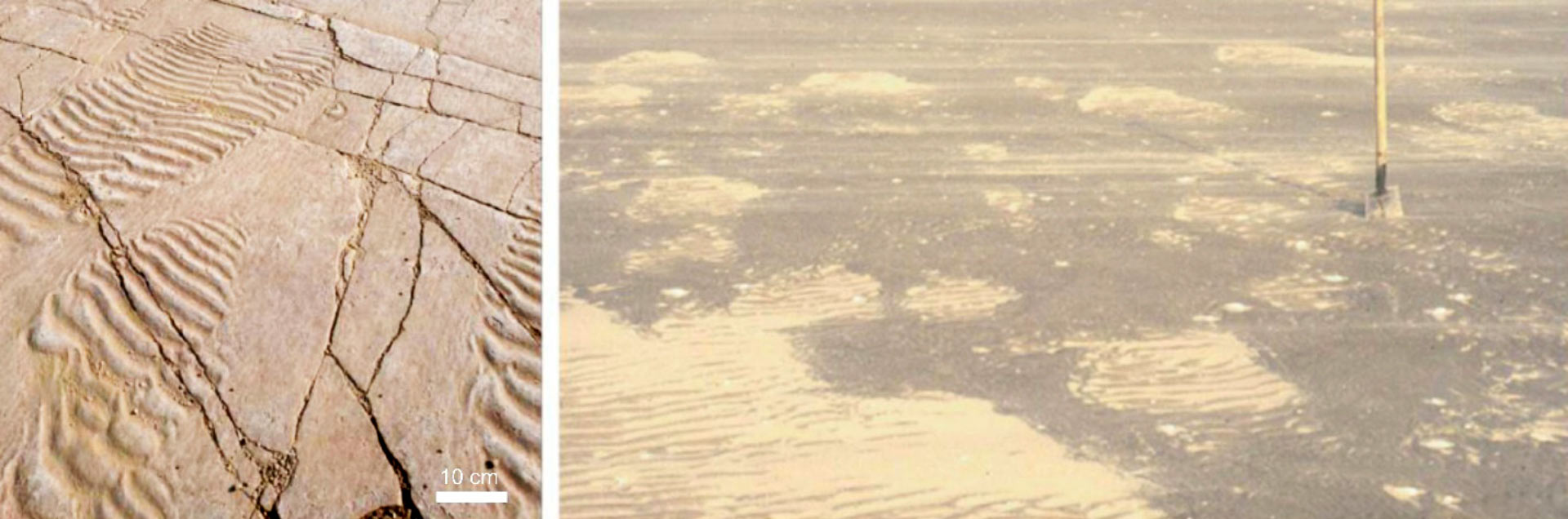
Planar microbial mats with ripple marks in Cambrian (left) and modern (right) tidal flats. Image credit: Nora Noffke.
Often underestimated as mere “pond scum,” this concoction of microorganisms and sand is crucial for preserving sedimentological evidence from the ancient world.
At the notable Cambrian Blackberry Hill Site in Wisconsin, USA, these microbial mats have transformed ancient tidal flats preserved in quartz sandstone into remarkable microfossil hubs.
By binding loose sand particles, these microbial mats create stable surfaces that capture delicate imprints of soft-bodied organisms, including jellyfish (Ladle insect), ancient grazing behaviors of mollusks, the enigmatic footprints of long-extinct arthropods, and other signs of animal activity.
Without this microbial adhesive, the shifting tides and storms of the Cambrian inland sea would have erased trails and roads as swiftly as modern-day sandcastles vanish on beaches.
The findings at Blackberry Hill offer crucial insights into why animals inhabited tidal flats around 500 million years ago.
Among these was the Eutycarcinoid known as Mosineia—one of the first organisms to construct orbits on land (Protik Knight), a mystery that has fascinated scientists for over 150 years.
This research has also revealed that arthropods likely possessed increased agility compared to sluggish mollusks, taking advantage of the upper intertidal zone to seek alternative food sources and possibly scavenging.
Large, slug-like mollusks—approximately the size of an adult’s foot, occasionally growing to a meter in length—graze on these microbial mats, creating trails termed microbial mats. This behavior supports the theory that the “scum” served as a primary food source that attracted marine life to the intertidal zone (the area between high and low tides along coastlines).
Microbial mats played a pivotal role in the rapid development of fossil traces, shielding them from currents and storm surges, thus preserving records of animal activity, including “death traces” (mortichnia) of animals struggling to survive in dynamic environments.
Moreover, microbial mats preserved in geological formations provide vital clues regarding environmental conditions and events, such as seasonal variations and sudden storms. Ancient storm activities are evidenced by meter-scale fragments of thick microbial mats that have been torn and flipped. Only thinner, more adaptable mats can successfully record these traces.
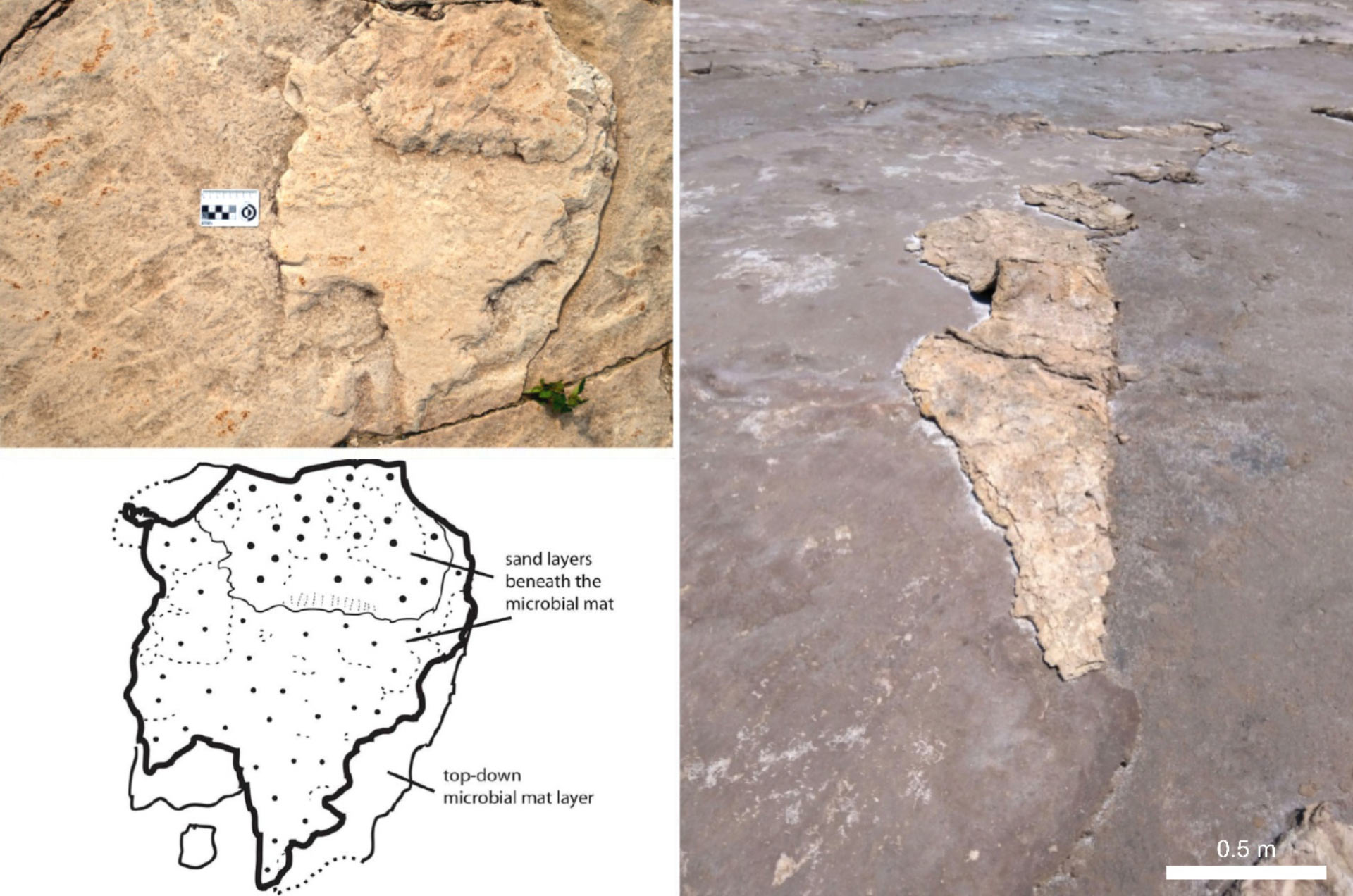
Large overturned fragments of microbial mats deposited on Cambrian (left) and modern (right) beaches. Note the Climac Knight footprints near the scale in the photo on the left. Image credit: Nora Noffke.
Additionally, the fragments of these mats are preserved, particularly toward the end of the growing season when the microbial mats start to disintegrate.
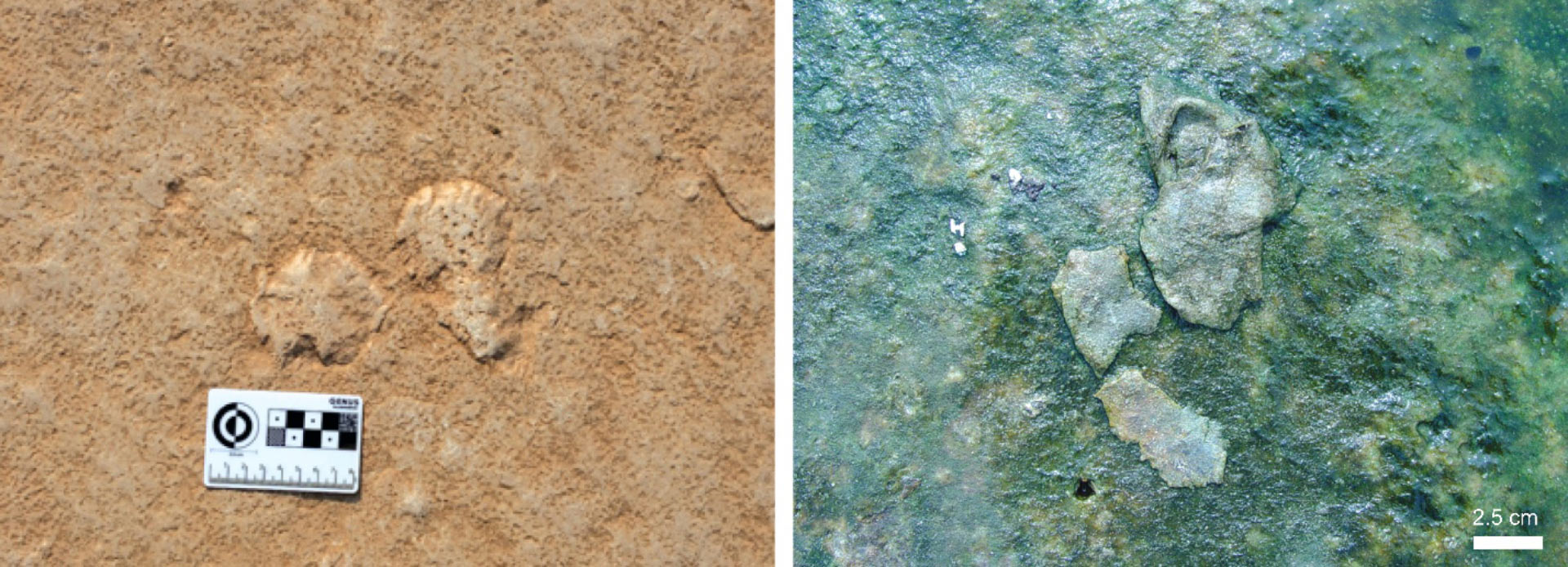
Microbial mat chips scattered in Cambrian (left) and modern (right) tidal flats. Image credit: Nora Noffke.
“Today, extensive microbial mat systems flourish in tidal flats and lagoons along the coastlines of Earth’s oceans,” stated lead author Nora Noffke, a professor at Old Dominion University. This study was published in the journal Palaios.
“These modern mats thrive under the same conditions seen on Blackberry Hill.”
“Without these essential microbial mats, our understanding of life and earth events through the ages would remain largely hidden from the relentless forces of ancient currents, waves, and time.”
_____
N. Noffke & KC Gass. 2026. Microbial mat fauna of a Cambrian tidal flat and its implications for the trace fossil record (Elk Mound Group, Wisconsin, USA). Palaios pp. 74-90; doi: 10.2110/palo.2025.042
Source: www.sci.news