


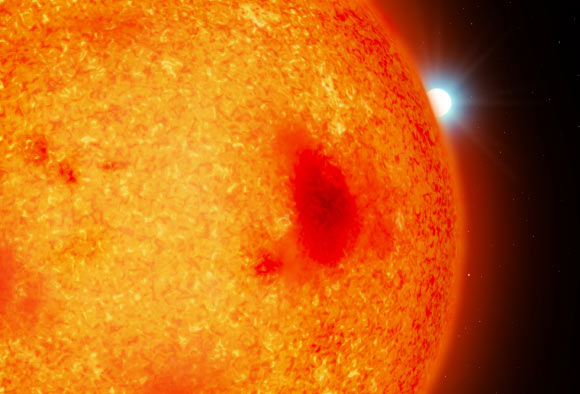
Astrophysicists have identified four white dwarf stars orbiting a neighboring red dwarf star, utilizing near-ultraviolet spectroscopy data from the NASA/ESA Hubble Space Telescope’s Space Telescope Imaging Spectrograph (STIS). These binary systems are situated within 20 parsecs (65 light-years) of the Sun, and notably, one of the white dwarfs ranks as the ninth closest star to our solar system.
An artist’s impression of a red dwarf and white dwarf binary companion. Image credit: Mark A. Garlick / University of Warwick.
For decades, astronomers have conducted extensive research on stellar neighborhoods, yet locating white dwarfs like these remains a challenging endeavor.
The newly discovered systems—G 203-47, GJ 207.1, LHS 1817, and Wolf 1130—showed significant radial wobbles, a key indicator of massive companion objects orbiting them.
Mairi O’Brien, an astrophysicist at the University of Warwick, stated: “Isolated white dwarfs are typically easy to spot, but these four stars were obscured by their luminous red dwarf companions.”
“This highlights that there are still surprising discoveries to be made in our universe if we observe it through the right lenses and at the proper wavelengths.”
Astronomers utilized Hubble/STIS data to conduct detailed investigations of the four systems.
White dwarfs are generally distinguishable in ultraviolet observations; however, intense flares from red dwarfs can often disguise their signals.
To verify the presence of these four white dwarfs, researchers applied a custom calibration technique.
Notably, G 203-47 stands out as particularly enigmatic. Despite being just 25 light-years away, it took 27 years from the initial radial wobble observations to confirm the companion white dwarf. It is now recognized as the ninth closest white dwarf to the Sun.
G 203-47 is peculiar as red dwarfs typically rotate every 100 days, while the white dwarfs complete orbits every 14.9 days.
This irregularity suggests that gravitational forces usually synchronize tides, as seen with the Earth and Moon, but the red dwarf’s slower rotation disrupts this pattern.
“Interestingly, if G 203-47 formed similarly to other star systems, its rotation should not be this slow,” explained Dr. David Wilson from the University of Colorado Boulder.
“This indicates that these binary systems have distinct evolutionary backgrounds.”
“Some likely experienced tumultuous interactions early, while others, like G 203-47, had gentler encounters that led to this unusual state.”
The identification of these four new white dwarfs allows researchers to refine their census of white dwarf populations within 65 light-years of the Sun.
Notably, theoretical models had predicted the existence of four to five closely orbiting white and red dwarf pairs, and the researchers discovered exactly four, aligning with theoretical expectations.
Professor Pier Emmanuel Tremblay from the University of Warwick commented: “Only about 30% of red dwarfs within 20 parsecs have been thoroughly examined for hidden white dwarf companions.”
“We believe that there are potentially nine to ten additional binary systems in our local stellar environment still awaiting discovery.”
“By intensifying our efforts to observe red dwarfs, it’s likely we’ll uncover more intriguing surprises like this.”
The team’s paper has been published today in Royal Astronomical Society Monthly Notices.
_____
Mairi W. O’Brien et al. 2026. Direct detection of white dwarfs in four WD+dM post-common envelope binaries within 20. MNRAS 550 (2): stag1195; doi: 10.1093/mnras/stag1195
Source: www.sci.news