


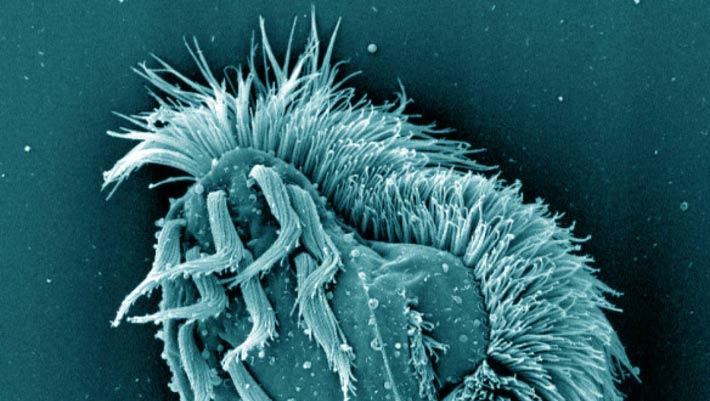
Euprothes Gigatrochus, a newly identified species of ciliate organisms, has been discovered within a seawater filtration system on the Caribbean island of Curaçao. This remarkable find hints at the potential for these organisms to evolve into cannibalistic “supergiants,” deepening our understanding of microscopic life complexity.
“Ciliates in the genus Euprotes have fascinated researchers since the advent of microscopy due to their widespread presence and distinctive features,” stated lead author Dr. Ben Larson from Rensselaer Polytechnic Institute.
Euprotes species inhabit diverse aquatic ecosystems, and their behavior, reproductive patterns, symbiotic interactions, geographical distribution, and environmental adaptations have been the focus of extensive research.
These ciliates have a complex, organized body structure similar to animals, with cilia arranged into specialized membranous cells for feeding, swimming, and locomotion.
Euprothes Gigatrochus was collected from a seawater filtration system in Curaçao and represents a new addition to this fascinating genus.
Interestingly, within clonal populations where all cells share identical DNA, certain cells can develop into supergiants—over twice the length of typical cells, possessing a broader body and enlarged mouths.
Rather than filtering and consuming bacteria like their normal counterparts, these supergiant cells become formidable predators, capturing smaller cloned relatives at a startling rate of approximately one every ten minutes.
“This single-cell behavior aligns with traits typically associated with larger animal development,” Dr. Larson observed.
“This research broadens our understanding of single-celled organisms and offers a novel framework to explore cellular form and function control.”
Moreover, the behavioral shifts observed extend beyond feeding.
Normal cells exhibit graceful swimming and walking behaviors, while supergiants modify their movement to a circular walking pattern, ideal for hunting surface-dwelling prey, and awkwardly roll when not on a surface.
“Supermacrogenesis involves trade-offs. While these cells excel in hunting, their swimming capabilities decline, shifting their dietary focus from bacteria to a new prey type,” Dr. Larson explained.
To uncover the molecular underpinnings of this transformation, the study sequenced transcriptomes from Euprothes Gigatrochus, including normal cells, supergiants, and those reverting from the supergiant state.
The findings revealed that supergiants represent transcriptionally distinct developmental stages, showcasing significant differences in gene expression involving cell cycle regulation, protein synthesis, and membrane organization.
Cells transitioning back from the supergiant phase exhibited unique molecular signatures that temporarily inhibit pathways responsible for transformation.
Populations starting from recently reverted cells generated new supergiants more slowly and less frequently than those initiated from normal cells, irrespective of external factors.
The emergence of supergiant cells typically coincides with a shift from rapid growth to stationary phases, particularly in environments with limited small prey, and they persist only as long as large prey (normal cells) are available.
Supergiants constitute no more than 5% of the population, suggesting a bet-hedging strategy that allows a small fraction of cells to exploit alternative resources.
This groundbreaking discovery establishes a new paradigm for studying the developmental biology of unicellular organisms, which uniquely manage both cellular and organismal functions within a single membrane.
“Much of our current developmental knowledge stems from multicellular organisms,” Dr. Larson highlighted.
“Similar developmental processes are observable in single-celled organisms, paving the way for studying fundamental biological questions across different life forms.”
The findings from this study will be published in Proceedings of the National Academy of Sciences.
_____
Ben T. Larson and others. 2026. Controlled development of cannibalistic supergiant cells in ciliates: Euprothes Gigatrochus. PNAS 123 (20): e2606891123; doi: 10.1073/pnas.2606891123
Source: www.sci.news