


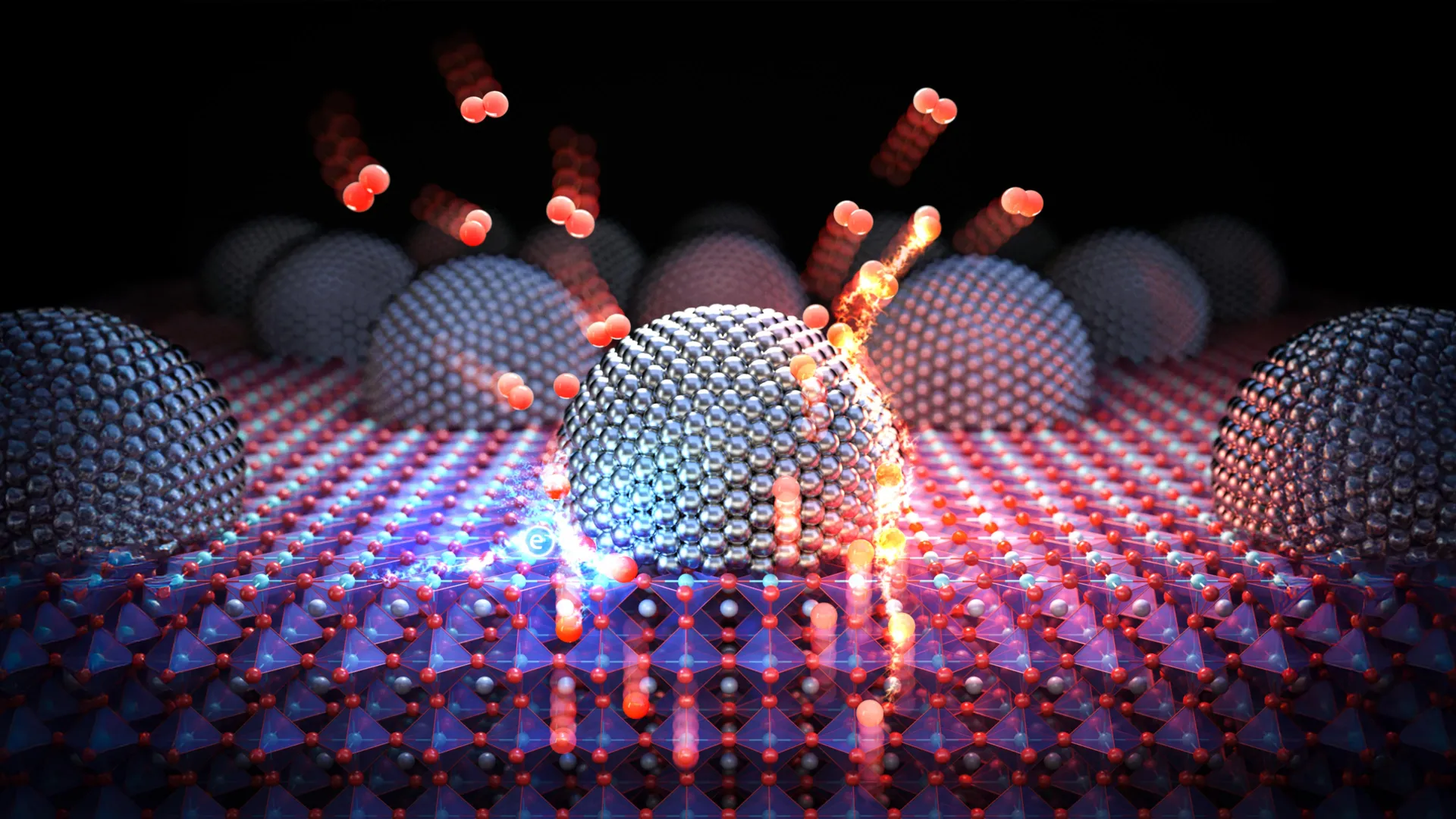
Researchers have discovered that the same silver (Ag) nanocatalyst operates at different reaction sites depending on whether a solid oxide cell is generating electricity or producing hydrogen. The breakthrough could lead to improved designs for solid oxide fuel cells, solid oxide electrolysis cells, and reversible energy systems.
The study was led by Professors WooChul Jung and Jeong Woo Han of the Department of Materials Science and Engineering at Seoul National University (SNU), in collaboration with Professor Sang Ouk Kim’s team at KAIST and Dr. Beomgyun Jeong’s team at the Korea Basic Science Institute (KBSI). The research clarifies how silver nanocatalysts enhance solid oxide cell performance and demonstrates that both the location and mechanism of oxygen reactions change according to the cell’s operating mode.
How Solid Oxide Cells Generate Electricity and Hydrogen
Solid oxide cells transport oxygen ions through a solid electrolyte to support two key energy functions. In fuel cell mode, they generate electricity. In electrolysis mode, they use electricity to split water and produce hydrogen.
Because they can support both power generation and hydrogen production, solid oxide cells are considered an important technology for expanding clean energy systems. Potential applications include distributed combined heat and power systems for buildings and factories, as well as renewable energy-powered green hydrogen production.
The study was published in the internationally recognized journal Energy & Environmental Science and was selected as an Outside Back Cover article, underscoring the importance of the findings.
Identifying the Active Sites of Silver Nanocatalysts
The performance and long-term durability of solid oxide cells depend largely on the rate of oxygen-related reactions at the air electrode. However, the complex structure of conventional electrodes makes it difficult to determine exactly where nanocatalysts work and how they improve electrochemical performance.
Previous studies had shown that metal nanocatalysts can improve the operation of solid oxide cells. However, it remained unclear whether catalytic activity occurred mainly on the surface of the nanoparticles or at the interface between the catalyst and the electrode. Researchers also did not know whether the same catalytic mechanism controlled both electricity generation and hydrogen production.
To answer these questions, the team developed a model electrode with a precisely controlled structure and composition. Unlike conventional electrodes, which contain complex networks of materials, the model electrode featured metal nanoparticles with uniform sizes and carefully controlled spacing. This ordered design allowed the researchers to examine the catalytic activity of each component more accurately.
The researchers first compared several metal nanocatalysts, including silver, cobalt, palladium, and platinum. Each material was deposited onto a thin-film perovskite oxide electrode and evaluated for its ability to accelerate oxygen reactions.
Among the metals tested, silver produced the greatest improvement in catalytic performance.
Silver Nanocatalysts Change Reaction Sites
The team then varied the size and arrangement of the silver nanoparticles to identify where the most important reactions occurred.
During the oxygen reduction reaction, which takes place when the cell generates electricity, the reaction rate increased as the length of the boundary between the silver nanoparticles and the electrode increased. This result showed that the silver–electrode interface is the primary reaction site in electricity-generation mode.
By contrast, during the oxygen evolution reaction associated with hydrogen production, the reaction rate increased with the surface area of the silver nanoparticles. This finding demonstrated that the outer surface of the silver particles becomes the dominant reaction site during hydrogen-production mode.
In effect, the same silver nanocatalyst performs its most important chemical functions in two different locations, depending on the operating direction of the solid oxide cell.
The researchers further investigated this behavior by varying the applied voltage and oxygen concentration. Their results indicated that, during oxygen reduction, silver nanocatalysts promote electron transfer to oxygen. During oxygen evolution, the silver surface helps oxygen atoms combine into oxygen molecules and facilitates their release.
Understanding the Atomic-Scale Catalytic Mechanism
The team also used synchrotron-based analysis to observe changes on the electrode surface while the solid oxide cell was operating. These measurements were combined with atomic-scale theoretical calculations to better understand the reaction mechanisms.
The analysis showed that silver nanocatalysts modify the electronic structure of the electrode surface in ways that promote oxygen reduction. During oxygen evolution, the nanocatalysts create conditions that make it easier for oxygen atoms to combine and form oxygen molecules.
These results explain why silver nanocatalysts exhibit different active sites and catalytic behaviors depending on whether the cell is generating electricity or producing hydrogen.
A New Design Strategy for Clean Energy Catalysts
The findings suggest that nanocatalysts should not be treated simply as additives that accelerate chemical reactions. Their active sites and operating mechanisms can change depending on the operating mode of the energy device.
This insight offers a new strategy for designing high-performance solid oxide cells. Rather than optimizing the catalyst as a single component, researchers could separately engineer the catalyst surface and the catalyst–electrode interface when developing air electrodes for solid oxide fuel cells and solid oxide electrolysis cells.
If applied to commercial devices, this approach could improve electricity-generation efficiency in distributed energy systems used in buildings, factories, and other facilities. It could also reduce the electricity required for renewable energy-powered water electrolysis and green hydrogen production.
The strategy may be especially valuable for reversible solid oxide cells, which can both generate electricity and produce hydrogen within the same system. These devices could support more efficient energy storage and conversion in residential, commercial, and industrial applications.
A Research Platform for Advanced Catalysts
The nanoparticle-array model electrode developed by the researchers provides a precise platform for determining where catalysts operate and how they function in practical energy conversion systems.
The platform could be applied beyond solid oxide cells, including hydrogen production technologies, electrochemical energy conversion systems, and oxygen separation devices.
Professor WooChul Jung, who led the study, stated: “This research is significant because it quantitatively evaluates the performance of nanocatalysts while also identifying their actual reaction sites and operating mechanisms.”
He added: “We plan to further establish this as a new design principle that can be applied to various energy conversion materials and catalytic systems.”
Dr. Jinwook Kim, who led the research, is currently a postdoctoral researcher at Northwestern University and will soon join the University of Seoul as an assistant professor in the Department of Materials Science and Engineering. He plans to continue researching nanocatalysts and solid oxide cells, with the goal of developing high-efficiency materials and devices for clean energy conversion.
This research was supported by the Ministry of Science and ICT and the National Research Foundation of Korea (RS-2024-00452853, RS-2025-00521316). Synchrotron-based AP-XPS research at the KBSI-PAL 8A2 AP-XPS beamline was supported by Pohang Accelerator Laboratory/POSTECH and the Korea Basic Science Institute.
Source: www.sciencedaily.com