


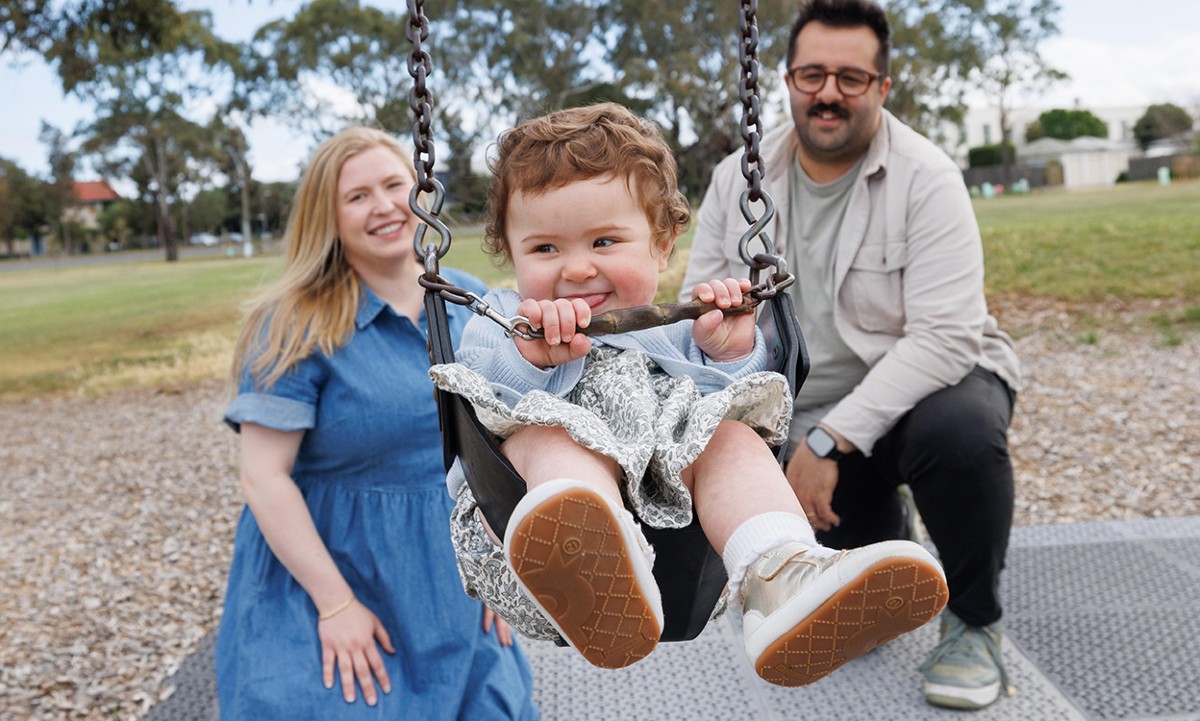
Two-year-old Gisele Ghattas is fearless, funny and loving, her parents say. She loves jumping headfirst into playground slides and climbing anything she can reach. Gisele looks like any other healthy toddler, even though she has a rare genetic disease that can cause her immune system to go into overdrive.
Controversial embryo test that promises better babies
Familial hemophagocytic lymphohistiocytosis (HLH) causes fever and severe inflammation. If left untreated, it can lead to organ failure, nerve damage and death. Because HLH is rare and its symptoms vary, clinicians can misdiagnose the condition or fail to detect it early.
Gisele was diagnosed sooner than most children with HLH after her parents, Justin Ghattas and Scarlett Morwood, enrolled her in BabyScreen+, an Australian study using whole-genome sequencing to screen newborns for genetic mutations linked to serious, treatable diseases. The couple learned about the study through social media.
“If I hadn’t joined Facebook and just kept scrolling through it, I probably would still be thinking, ‘What’s wrong with her?’” Ghattas said. Gisele received a bone-marrow transplant at six months old. Despite some complications, she recovered and began to grow. Her doctors say she is unlikely to need further treatment beyond regular follow-up visits, Ghattas said.
BabyScreen+ is one of dozens of initiatives worldwide examining whether genomic newborn screening could be expanded. Early results suggest that whole-genome sequencing can identify treatable diseases that are not covered by traditional newborn screening, which currently tests for a limited list of conditions. If larger trials are successful, genomic screening could transform newborn healthcare by providing early warnings of rare genetic diseases, debilitating disorders and some cancers.
For Wendy Chan, a physician and scientist at Boston Children’s Hospital in Massachusetts, the potential of genomic newborn screening was clear long before she became principal investigator of Guardian, one of the largest newborn screening studies to date.
“I would argue that newborn screening is one of the most successful public-health efforts because it leaves no one behind,” she says. “Guardian is really adding another lever to enhance what is already a hugely successful public-health effort.”
However, optimism is tempered by practical questions about cost, scalability and ethics. Robert Greene, a medical geneticist at Harvard Medical School in Boston, says some people are concerned about sequencing the genomes of thousands of newborns.
“There’s a lot of discussion around this, including privacy issues and potential discrimination by insurance companies,” he says. Not every family has had a positive experience with genomic newborn screening, either.
Early results from genomic newborn screening
In many parts of the world, traditional newborn screening uses dried blood spots collected from a baby’s heel soon after birth. Laboratory tests analyze proteins and metabolites in the blood to identify congenital disorders. In the United States, guidelines recommend screening for 66 conditions, primarily metabolic diseases. France screens for 16 diseases, while the United Kingdom screens for 10.
Of the approximately 3.6 million infants born each year in the United States, 98% undergo traditional newborn screening. About 6,600 babies — roughly 1 in 600 — are expected to receive a positive result for a disease.1.
Genomic newborn screening could substantially expand the number of conditions that can be detected. Pilot studies have used DNA from the same dried blood spots collected for traditional screening to sequence hundreds of genes or, in some cases, entire genomes. Some programs screen for more than 700 diseases. If widely implemented, genomic screening could identify thousands — or potentially millions — of children worldwide with rare genetic conditions.
Greene co-led the BabySeq project, one of the first studies to evaluate genome sequencing in healthy newborns. Across two independent BabySeq trials, approximately 1,045 infants were enrolled, including 432 who were randomly selected to undergo genome sequencing. About 11% of the infants whose genomes were sequenced had a genetic variant associated with disease, and roughly one-third of those children were already showing early signs of the condition.2,3.
These ‘master’ proteins could protect us from deadly mutations and lead to new drugs
More than a decade after BabySeq began, the project has been joined by increasingly large genomic newborn screening studies. These programs provide screening results, not definitive diagnoses. Potential findings require confirmatory testing; some are confirmed while others are ruled out.
As genomic screening expands, researchers are beginning to understand how it performs at scale. At a conference last October, scientists shared preliminary results from the GUARDIAN study, which had enrolled 15,000 of its planned 100,000 newborn participants.4 Whole-genome sequencing identified potentially significant findings in 411 infants, or 2.7% of participants. Follow-up diagnostic testing confirmed the screening results. Traditional newborn screening would not have identified most of these babies because their conditions are not included in standard testing. In some cases, the findings led to life-saving treatments, including bone-marrow transplants.5.
Several studies published early findings in 2025 and reported comparable results. The BabyScreen+ study, in which Gisele Ghattas participated, screened 1,000 newborns and reported confirmed findings in 1.6% of participants.6 The BabyDetect study in Belgium identified genetic disorders in 1.8% of approximately 4,000 infants, including conditions missed by traditional newborn screening in 0.8% of participants.7
For researchers leading these projects, the findings suggest that genomic newborn screening is effective and acceptable to many families.
“Although we are based in different health systems and have a slightly different approach to some components, many of the results are actually very similar, which is reassuring,” says Zolnitza Stark, a clinical geneticist at the Murdoch Children’s Research Institute in Parkville, Australia, and co-leader of the BabyScreen+ study.
Which genes should newborn screening include?
To maximize the benefits of genomic newborn screening, researchers must decide which genes and conditions to include in testing panels. This question has become surprisingly controversial. BabyScreen+ analyzes 605 genes, while BabyDetect screens 405 genes. GUARDIAN began with approximately 250 genes and has since expanded to 450. North Carolina’s early testing program is evaluating 169 genes. Most programs focus on severe childhood-onset disorders for which early intervention is available.
However, as more studies are conducted, researchers are uncovering the limits of current knowledge about how genetic variants relate to disease. In the GUARDIAN study, for example, infants with variants in the epilepsy-related gene SCN1A had significantly different ages of seizure onset. Even well-characterized variants do not always predict disease reliably. Genetic databases can also disagree about whether a particular variant is harmful.
“To understand genotype–phenotype correlations and fine-tune reports, we need to test a very large number of individuals,” Stark says. “We’re not going to get there unless we actually test thousands, if not millions, of people.”
A central goal of genomic newborn screening is to distinguish disease-causing genetic changes from harmless variants. In the GUARDIAN study, 64 of the 475 infants initially identified as possibly having a genetic disorder showed no signs of disease during confirmatory testing. The Early Check study reported 22 such cases among 50 infants who received a positive screening result. No comparable cases were reported in the BabyScreen+ study.

An approach to predictive medicine that is taking genomics research by storm
The second challenge is determining which conditions are treatable enough to justify screening.
“We screen only when detecting it before it’s clinically diagnosed will lead to better outcomes,” says Ned Kalonji, a physician at the Colorado School of Public Health in Aurora and the former chairman of a disbanded advisory group that recommended newborn screening in the United States. However, what constitutes a meaningful health benefit remains a matter of debate.
Some genomic newborn screening studies have therefore taken an exploratory approach to designing gene panels. Certain programs allow parents to choose tests for conditions whose clinical usefulness is less established than that of standard screening panels. In GUARDIAN, parents who agreed to screen their children for a primary panel of treatable conditions could also opt for a second panel covering seizure-related neurodevelopmental disorders. Although many of these conditions have no cure, researchers say early identification could enable prompt treatment of seizures and improve outcomes.
Parental consent and the experience of genomic screening
The benefits of genomic newborn screening can vary widely among families. For Dorka Nemeth, the results were transformative. Her daughter, Safi Ford, took part in the UK Generation Study and tested positive for isolated growth-hormone deficiency, a condition that can restrict growth. Nemeth’s brother and father have experienced similar symptoms.
Safi began growth-hormone therapy at six months old. Her mother did not receive treatment until she was 17, after many of the critical years for maximizing growth had passed. Stories such as Safi’s are one reason patient advocates support broader genomic screening.
Jennifer Hand, whose son has Duchenne muscular dystrophy and who helped advocate for the condition’s inclusion in the current US newborn-screening panel, says early symptoms are often difficult for families to interpret.
“I don’t live a happy life where I think my kids are going to be okay,” she says. Watching a child struggle while a diagnosis is delayed can feel like a “double injury”, but expanded newborn screening could help prevent some of these experiences.

Safi Ford, the daughter of Dorka Nemeth and Cameron Ford, was able to start treatment for her genetic disease earlier than most children.Credit: Mel Yeteralski/Cambridge University Hospitals NHS Foundation Trust
But not every family has a positive experience. Drew Villano gave birth to a healthy baby boy, Harmony, in April. Shortly after giving birth, a program coordinator approached her about enrolling in the GUARDIAN study, and she agreed to participate.
Five weeks later, a genetic counselor called to say that her son had a genetic variant associated with Smith–Magenis syndrome, a rare genetic disorder. Villano says the counselor struggled to explain the significance of the finding during several phone calls and eventually suggested that she look up the condition online.
Villano, a writer and real-estate company owner, says the information she received was not reassuring.
Further testing ultimately showed that the variant was unlikely to cause disease. Even so, Villano says she was distressed by the lack of a clear, easy-to-understand explanation throughout the screening and follow-up process.
Source: www.nature.com