Ancient Aspendos Tomb May Belong to a Wrestler, Archaeologists Say
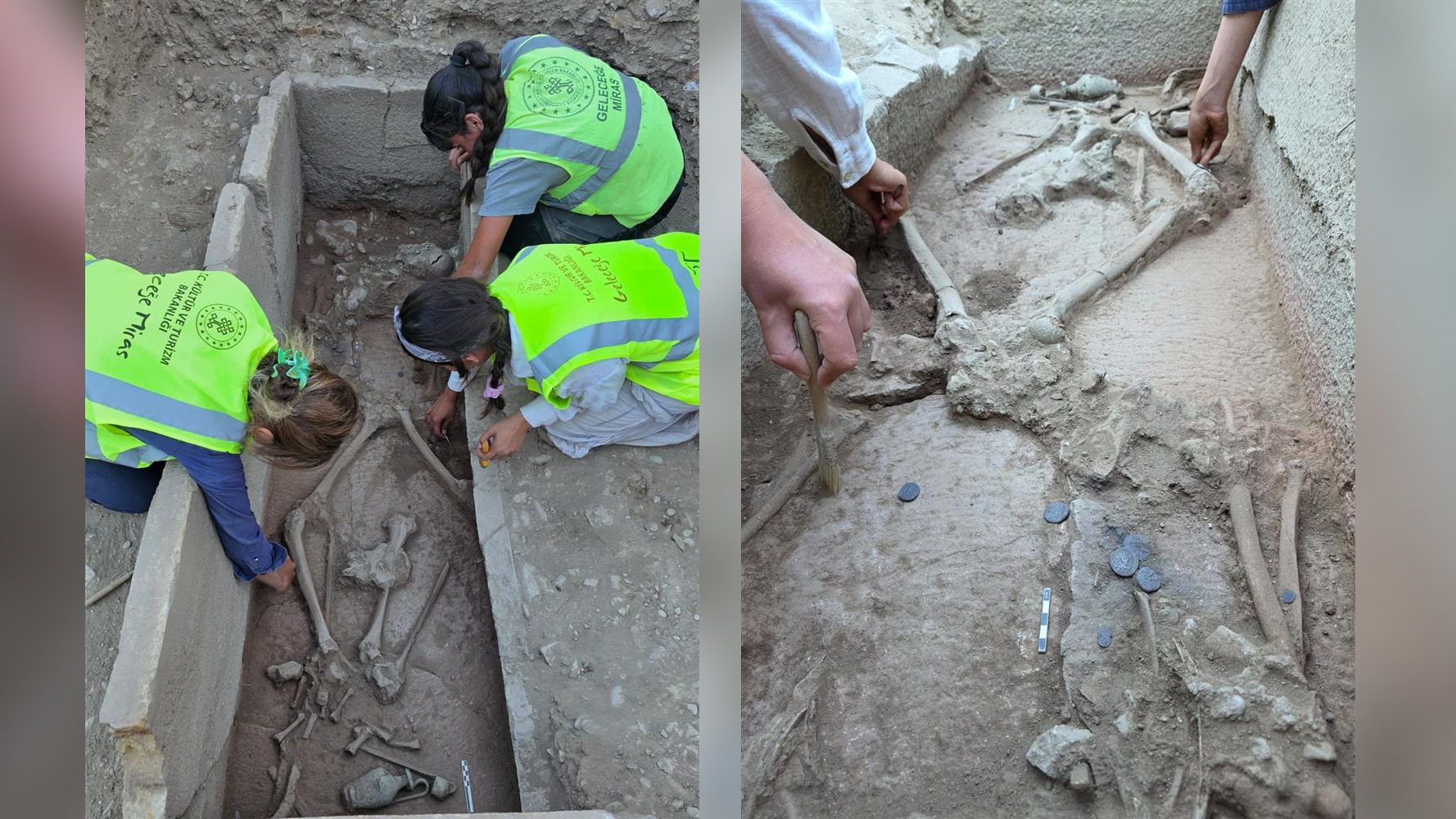
Archaeologists excavating near the ancient city of Aspendos in modern-day Turkey have uncovered a 2,400-year-old grave that may belong to an elite athlete — possibly a wrestler.
“Coins depicting wrestlers and other artifacts discovered in the tomb suggest that the individual may have been involved in sports, perhaps even wrestling,” Mehmet Nuri Ersoy, Turkey’s minister of culture and tourism, said in a translated statement released Monday, Aug. 10.
The archaeological team found a human skeleton and associated artifacts inside a box-shaped sarcophagus built from stone slabs. The burial was located in one of the cemeteries outside Aspendos and likely dates from between 475 and 300 B.C., during the city’s Classical period.
Latest Videos FromLive Science
Aspendos was a major Greco-Roman city in southwestern Turkey, about 10 miles (16 kilometers) inland from the Mediterranean coast. Greek colonists founded the city during the fifth century B.C. Aspendos later became an important trading center for salt, olive oil, timber and horses.
The ancient city also featured a large Greek gymnasium and a stadium built during the second century A.D. The stadium could accommodate as many as 8,000 spectators, who watched athletic events including footraces, javelin competitions and wrestling.
Wrestling appears to have held a special place in Aspendos’ civic culture. The city produced silver coins, known as staters, featuring two nude wrestlers on one side.
Archaeologists discovered a human skeleton and silver coins depicting wrestlers in a newly excavated tomb at Aspendos, Turkey.
(Image credit: Alamy)
The wrestler-themed staters were minted for more than a century, suggesting that wrestling may have had broader civic importance in Aspendos, Oğuz Tekin, an archaeologist at Koç University in Turkey, noted in a 2000 study.
However, the discovery of wrestler-decorated coins does not prove that the person buried in the tomb was a wrestler.
Get the world’s most fascinating discoveries delivered straight to your inbox.
“Much more analysis will be needed before researchers can positively identify the individual as a wrestler,” Sarah E. Bond, a historian at the University of Iowa who was not involved in the excavation, told Live Science. Evidence such as a broken and healed nose could provide clues that the individual participated in combat sports.
“Coins alone cannot indicate that this was a Classical-era Greek wrestler,” Bond said. The coins were widely circulated and used as payment by people throughout the population, rather than being reserved for athletes.
The burial was uncovered during ongoing excavations at a newly identified cemetery near Aspendos. According to Ersoy, further discoveries may help researchers reconstruct the history of the ancient city while preserving its archaeological heritage through scientific study.
Can you identify these mysterious artifacts? Test your knowledge with our archaeological fragments quiz!