


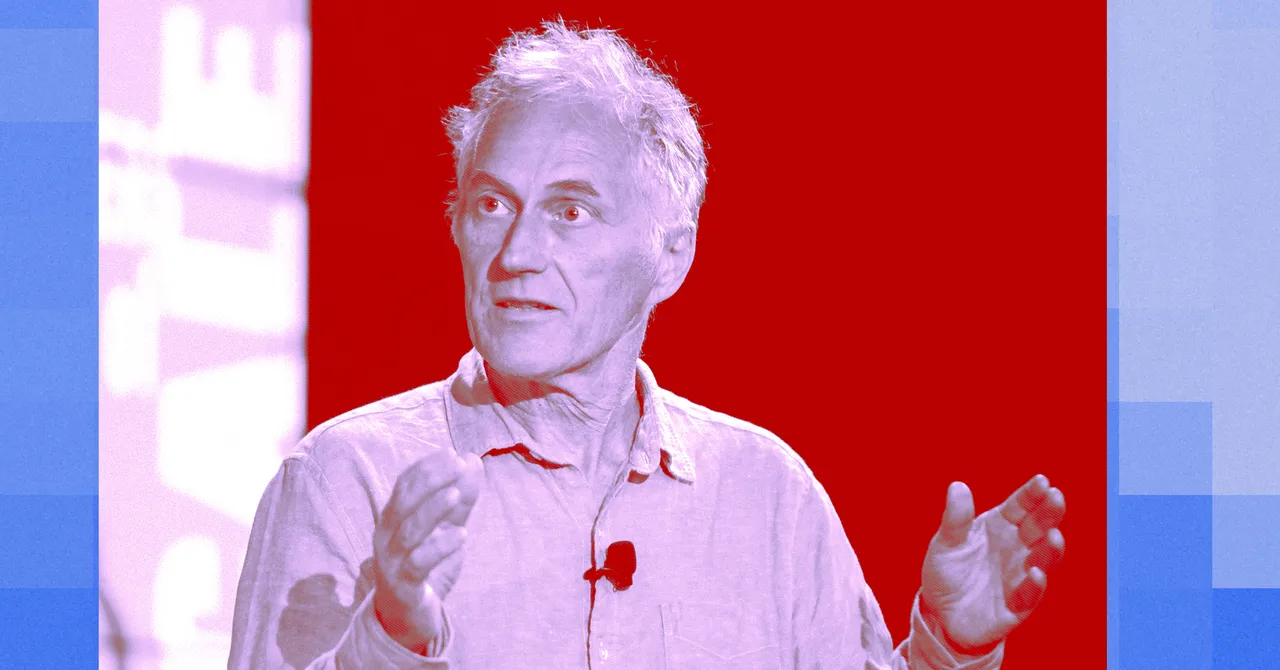
Tim O’Reilly’s measure of value Tim O’Reilly has long applied a simple principle to companies, individuals, and society: create more value than you capture. As a technology publisher, internet pioneer, venture capitalist, and conference organizer, O’Reilly is now applying that philosophy to artificial intelligence. He is helping advance a future in which open source AI gives developers, businesses, and everyday users greater control over the technology they rely on.
O’Reilly argues that today’s hyperscalers are building systems designed to lock users into proprietary platforms, echoing the software battles of the 1990s. His alternative is a more open AI ecosystem—one that provides access not only to model weights and technical details, but also to the broader infrastructure, tools, and applications that make an AI system useful.
He views AI as a new creative medium and uses it extensively. On his blog, he writes about his experiments with AI and the changing role of machine-generated content. In our conversation, we explored the growing debate over AI, originality, authorship, and the future of open source technology.
STEVEN LEVY: You are a strong supporter of open source AI. What is your case for it?
Tim O’Reilly: First, we should clarify what we mean by “open source AI.” Most people are referring to open-weight models, but the concept should be broader. In the 1990s, when people debated open source licenses, I focused on the architecture of the system. The important question was whether the system allowed people to participate, adapt it, and build on top of it.
Why does open source AI matter?
Many major AI research laboratories are misreading the future. They have convinced themselves that the biggest and most capable model will ultimately win. But large frontier models are often optimized for particular use cases—not necessarily for the applications people want to build.
Users should be able to add their own data, choose the model that fits their needs, and maintain a clear separation between AI models, the harnesses that run them, and the applications built around them. We still do not fully understand how to create that separation. Instead, many companies are developing architectures of control that make it possible to track users and limit their choices.
Isn’t giving up control against the interests of large technology companies?
Absolutely. But that does not mean it is the right strategic decision for them. For years, the newest and most powerful AI models appeared to be better at nearly everything. Now, the trade-offs are becoming clearer: frontier models may excel in some areas while performing worse in others. People often say that certain leading models are less effective writers than smaller or less expensive alternatives.
The breakthroughs taking place in frontier AI may be moving us further away from what society actually needs. The United States may lead in advanced AI research, but China could gain an advantage by deploying capable, lower-cost models throughout society. The real opportunity is to give people the freedom to innovate, customize AI, and build outside the boundaries defined by a handful of large companies.
Critics argue that open source software can create security risks because bad actors may bypass the safeguards built into frontier AI models.
Many of the cybersecurity incidents we have seen have involved frontier models and centralized systems. Risks involving cybersecurity or the development of dangerous biological agents may therefore be arguments for slowing the deployment of frontier capabilities, rather than for restricting open-weight models alone.
Do you believe the future of AI is shifting toward open source?
I do not claim to predict the future, but I am encouraged that the technology is developing in a direction I have long advocated. It is possible that the largest frontier models will become more like mainframes or supercomputers—specialized systems used to solve extremely difficult problems without becoming the only AI tools available to society.
At the same time, developers are creating open source AI agent harnesses and new tools that give users more flexibility. One project my nonprofit is supporting is the AI Disclosure Project, which grew from an idea associated with the Open Memory Consortium.
Mark Zuckerberg has argued that Meta can provide an AI assistant that knows each user better than any other system. But an open source AI vision should challenge that assumption. Users should be able to switch models, change providers, retain their personal context, and control how their information is stored and used. That is the promise of open AI: more choice, greater transparency, and the freedom to participate in shaping the future of artificial intelligence.
Source: www.wired.com