


99-Million-Year-Old Amber Preserves a Lizard’s Dropped Tail
A small piece of amber from Myanmar provides the first direct fossil evidence that lizards were dropping their tails to escape predators at least 99 million years ago. The exceptionally preserved tail records a defensive behavior still used by many lizards today.
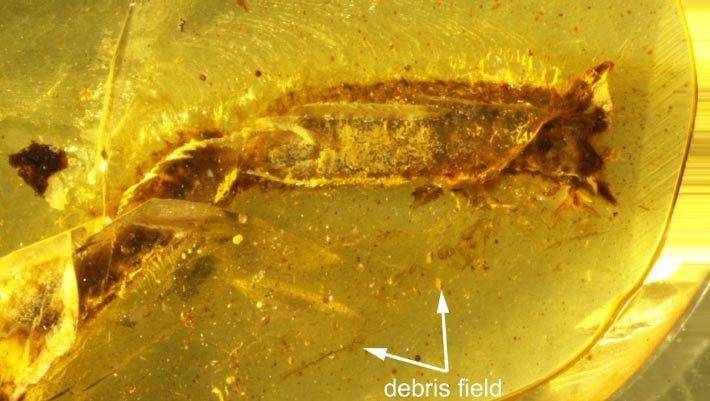
Amber from Myanmar. Arrows highlight debris attached to the first resin stream at the level of the tail’s underside. Image credit: Fabricant et al., doi: 10.26879/1706.
How lizards use tail autotomy to escape predators
Tail shedding, scientifically known as caudal autotomy or caudal autotruncation, is a widespread anti-predator defense among living lizards.
When threatened, a lizard can deliberately detach part of its tail and flee. The severed tail may continue moving, distracting a predator long enough for the lizard to escape.
The strategy comes with significant costs. Losing the tail can affect movement, growth, reproduction, social interactions and other aspects of the animal’s life.
Although tail autotomy is common among modern lizards, its evolutionary history has been difficult to establish because behavior rarely survives in the fossil record.
“Caudal autoamputation, or spontaneous shedding of the tail, is one of the most distinctive and best-studied anti-predator behaviors in modern squamate reptiles, which constitute the most diverse clade of terrestrial vertebrates,” said paleontologist Dorev Fabricant of Tel Aviv University and colleagues.
“The mechanism of caudal autoamputation involves the contraction of muscles along a specialized fracture surface, which allows the detached tail to continue moving and distract predators while allowing the lizard to escape.”
“While this behavior is ecologically consequential and energetically costly, affecting locomotor performance, growth, social interactions and reproduction, it also has the potential to be a source of new biomimetic technologies.”
Phylogenetic studies indicate that caudal autotruncation occurs near the base of the squamate evolutionary tree and is present in at least two-thirds of modern lineages, although it has been lost independently in some groups.
Fossil lizard tail found in Burmese amber
The researchers examined a piece of mid-Cretaceous amber containing a severed lizard tail. Its skin and muscle tissue were exceptionally well preserved.
The specimen came from a mine in the Hukaung Valley in Kachin State, northern Myanmar.
“The specimen was acquired legally through commercial channels (barmite miners) in 2022 and is permanently stored in a publicly accessible research collection at the Tel Aviv University Steinhardt Museum of Natural History,” the scientists explained.
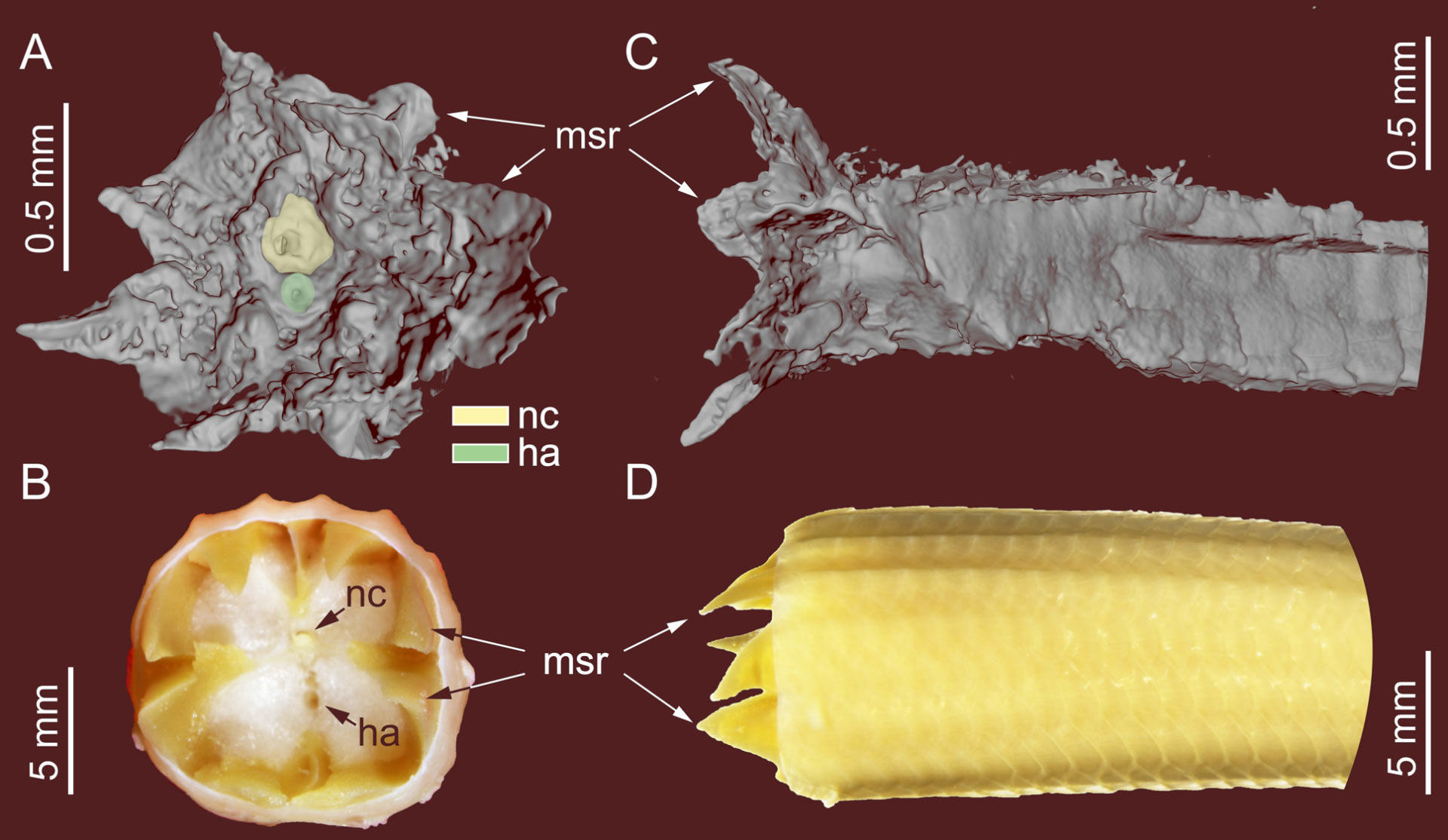
Comparison of the fossil lizard tail with the tail of a modern sincid lizard (Eremiascincus sp.). Image credit: Fabricant et al., doi: 10.26879/1706.
Using X-ray microcomputed tomography, the team analyzed the fossil’s internal structure and compared it with the tails of living lizards.
The scan revealed a ring of muscle tissue around the break. The muscles were arranged in a rosette- or wedge-shaped pattern, matching the structure formed when modern lizards contract their muscles to deliberately shed their tails.
The tail belonged to a lizard related to monitor lizards, according to the researchers.
How did the lizard lose its tail?
The exact circumstances of the fossil’s preservation remain unclear. The researchers proposed two possible scenarios.
In one, a tree-dwelling lizard became trapped in resin, dropped its tail and escaped. In the other, a predator grabbed the lizard, which lost its tail during the struggle. The detached tail then fell onto a sticky resin surface.
Evidence for ancient tail regeneration
Because tail autotomy in modern lizards is often linked developmentally to the ability to regenerate the tail, the fossil also provides clues about the history of regeneration.
“Given that caudal autonomy in modern lizards is often linked developmentally to the ability of the tail to regenerate, its confirmed presence in the mid-Cretaceous also places constraints on the antiquity of the associated regeneration program,” the researchers concluded.
“Therefore, candidate genes involved in tail regeneration may have emerged by at least 99 million years ago.”
“This specimen provides a behavioral calibration point for the evolution of a major anti-predator strategy in squamates by recording a complete autonomic event, not just an anatomical predisposition.”
“More broadly, we show that amber can preserve discrete defense events and functional responses, thereby extending the deep-time behavioral resolution of the vertebrate fossil record.”
The study was published online in Old Trogia Electronica.
_____
Doref Fabricant et al. 2026. Direct fossil evidence for caudal autotomy in Cretaceous lizards. Old Trogia Electronica 29 (3): a38; doi: 10.26879/1706.
Source: www.sci.news