


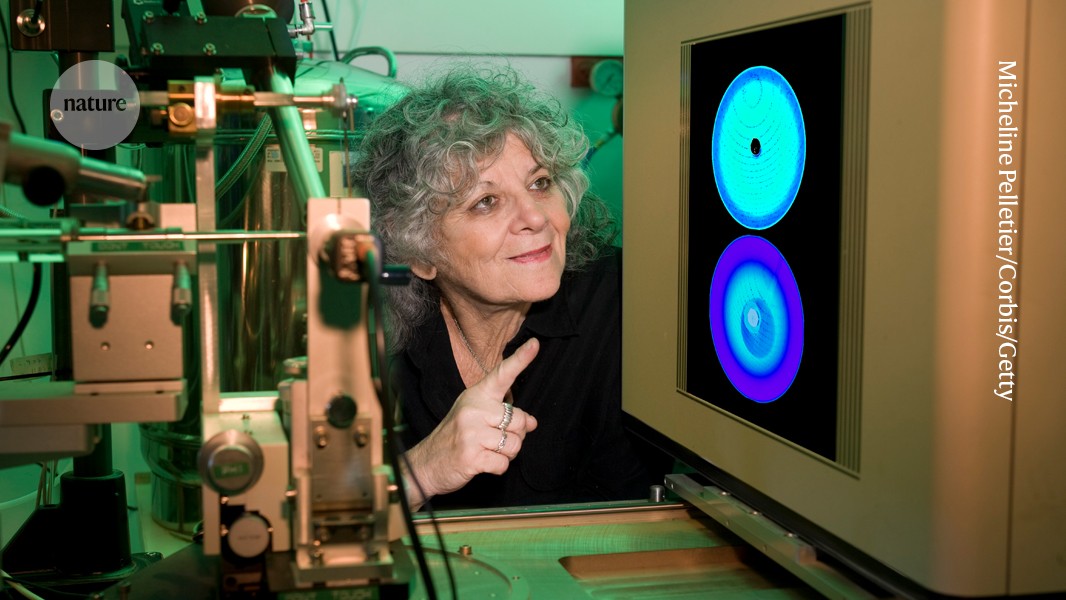
Credit: Micheline Pelletier/Corbis/Getty
Many scientific careers demand persistence, but Israeli structural biologist Ada Yonath overcame extraordinary obstacles to transform our understanding of one of biology’s most important molecular machines. She was the first scientist to grow crystals suitable for X-ray crystallography of ribosomes — large molecular complexes that function as protein factories inside living cells. Her pioneering work on ribosome structure earned her a share of the 2009 Nobel Prize in Chemistry.
Ada Yonath was the fourth woman to receive the Nobel Prize in Chemistry and the first since Dorothy Crowfoot Hodgkin, who won the award 45 years earlier. Yonath rarely viewed gender as central to her work. “I’m a scientist. I’m neither male nor female. I’m a scientist,” she said.
Yonath, who has died aged 87, also made important discoveries about how antibiotics interact with bacterial ribosomes. Her research showed how these drugs bind to and disrupt ribosome function, while providing valuable insights into antibiotic resistance. The findings helped create new opportunities for developing more effective antimicrobial medicines.
Making samples 1 billion times larger allows simple microscopy to accurately identify amino acids
Born Ada Lifshitz into a poor Orthodox Jewish family in Jerusalem, Yonath lost her father when she was 11. Although her parents had little formal education, they encouraged her intense curiosity about the natural world. She worked nights and weekends to help support her family while completing her education at Beit Hakerem, now Hebrew University Secondary School. She went on to earn bachelor’s and master’s degrees from the Hebrew University of Jerusalem, followed by a PhD in structural biology from the Weizmann Institute of Science, where she studied the protein collagen.
After postdoctoral research at the Mellon Institute in Pittsburgh, Pennsylvania — now part of Carnegie Mellon University — and the Massachusetts Institute of Technology in Cambridge, Yonath returned to the Weizmann Institute in 1970. There, she established Israel’s first biological crystallography laboratory. Her early research focused on individual proteins before she pursued the far more ambitious goal of determining the three-dimensional structure of the ribosome.
At the time, solving the ribosome structure appeared impossible, and many scientists dismissed the idea. Ribosomes consist of large and small subunits made from proteins and ribosomal RNA, forming molecular complexes containing hundreds of thousands of atoms. They were more than ten times larger than any molecule whose structure had previously been determined.

How to win the Nobel Prize: What kind of scientist will win the medal?
X-ray crystallography also depends on producing high-quality crystals. Until then, no one had successfully crystallized the large, asymmetric and flexible ribosome. Yonath travelled to West Germany to work at the Max Planck Institute for Molecular Genetics in West Berlin, led by ribosome expert Heinz-Günter Wittmann. The institute studied ribosomes from several species, giving Yonath access to expertise and biological material that helped her tackle one of structural biology’s most challenging problems.
Source: www.nature.com