


How Graduate Students With Disabilities Can Handle PhD Burnout and Seek Accommodations
Experts offer guidance on disability disclosure, university accommodations, documentation and support for graduate students facing overwork and stigma in academia.
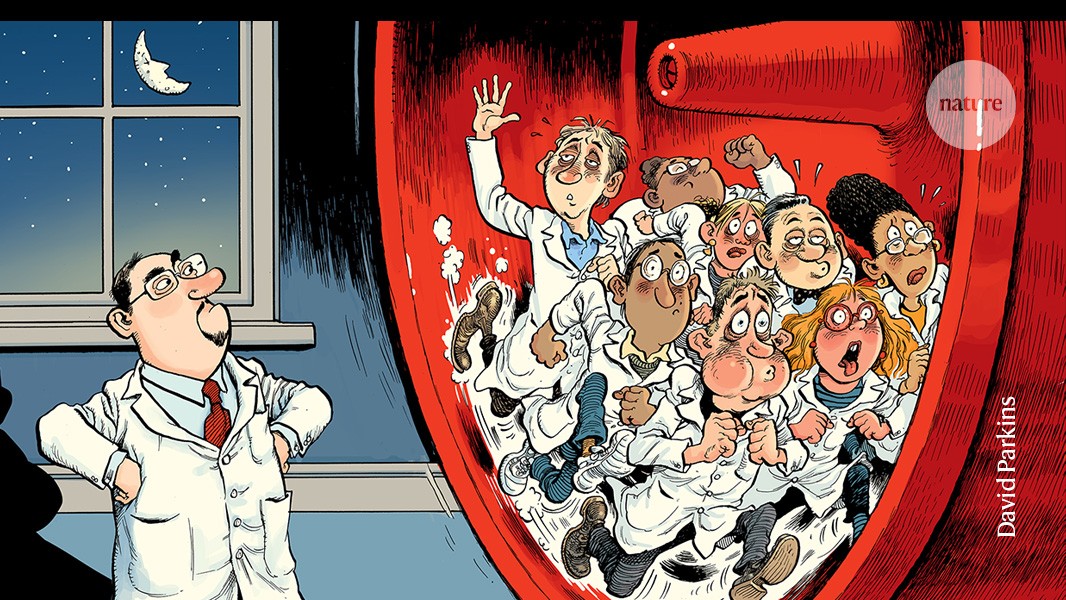
Illustration: David Perkins
Overwork is not a personal failure
“Disability stigma contributes to the power imbalance between graduate students and their supervisors,” says Bonnielyn Swenner, director of the Center for Disability Health Research at Johns Hopkins University in Baltimore, Maryland. That stigma is reflected in differences in earnings.1 Research on scientists in the United States shows that relationships between researchers with disabilities and non-disabled researchers in science, technology, engineering and mathematics (STEM) fields can be positive.2 Even so, Swenner says that taking action can feel frightening because many disabled scientists fear retaliation.
“What you are describing is not a personal failure of work ethic,” says Deepti Sharma, a management researcher at Ahmedabad University in India. Instead, the student is working in a dysfunctional environment. In that environment, Sharma says, “your disability made dysfunction visible earlier and more painfully than others.”
Nature’s Careers team asked Sharma, Swenner and two other researchers for advice on how graduate students with disabilities, and others facing similar challenges, can protect themselves.
Start by reviewing university disability resources
Rebecca Williams, an environmental law researcher and disability officer at the University of Glasgow in the United Kingdom, recommends researching the support available through the university. Potential resources include the graduate students’ union, the head of graduate studies and the university’s disability-services office.
In many jurisdictions, universities have a legal obligation not to discriminate against people with disabilities, Williams says. Students should also check whether their institution offers grants or other financial assistance for necessary resources. In the United States, the Job Accommodation Network provides information about workplace accommodations.
Understand formal disability disclosure and PI disclosure
Sharma distinguishes between formal disclosure to a university disability-services department and personal disclosure to a PI.
“Registration with a university’s Disability Services Department is a formal, documented process that establishes the accommodations to which you are entitled,” Sharma says. In most institutions, the office must tell supervisors about the accommodations required, rather than the diagnosis that led to them.
Disclosing personal health information directly to a PI is a separate and discretionary decision. Sharma strongly recommends formal registration as a first step. “Regardless of what you decide about your PI, informal goodwill evaporates under pressure, but documented consideration does not,” she says.
Williams recommends pausing before approaching a PI. A student might first try to understand the new PI’s supervisory style before deciding how much information to disclose beyond the accommodations that are necessary.
Document requests, refusals and working conditions
All four disability advocates emphasize the importance of documentation when using institutional resources. “Keep written records, such as emails confirming verbal instructions and notes of rejected leave requests,” Sharma advises. “A pattern documented over time has far more significance to the department than a single complaint.” Documentation can also help when raising concerns about conditions affecting other students.
Swenner says it is often necessary to keep detailed records of emails and other communications involving disability discrimination. Such information can support a complaint or grievance if a student later chooses to file one. She also says students should understand their rights and legal protections.
However, keeping records is only one protective measure. “Formal documentation of needed accommodations does not eliminate bias or discrimination,” Swenner warns.
Build a support network outside the PI’s control
Sharma recommends building a support system that does not depend solely on the supervisor. This might include a trusted dissertation committee member, a mentor from another department or a peer colleague.
Williams also suggests considering the department chair and, where available, a staff disability network that can connect students with support staff or graduate students with relevant lived experience.
“The hurdle in academia is often finding ‘your people’ who understand what it’s like to deal with health challenges,” Williams says. She has written about her own experience of dealing with chronic illness in academia.
Finding someone who understands can help a student feel less alone during a PhD and make it easier to decide what a realistic daily or weekly routine should look like while managing health challenges.
Source: www.nature.com