


Ancient DNA Reveals the Diverse Roles of Women in Prehistoric Societies
Ancient DNA research is transforming archaeology and challenging long-held assumptions about gender, power and social organization in prehistoric societies. Genetic evidence is showing that women were not simply passive members of ancient communities: some held wealth, led dynasties, inherited land and may even have taken part in warfare.
For centuries, archaeologists often identified burials as male or female based on grave goods and traditional ideas about gender. One striking example is a richly furnished, 4,000-year-old tomb discovered near Stonehenge in 1801. The remains were initially identified as belonging to a man. More than 200 years later, ancient DNA analysis revealed that the skilled goldsmith was a woman.
This discovery is part of a wider shift in archaeology. By combining ancient DNA with skeletal analysis, burial evidence and historical records, researchers are uncovering a far more complex picture of women’s lives in prehistoric Europe.
Ancient DNA Challenges Assumptions About Male Power
Changing traditional interpretations has not always been easy. In 2017, DNA analysis showed that the famous Viking warrior burial at Birka in Sweden belonged to a woman. The grave contained weapons and other objects associated with a high-ranking military leader.
The finding sparked debate, with some researchers questioning both the genetic results and whether the grave goods necessarily indicated a warrior. The controversy highlighted how difficult it can be for modern researchers to accept evidence that women held positions of authority in the past.
The assumption that prehistoric societies were universally male-dominated became especially influential during the late 19th century. Earlier scholars had recognized references to politically powerful and war-fighting women in classical texts. Some proposed that patriarchal systems became more common during the rise of ancient Greece and Rome, rather than representing the standard organization of all earlier societies.
By the late 19th century, however, many British researchers rejected these interpretations. For much of the following century, women’s political, economic and military roles in the ancient world were minimized or explained away.
Rachel Pope
Rachel Pope is Professor of European Prehistory in the Department of Archaeology, Classics and Egyptology at the University of Liverpool, UK. She is vice president of the Prehistoric Society and a fellow of the London Antiquarian Society. Her research uses data-driven archaeological methods, including the analysis of settlements and burials, to investigate social organization and cultural change in prehistoric Europe.
How Archaeology Historically Misread Women’s Status
These assumptions influenced the way archaeologists interpreted ancient settlements and burials. In 1972, archaeological thinker David Clarke described hillforts as “territorial centers for the exchange of goods, livestock and women.” The language reflected an understanding of women as property rather than as active participants in economic and political life.
Similar interpretations shaped the analysis of grave goods. Some researchers argued that valuable objects found with women represented the wealth or status of their husbands, rather than the women themselves. In this view, an elaborately decorated woman was treated as a symbol of male prestige instead of an individual who may have possessed wealth, influence or inherited power.
Evidence of Powerful Women in Iron Age Europe
From the 1970s onward, archaeologists increasingly identified evidence of women occupying high-status positions. Research into the early Iron Age in Europe revealed elite female burials at sites including the Heuneburg in Germany and Vix in eastern Gaul.
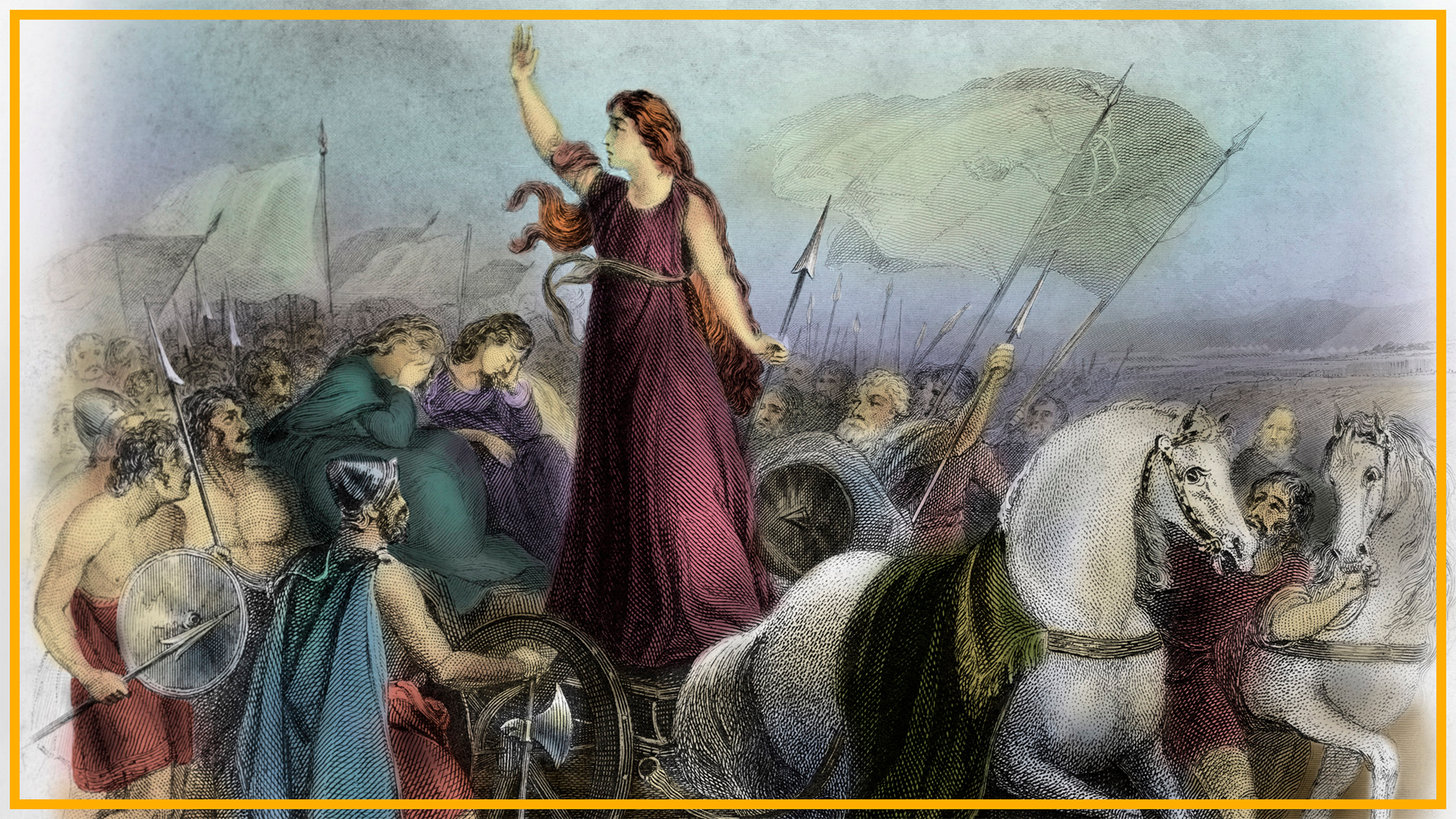
Later studies of Iron Age cemeteries in the Paris Basin and East Yorkshire found that men and women were often treated relatively equally in death. Skeletal evidence also indicates that some women took part in violent conflict, supporting aspects of Roman accounts about figures such as Boudicca.

A richly furnished tomb discovered at Birka, Sweden, was initially identified as a male warrior’s grave. Genetic analysis later revealed that the person buried there was a woman.
(Image credit: Evalo Hansen, Public Domain, via Wikimedia Commons)
Ancient genetics is now adding another layer to this evidence. By examining biological relationships between people buried at the same site, researchers can identify patterns of inheritance, migration and residence that are difficult to detect from artifacts alone.
Female Lineage at Neolithic Çatalhöyük
In 2025, a team of researchers reported evidence that burial practices at Neolithic Çatalhöyük in modern-day Türkiye favored female descendants. The settlement, occupied between approximately 7,000 and 6,000 BC, is one of the world’s best-known early farming communities.
The genetic relationships found at the site suggest that descent and inheritance may, in some cases, have been organized through the female line. This does not prove that Çatalhöyük was a universally matriarchal society, but it does show that women and female relatives could have played a central role in family continuity and property transmission.
These findings have renewed interest in the work of Marija Gimbutas, a scholar of Neolithic Europe who argued that archaeological evidence pointed to societies in which women held important social and religious positions. For decades, many of her interpretations were dismissed or oversimplified.
Later archaeological theories often portrayed the rise of farming as the beginning of the “domestication” of women and animals. From this perspective, Neolithic figurines found at Çatalhöyük and elsewhere were commonly interpreted as images of pregnancy and fertility.
However, feminist archaeologists and other researchers have argued that some of these figures may instead represent older or menopausal women. Such interpretations emphasize that women’s identities in prehistoric societies may have included age, authority and community leadership—not only reproduction.

Çatalhöyük figurines were once interpreted as representations of pregnant women. Some researchers now suggest that they may depict older or menopausal bodies.
(Image credit: DEA / M. Seemuller, via Getty Images)
The evidence from Çatalhöyük may reflect a connection between female lineage and land rights during the Neolithic agricultural revolution. If women and their relatives remained central to household production and inheritance, farming could have strengthened—not diminished—their economic position in some communities.
Prehistoric Europe Had Many Different Social Systems
Female-centered societies were not universal. Ancient DNA shows that prehistoric communities developed different systems of marriage, residence and inheritance depending on their environment and cultural traditions.
At Hazleton North Long Barrow in Gloucestershire, England, which dates to approximately 3700–3600 BC, DNA analysis revealed descendants of four women who shared a male partner. The discovery provides evidence of a complex family structure that may have involved relationships between several women and one man.
At a Bronze Age site in the Orkney Islands, researchers found a different pattern: descendants were linked through the male line, suggesting that women may have moved away from their birth communities after marriage. These contrasting examples demonstrate that there was no single prehistoric model for family life or gender relations.
Matrilineal Dynasties in Iron Age Britain
Evidence for matrilineal societies in Iron Age Europe is also growing. In 2024, researchers from the Max Planck Institute for Evolutionary Anthropology reported evidence consistent with matrilineal dynastic succession—a system in which ancestry, status and possibly land were traced through the female line.
More recent research has identified patterns of matrilocality and maternal ancestry in Late Iron Age Dorset. Genetic links spanning as many as 13 generations have also been reported at sites in Britain, including third-century BC Yorkshire. These findings suggest that some communities maintained strong maternal-line relationships over many centuries.
Such evidence does not mean that all women in Iron Age Britain held equal power, or that every community was matriarchal. Instead, it reveals that women could be central to political succession, property ownership, family identity and long-term community stability.
As the writer L. P. Hartley famously observed, “The past is a foreign country. They do things differently there.” Ancient DNA is helping archaeologists understand just how different those social systems could be.
Prehistoric societies were often smaller and more localized than previously assumed. Communities living in neighboring valleys, coastal regions or peninsulas could follow entirely different customs. Some cemeteries reveal maternal ancestry, while others show predominantly male-line descent. Some settlements contain evidence of women associated with weapons, while others do not.
The most important lesson is that prehistoric gender roles were diverse and changeable. Rather than searching for a single answer about whether ancient societies were patriarchal or matriarchal, researchers must examine the evidence from each community on its own terms.
Ancient DNA cannot explain every aspect of a person’s identity or social status, but when combined with archaeology, anthropology and historical research, it can expose assumptions that once seemed unquestionable. The result is a more accurate understanding of women’s roles in human history—and a reminder that the unexpected is often the most revealing discovery.
Opinion on Live Science offers insight into important scientific issues affecting people and the world around them, written by experts and leading researchers.
Source: www.livescience.com