


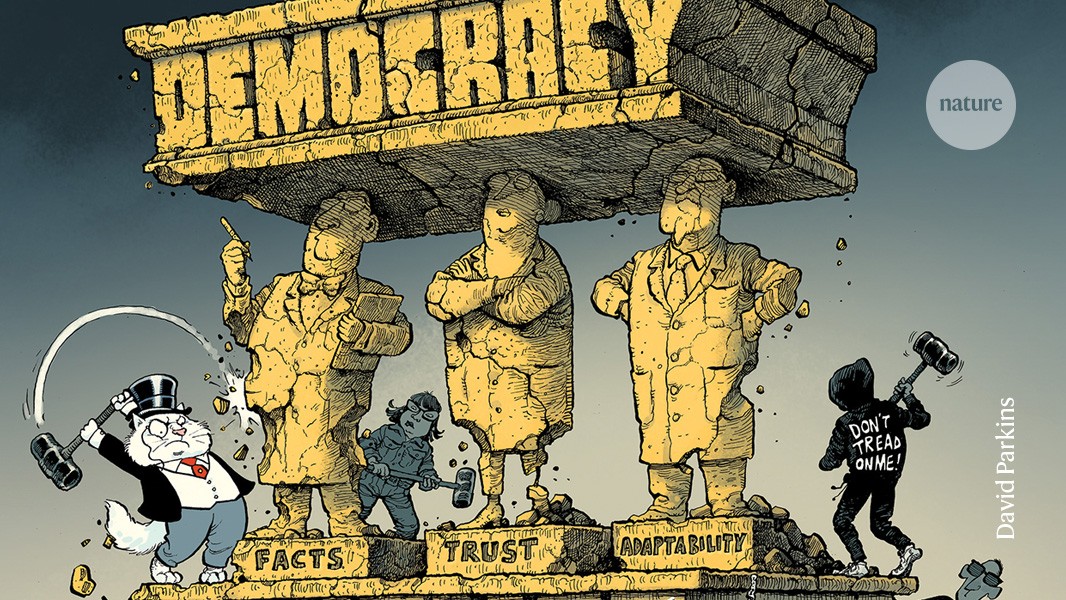
Democratic societies depend on science for reliable information, critical inquiry and the ability to respond to changing conditions. Yet governments around the world are restricting academic freedom, influencing research funding and appointments, and subjecting scientists to politically motivated interference and attacks.12 As members of the European Commission’s Chief Scientific Advisory Group, we argue that science and democracy are inseparable and identify three ways science can support democratic resilience: establishing a shared baseline of facts, strengthening trust in institutions, and helping societies adapt policies and institutions as circumstances change.
Science is often described as a source of discovery, expertise and innovation, while democracy is understood as a system of institutions, rules and procedures. In practice, the two are closely intertwined.3 In an increasingly complex and rapidly changing world, people need access to verified information and specialized knowledge to make informed decisions.4,5 Research contributes by producing reliable evidence, encouraging critical inquiry, enabling competing views to be debated and helping societies learn from experience.
In May, European Commissioner for Start-ups, Research and Innovation Ekaterina Zakharieva asked us for advice on how science can strengthen the democratic functioning and resilience of the European Union. Independently of that process, we propose three pillars through which science can enable democracy: creating a common factual baseline, supporting trust in institutions, and providing tools that allow policies and institutions to adapt to changing circumstances.
A shared factual baseline supports democratic decision-making
The first pillar is the protection of the infrastructure and integrity of the information on which democratic judgment, public deliberation and collective action depend.
Democratic societies continually face problems with no simple, universally correct or permanent solutions. Scientific institutions help societies respond to changing realities by developing methods to collect evidence about current conditions, past trends, expected outcomes and possible management options. These methods assess impacts, communicate disagreements and quantify uncertainty. Conclusions can then be revised as new findings emerge.
Artificial intelligence and other digital platforms are changing how people find information, form opinions and participate in public life.6 These technologies create opportunities for broader participation and greater transparency, but they also increase the risks of misinformation, manipulation, bias, polarization and fragmentation.6,7 They can also amplify the disproportionate influence of a small number of powerful technology companies and their leaders,8 including their ability to “create suspicion” and shape public opinion.9,10
The challenge is not simply to correct misconceptions. Disinformation is often rooted in social networks, reinforced by emotion and group identity, and deliberately used for political purposes.5,7 It spreads through networks connected by identity, grievances and mistrust. Individuals seeking to advance political or economic interests can exploit these vulnerabilities.9 The result can be damage to democratic institutions, deeper social divisions and greater instability.6
Citizens have legitimate concerns about economic restructuring, regional inequality, the management of immigration, technological change, ageing, climate risks and geopolitical instability. People may lose faith in democratic institutions when they do not feel heard, cannot understand why circumstances have changed, believe they are being treated unfairly or see their communities falling apart.11 Such conditions can create openings for disinformation and political manipulation.5
A scientific approach to democratic resilience must therefore go beyond fact-checking. It should include effective channels for scientific communication and information-sharing, along with opportunities for meaningful public participation and informed deliberation.4,12 Necessary measures include transparent data sources on digital platforms, independent media, strong safeguards against foreign interference, secure information infrastructure and independent monitoring and assurance of algorithmic systems. Understanding has also improved of how the expanded use of AI tools shapes democratic debates and outcomes.13
Science-based governance can strengthen trust in democracy
The second pillar concerns the legitimacy of expertise and the credibility of institutions. Democratic governance can be understood as a society’s shared capacity to understand complex realities, think across differences and act together amid social, economic and technological change and uncertainty.4,6 Democratic resilience depends on institutions that sustain public trust and active citizenship, as well as on people’s ability to participate meaningfully in deliberation and collective problem-solving.4,14
Institutions informed by scientific evidence and guided by scientific principles are better positioned to make decisions that are effective, transparent and accountable, thereby strengthening public trust in democracy.11 During or in anticipation of a pandemic or another crisis, authorities can build trust by explaining clearly how scientific evidence—including its limitations and uncertainties—influences their decisions.
For science to strengthen democracy, however, researchers must also be trusted.15,16 In Europe and elsewhere, the legitimacy of expertise has become increasingly contested in recent years.5,15
Scientific advice has become politicized in many countries. Consensus findings and clear evidence, including evidence of climate change, may be dismissed as “just opinion” or subordinated to political objectives.5,9 Public trust in expertise is increasingly divided along political lines.5,15 Some officials and politicians may favor particular scientific fields, for example by selectively promoting individual researchers or disciplines. Such incentives affect funding decisions.
This “divide and conquer” approach to science is often tacitly accepted in academia, where research institutions may prefer silence to the risk of budget cuts. Individuals with vested interests can also use the growing volume of online information to influence public decisions, making impartial scientific evidence and advice harder to see.
Expertise strengthens democratic legitimacy when it is transparent, diverse, independent and open to scrutiny, as required by scientific practice. Its legitimacy is weakened when it is seen as opaque, unclear, politicized, elitist or disconnected from people’s lived experiences.
For expert information to be democratically legitimate, institutions and mechanisms must structure interactions among science, policy and society. They must also protect the separate and independent roles of organizations, manage conflicts of interest and prevent undue influence.
Not all forms of engagement with science carry equal weight. Equitable access to scientific knowledge is best supported by a diverse group of experts from multiple disciplines. By contrast, the opinion of a single scientist may provide only a partial understanding by emphasizing one academic perspective, or may give undue weight to views that differ from the majority position. A high-level expert group working directly with senior decision-makers can identify a broader range of concerns, assess the wider implications of policy issues and provide relevant evidence and advice while maintaining independence in its analysis, conclusions and recommendations.
Public authorities must ensure that scientists who provide advice can act independently and publish their research findings. This generally requires stable public funding for research.1 Cuts to public science budgets may increase researchers’ dependence on a narrow range of funders, including private and commercial organizations or institutions linked to other countries. Funding decisions may reflect strategic or political interests, creating actual or perceived conflicts of interest unless appropriate transparency rules and safeguards are in place.
The European Commission’s Scientific Advice Framework offers an example of how scientific independence can be supported. It combines a thematic evidence review by a multidisciplinary group of experts with independent policy recommendations from seven chief scientific advisors. A permanent secretariat supports the advisors, tailoring scientific advice to policy needs while protecting the independence of the advisory process. The framework also includes rules on transparency and the disclosure of advisors’ conflicts of interest (see go.nature.com/4jndrg).
Scientific expert groups must be able to propose topics independently, identify questions and communicate evidence, uncertainties and policy options to decision-makers and the public.
Trust also depends on whether people have opportunities to engage with science. Scientific literacy, civic education, public participation in research and access to reliable information are all essential. They require support from public and educational institutions. Opportunities for science education are a public good and should be accessible to everyone.
Source: www.nature.com