


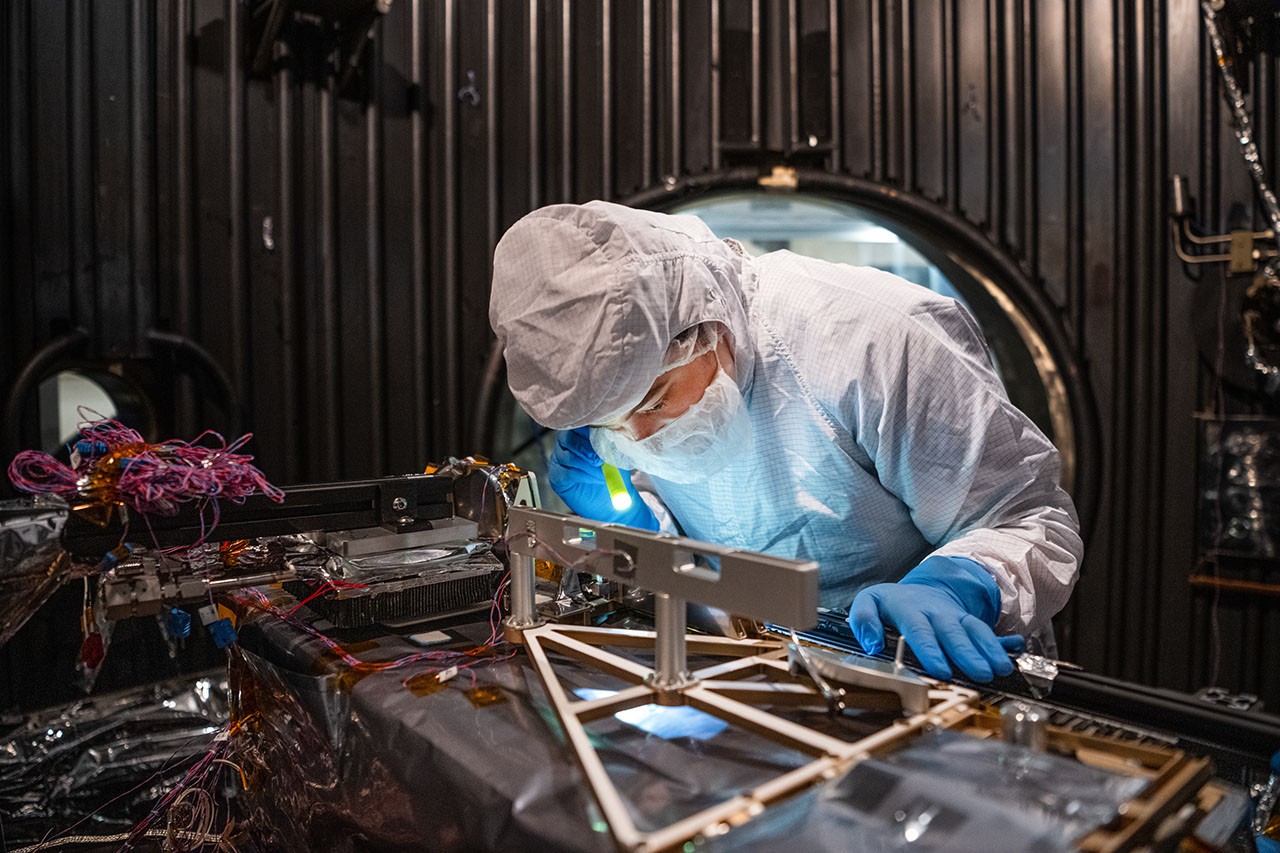
NASA has completed hardware development and testing for the Lunar Environment Monitoring Station, or LEMS, the first payload designed for Artemis astronauts to deploy on the Moon. The lunar seismic monitoring station is now ready for assignment to an Artemis mission and eventual deployment near the lunar South Pole, supporting NASA’s goal of advancing long-term lunar science and exploration.
LEMS features two highly sensitive seismometers that will detect ground vibrations caused by moonquakes and meteorite impacts. The data will help scientists study the Moon’s internal structure while identifying potential seismic hazards for astronauts working on the lunar surface. Its modular design also allows additional instruments to be added in the future, creating a flexible scientific platform for evolving lunar research.
Until it is assigned to an Artemis mission, the completed LEMS payload will remain in a clean room at NASA’s Goddard Space Flight Center in Greenbelt, Maryland, where the system was built and tested.
“The completion of the LEMS scientific instrument is a major step in a new era of lunar surface science. Innovative science experiments will uncover, measure, and reveal the Moon’s secrets while astronauts open new frontiers for discovery,” said Joel Kearns, deputy associate administrator for exploration in NASA’s Science Mission Directorate at NASA Headquarters in Washington. “And, behind the scenes, countless teams across NASA and our partners are pushing the boundaries of what surface instruments can do, building the tools that will make future exploration possible and safer.”
The LEMS lunar seismic station builds on NASA’s history of monitoring moonquakes. Between 1969 and 1972, Apollo astronauts deployed a network of seismometers across the Moon’s nearside equatorial region. The instruments operated until 1977 and recorded approximately 13,000 moonquakes and other ground vibrations, giving scientists important early insights into the Moon’s interior.
LEMS will continue that legacy by carrying the first seismometers intended for deployment by future astronauts. The instruments will listen for faint vibrations across the lunar surface, providing new information about the Moon’s internal structure and ongoing seismic activity. They are designed to be the most compact, sensitive, and energy-efficient seismometers ever developed for planetary exploration.
About the size of a small suitcase, LEMS weighs approximately 11 pounds in the Moon’s low-gravity environment. The autonomous payload includes everything it needs to operate after astronauts deploy it. A lightweight, flexible solar array will generate power while conforming to the shape of the instrument. LEMS will also manage its operations, follow a preset schedule for continuous data collection, transmit information to Earth each month, and maintain a stable internal temperature during the extreme day-to-night temperature changes near the lunar South Pole.
“When we conceived of LEMS, we weren’t just thinking about the next mission, we were thinking about the next generation of lunar exploration,” said Mehdi Benna, a University of Maryland Baltimore County scientist who leads LEMS from NASA Goddard. “Our vision was to create a scientific buoy for the Moon. Like an ocean buoy on Earth, LEMS is designed to be easy to build, adaptable to different scientific objectives, and capable of operating independently for years.”
Before the lunar seismic monitoring station could be approved for surface operations, Benna and his team had to confirm that LEMS could survive launch, the journey to the Moon, and the harsh lunar environment. During five months of testing, engineers evaluated the payload’s ability to withstand launch vibrations, lunar temperature extremes, radiation, and the conditions of landing. The team also confirmed that LEMS’ mechanical and electrical systems are safe for astronauts to handle and deploy.
LEMS is designed to operate through the lunar night, which lasts approximately two Earth weeks, without external power or a dedicated heat source. Unlike earlier lunar instruments that used radioisotope heaters for warmth and electricity, LEMS will withstand temperatures that can fall to minus 400 degrees Fahrenheit in some areas. Advanced insulation, low-thermal-conductivity cables, and a thermal regulator will limit heat loss, release excess heat during the day, and help retain warmth at night.
These technologies reduce the payload’s mass and power requirements, helping pave the way for lighter, more energy-efficient scientific instruments. Future systems could operate continuously at Artemis landing sites and at the NASA-led Moon Base.
The LEMS payload is led by University of Maryland Baltimore County and University of Maryland College Park. NASA Goddard leads the technical implementation. The University of Arizona, in partnership with Silicon Audio, Inc., supplied LEMS’ two advanced seismometers. Morehead State University in Kentucky provided the telecommunications system and will operate the instrument on the lunar surface. Washington University in St. Louis will oversee data processing and distribute the findings to the broader scientific community.
Source: science.nasa.gov