


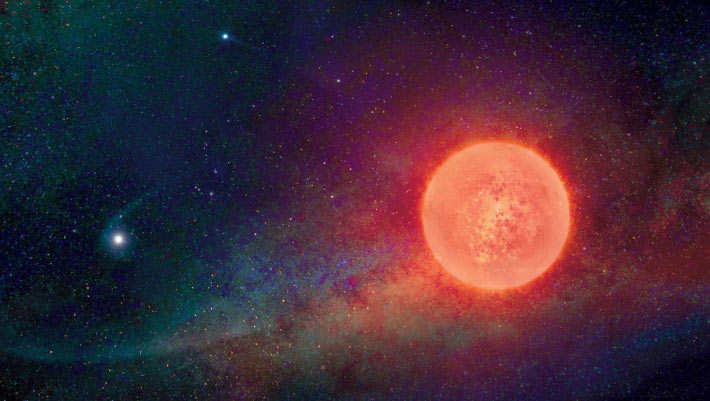
Dr. Étienne Artigau of the University of Montreal and his colleagues have discovered a white dwarf orbiting a red dwarf just 27.6 light-years from Earth. The pair is part of a hierarchical triple system that also includes a more distant white dwarf, creating a stellar arrangement with no known analog within 100 light-years. The system, nicknamed Weropoai, challenges current ideas about how multiple-star systems evolve.
An unexpected discovery
Weropoai contains two white dwarfs and one red dwarf. Artigau and his colleagues were searching for exoplanets around the red dwarf TYC 3980-1081-1 using the Canada-France-Hawaii Telescope’s SPIRou spectrometer.
Instead, they found that the star’s speed changed by about 16 kilometers per second over 4.8 years—far too much to be caused by a planet.
“We were actually looking for planets. Instead, we found something much more surprising,” Artigau said.
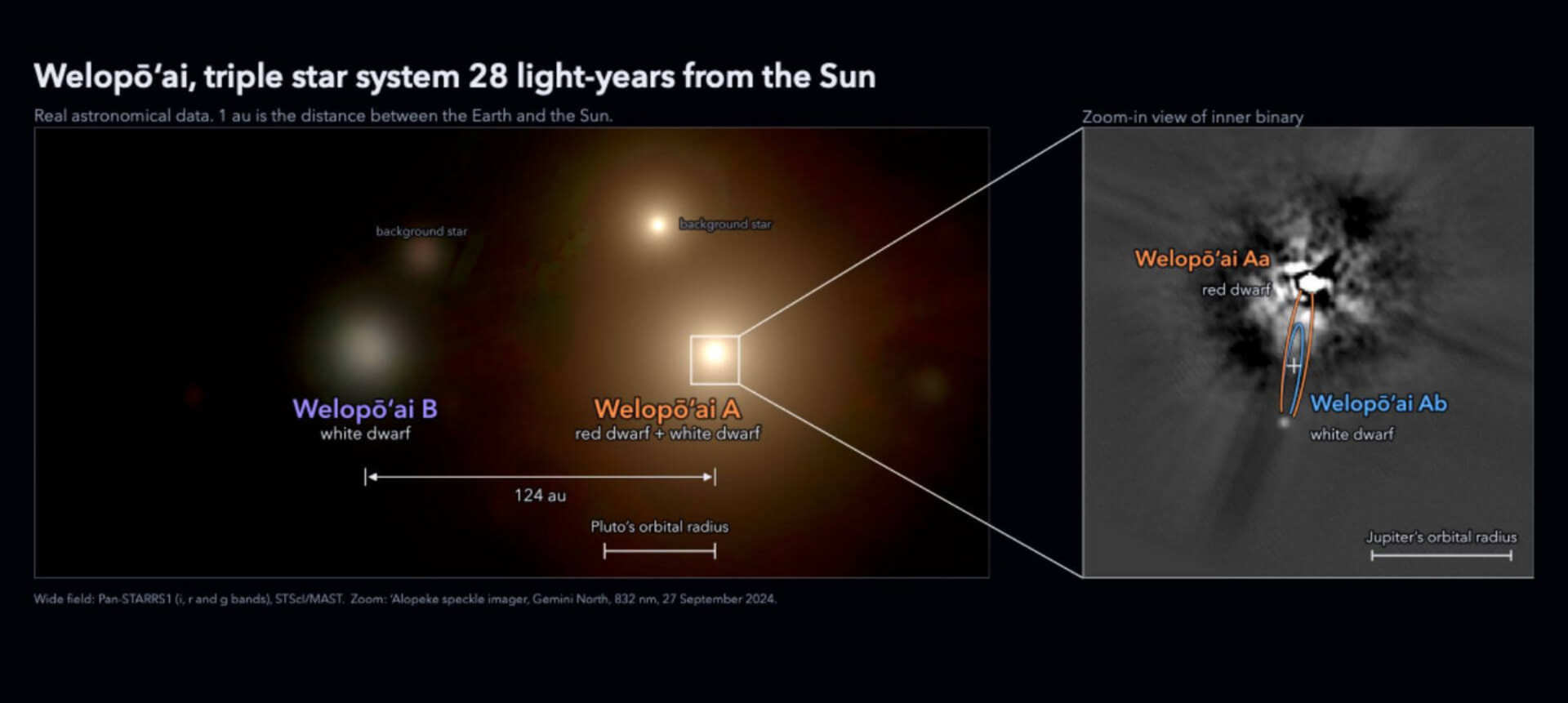
Follow-up observations with the Gemini North Telescope showed that the source of the motion was a white dwarf about six magnitudes fainter than the red dwarf and located approximately 0.6 arcseconds away.
By combining measurements of the stars’ velocities and positions, the astronomers calculated that the white dwarf has a mass of 0.618 solar masses, with an accuracy of 0.7%. That makes it one of the most precisely measured white dwarfs within 65 light-years of Earth.
The red dwarf has a mass of 0.419 solar masses. The two stars orbit each other once every 9.8 years at a separation of about 4.6 astronomical units (AU), slightly less than the distance between Jupiter and the Sun.
A system that should not exist
A second, previously known white dwarf orbits the inner pair at a projected distance of approximately 124 AU.
The progenitor of the inner white dwarf was probably about 1.4 times as massive as the Sun. As it evolved, it would have expanded to a size large enough to nearly engulf the red dwarf. Instead of spiraling inward, however, the red dwarf survived in a relatively wide orbit.
How that happened remains unclear. The gravitational influence of the outer white dwarf may have played a role, but further observations will be needed to test that possibility.
The properties of both white dwarfs suggest that the system is between 9 billion and 11 billion years old. The red dwarf, however, is rich in metals—a surprising feature for a star in such an ancient system.
“This system shouldn’t exist,” said Patrick Dufour, a professor at the University of Montreal.
“There’s no clear explanation for how it got here, and that’s the question that will drive our next observations.”
Further observations
The team also detected a temporary infrared excess around the inner white dwarf. This could indicate the presence of a dusty debris disk, although the finding still requires confirmation.
Future observations with the James Webb Space Telescope, Gaia and other facilities may reveal the system’s three-dimensional configuration and help resolve the infrared mystery.
“Discoveries like this remind us that there are still amazing surprises in our own cosmic neighborhood,” Artigau said.
“Even when we are looking for planets, something completely unexpected often awaits us in our universe.”
The discovery was reported in a paper published online in Astronomy & Astrophysics.
Étienne Artigau et al. 2026. “Weropoai: 8 strange triple systems from the sun.” A&A 715, A321. doi: 10.1051/0004-6361/202661214
Source: www.sci.news