


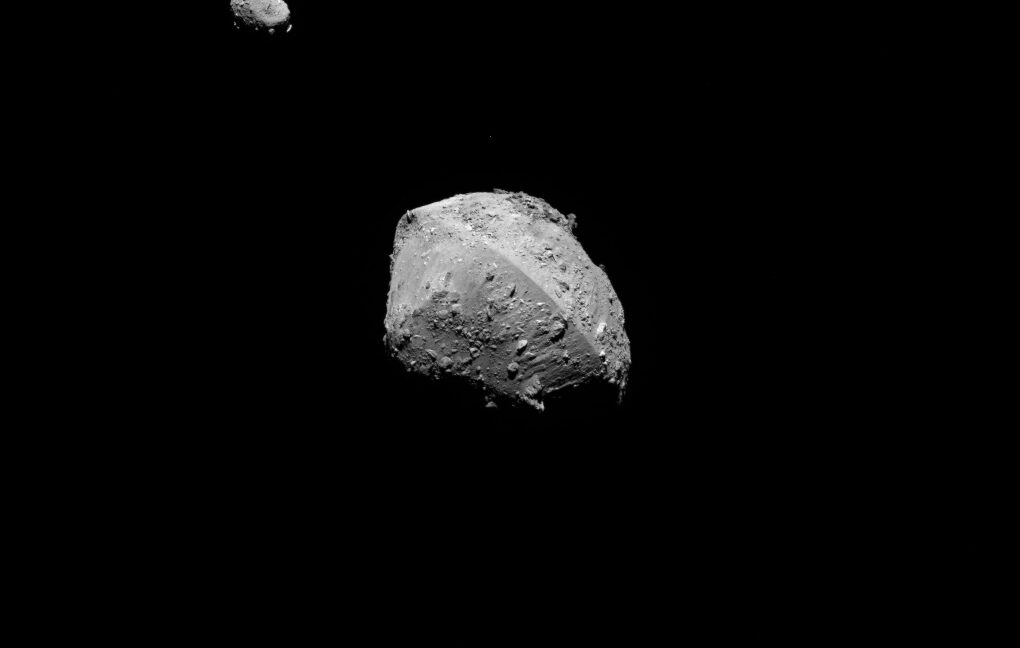
ESA’s Hera spacecraft has found hundreds of previously unseen rocks surrounding the asteroids Didymos and Dimorphos. The objects, ranging from soccer-ball-sized fragments to pieces as large as washing machines, could have been ejected when NASA’s DART spacecraft struck Dimorphos—or may be remnants from the asteroid’s ancient formation. Scientists say more observations are needed to determine their origin, while the debris could complicate Hera’s plans to deploy two CubeSats in January.
Hera finds a crowd around Didymos and Dimorphos
“As we approached Didymos and Dimorphos, we quickly realized that the asteroids were not alone,” said Naomi Murdoch, a planetary scientist at the Institute for Advanced Study in Aerospace Studies in Toulouse, France. “In fact, they had a lot of company.”
The image released by ESA on Wednesday combines 11 long-exposure frames captured by Hera’s hyperspectral camera. Ground-based image-processing equipment digitally removed the brighter Didymos and Dimorphos from the images, revealing a collection of dimmer streaks and points of light. Each appears to be a piece of rock ranging in size from a soccer ball to a washing machine.
“Hera came to visit two asteroids, and we found hundreds of companions,” Murdoch said.
The debris may have several possible origins
One obvious explanation is that the rocks were thrown into space when DART struck Dimorphos. However, scientists cautioned that they need more information before they can make that connection with confidence.
Hera is the first space mission to conduct sustained research on an asteroid that has a satellite. The debris surrounding Didymos and Dimorphos could also be relics from the ancient formation of Dimorphos.
“Hera allows us to study it even more closely,” Murdoch said. “We need to learn more about these rocks and characterize them to understand whether they are related to DART or another process and what impact they may have on other asteroid systems in the solar system.”
Rocky terrain could complicate CubeSat operations
Fields of boulders create challenges for spacecraft navigating around asteroids. The rocks pose an additional risk to the two small CubeSats that Hera plans to deploy in January.
“I’ve seen some images that don’t put me at ease,” said Margherita Caldi, Milan CubeSat project manager. “There’s a mixture of excitement and panic.”
Claudia Barossi, the spacecraft systems engineer for Hera’s other CubeSat, Juventus, said its planned trajectory would pass through the rocky debris while traveling within a few miles of the asteroid. The mission eventually aims to land the CubeSat on Dimorphos, where it would measure the miniature world’s tenuous gravitational field.
Source: arstechnica.com