


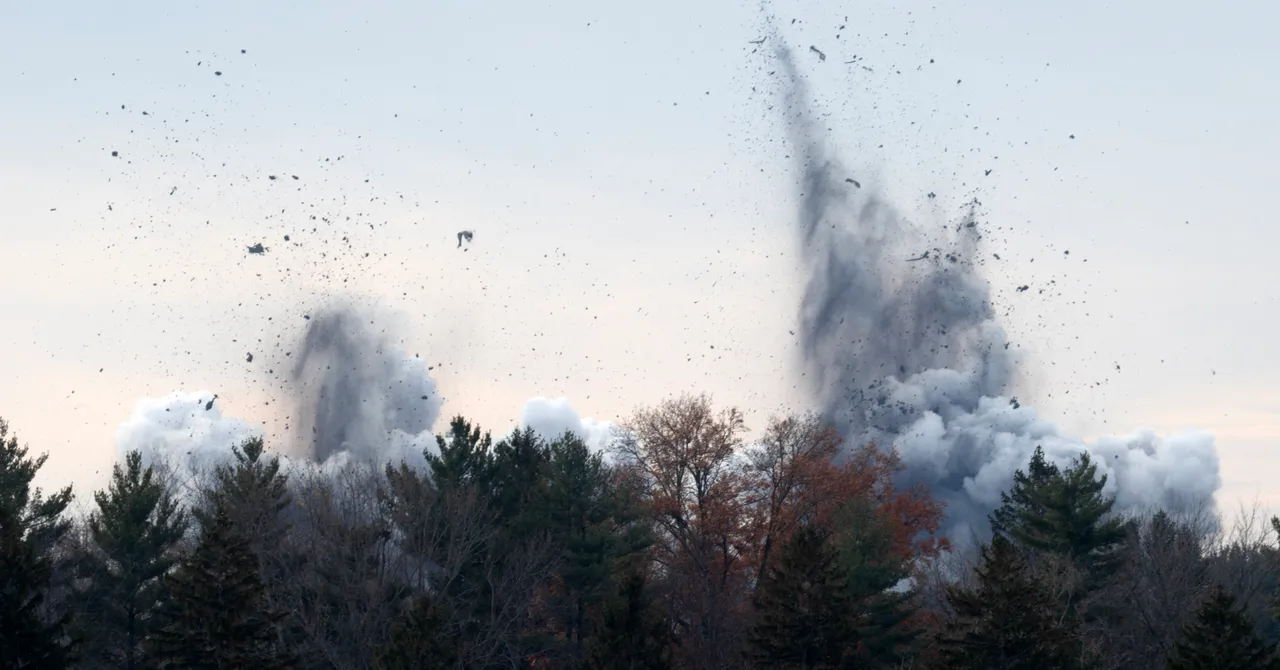
The U.S. military detonated nearly five tons of degraded lead azide outside Middletown, Iowa, on Wednesday morning, prompting federal, academic and community efforts to determine whether the explosion released lead into the surrounding environment. Initial monitoring reported no detected contamination, but officials say the full extent of any impact may not be known for several days as teams analyze air, soil and water samples.
Monitoring begins after controlled detonation
Environmental Protection Agency Secretary Lee Zeldin told CNN shortly after the explosion that preliminary monitoring at the scene had not detected anything. However, the possibility of lead being released into the air around the site remains under investigation. Release lead into the air around the site.
The full extent of any fallout may not be determined for at least several days. Government agencies, universities and local residents have begun intensive surveillance and inspection efforts. Their air, soil and water samples will help establish whether people in Middletown and nearby communities were exposed to lead.
The lead azide had been stored at a base near Middletown for decades. The Army recently determined that the material had become too unstable and dangerous to move or repair. Poor communication between the military and communities along the potential fallout path contributed to widespread confusion.
As the federal government increased mitigation efforts, the Army constructed a dam around the explosion site, while NASA deployed research aircraft and satellites for monitoring. Universities also began organizing their own investigations in response to the rapidly changing situation.
Universities organize independent sampling
Several departments at the University of Iowa began installing air and soil monitoring stations late last week.
“At first, we didn’t even know whether the EPA or the Army or someone else was going to do something,” said Peter Thorne, a professor of environmental health at the university.
Scientists at Purdue University, about 300 miles away, also requested soil samples from Middletown.
“We learned about the explosion late last week, but as soon as we learned of the delay in the initial explosion date, we decided to make the call,” said Ellen Wells, a public health professor at Purdue who is helping lead the testing.
Limited public notice fuels distrust
Surrounding towns were notified in late October that the military planned to conduct soil sampling before and after a “deliberate and controlled explosion” involving “large amounts of lead azide.” However, many communities in the initially modeled fallout path appear to have received no additional notice beyond an Army press release issued several days before the planned explosion.
The limited communication has contributed to public distrust of the federal government, including its environmental monitoring programs. Thorne said the University of Iowa’s work is not intended to replace federal oversight, but to supplement it and help reassure residents.
“We and the EPA are doing similar exposure assessment efforts, and if they agree, that would give us some confidence,” he said. “For people who are concerned about whether what the government says is true, if their findings match our findings, I think that will help alleviate some of those concerns.”
Source: www.wired.com