


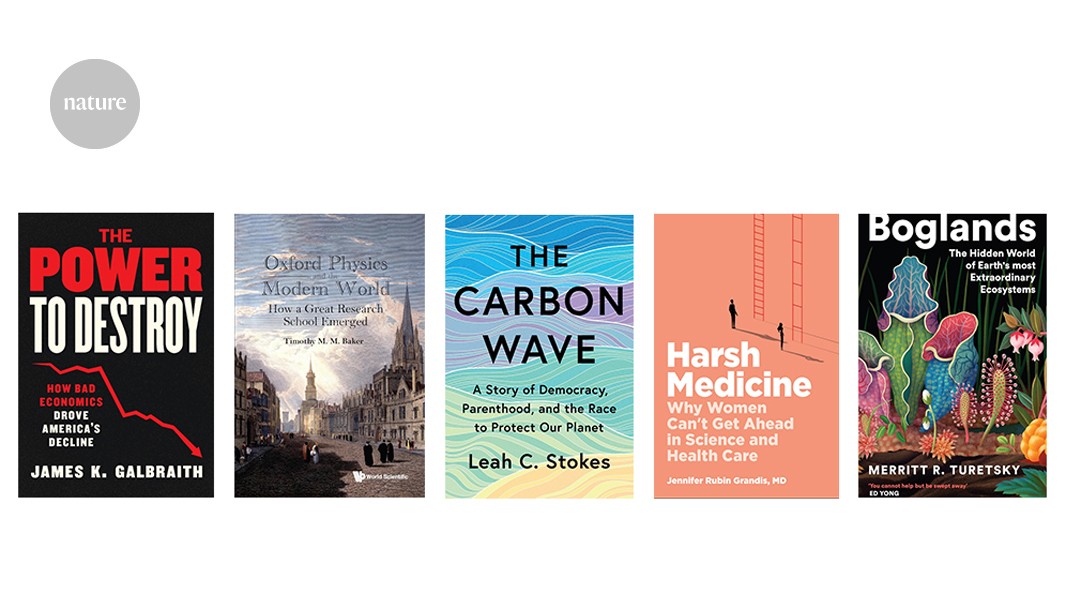
The 2026 books featured here explore wetlands and carbon storage, the political making of climate legislation, the relationship between economic power and democracy, and the place of physics in the modern world. Their subjects range from bog ecology to fossil-fuel infrastructure, financial oligarchies and the history of science.
Wetland
Merritt R. Turetsky Profile (2026)
Bogs form in waterlogged, oxygen-poor conditions that slow the decomposition of plants. As organic matter accumulates, it creates a thick layer of peat. Peatlands cover only 3% of Earth’s land area but store approximately 30% of the carbon in soil.
“In this liminal space, where land is water and water is land, a strange and haunting loveliness emerges,” writes ecologist Merritt Turetsky. Although many people might not immediately understand the appeal of studying bogs, her fascinating book could charm even skeptical readers.
Carbon Wave

Leah C. Stokes MIT Press (2026)
Environmental activist Leah Stokes was inspired by a 2006 documentary while she was in college. An Inconvenient Truth argued that individuals have a responsibility to reduce global warming. Later, while working as an associate professor in California, Stokes realized for the first time that fossil-fuel infrastructure was the main culprit.
In 2022, Stokes played a key role in pushing the U.S. government to pass the Inflation Control Act, a landmark bill that would invest more than $400 billion in efforts to combat climate change. Her book reveals “the details of how this climate change law was created.”
Power to Destroy

James K. Galbraith University of Chicago Press (2026)
Veteran economist James Galbraith launches a sharp attack on mainstream economics in the United States, declaring that his discipline has long been a “fraud.” He argues that economists have spent decades accepting the idea that control over money should be kept separate from democratic politics.
Yet oligarchs in finance, technology, pharmaceuticals and other industries now wield political power, Galbraith says. He contends that economists continue to rely on outdated tools developed 100 years ago, weakening democracy in the process.
Oxford Physics and the Modern World

Timothy MM Baker World Science (2026)
Source: www.nature.com