


Close Menu
HitechubHitechub
    What's Hot
    Science

    NASA Curiosity Rover’s 5,000 Days on Mars: 10 Stunning Photos of Alien Sunsets, Stone Spider Webs, and Mysterious Doors

    Science

    2025 Myanmar Earthquake Reveals How California’s “Big One” Could Unfold

    Science

    Scientists Uncover Potential Link Between Periodontal Disease and Heart Health Risks

    Important Pages:
    • About Us
    • Privacy Policy
    • Terms & Conditions
    Facebook X (Twitter) Instagram Pinterest
    Facebook X (Twitter) Instagram
    HitechubHitechub
    Friday, November 27
    • Shop
      • Fashion
        • Mens
        • Womens
        • Accessories
          • Handbags
          • Keychain
          • Masks
          • Money clicps
          • Neck Pillow
          • Rings
          • Towels
          • Wallets
        • Jewelry
        • Watches
        • T-shirts
        • Hawaiian shirts
        • Vests
        • Swim trunks
        • Swimsuits
      • Fun
        • Magic cubes
        • Magnifiers
        • Misc
        • Photo books
        • Puzzles
        • Toys
      • Home
        • Cleaning/Care
        • Mailbox covers
        • Mugs
        • Pot Holders
        • Spoon
      • Office and Electronics
        • Chairs
        • Office Supplies
        • IPad cases
        • Laptop stickers
        • Mouse pads
        • Notebooks
        • Pencil bags
        • Pens
        • Phone cases
      • Personalized
      • Pets
      • Sports
        • Cycling
          • Balaclava Mask
          • Bike Bell
          • Bike Computer
          • Bike Fender
          • Bike Grips
          • Bike Kickstand
          • Bike Light
          • Bike Locks
          • Bike Mitts
          • Bike Pumps
          • Bike Repair Stand
          • Bike Seat
          • Bike Trainer
          • Bike Wheels
          • BIKES
            • Folding Bikes
            • Road Bikes
          • Carbon Fiber Bike Products
          • Cycling Mask
          • Kid’ Bike Helmets
          • Inner Tube
          • Motorcycle Bag
          • Nylon Pedals
          • Adult Helmets
          • Photochromic Sunglasses
          • Soft Coolers
          • Suction Cup Bike Rack
          • Tool accessories
          • Winter Cloth
          • Heart Rate Monitor
        • Outdoors/Camping
          • Outdoor Bags
        • Sweatband
    • Technology
      1. AI
      2. Gadgets
      3. View All

      This is the most popular CEO in the world

      Sectors in which “Chat-GPT” is most often used

      Artificial intelligence has begun to “swallow” professions

      The unusual robot conductor of a concert in Seoul

      Here’s how you can tell if your phone is being tapped

      PlayStation 5 becomes a completely silent console and gets more space

      This is the first phone that can be used to park a car

      Best Gaming Laptops 2023: Powerful Portables for PC Games

      Windows Server 2028 Removes the WSUS Server Role: What Microsoft’s Change Means

      Intel Faces Pressure to Give Trump 10% Stake or Risk Consequences

      How AI May Transform the Role of Theoretical Physicists

      SAP Confirms Security Incident Following Suspicious GitHub Activity

    • Science
      1. Space
      2. Wheels
      3. View All

      Space Perspective: A Journey to the Edge of Space

      5 Fascinating Facts About Space

      Space Exploration: Unveiling the Wonders of the Universe

      Toyota wants to make a new generation battery with a range of up to 1,200 km

      Meet Toyota’s lunar “baby” that could make exploring the Moon easier

      What does a night drive look like with one of the most beautiful cars in the world: the Rolls-Royce Ghost

      James Webb Telescope Discovers Earliest “Little Red Dot” Candidate, Formed 450 Million Years After the Big Bang

      Postcard from the Grave: Exploring Nature’s Haunting Beauty

      Why the Next U.S. Congress Should Ban Self-Improving AI Development

      Natural Floating Island Installed in Glasgow Park as a Lasting Games Legacy Project

    HitechubHitechub
    Home » James Webb Telescope Discovers Earliest “Little Red Dot” Candidate, Formed 450 Million Years After the Big Bang
    Science

    James Webb Telescope Discovers Earliest “Little Red Dot” Candidate, Formed 450 Million Years After the Big Bang

    Share Facebook Twitter Pinterest WhatsApp
    Share
    Facebook Twitter LinkedIn Pinterest WhatsApp

    Astronomers using the James Webb Space Telescope (JWST) have identified a compact, unusually red object whose light was emitted when the universe was just 450 million years old. Known as CW-LRD-z10, it could be the most distant example yet of a “little red dot” (LRD)—a mysterious class of early-universe objects that may surround rapidly growing black holes. If confirmed, the object could offer clues to how the first supermassive black holes formed.

    “Such an object would be one of the most distantly accreting black holes known,” Roberto Maiorino, a professor of experimental astrophysics at the University of Cambridge who was not involved in the study, told Live Science via email. CW-LRD-z10 could provide further evidence that little red dots represent an early stage in the growth of supermassive black holes, he added.

    The study was published Nov. 24 in Astrophysics Journal Letters.

    A spectroscopically confirmed candidate

    Little red dots are compact, very red objects observed in the early universe. Their light is shifted toward longer, redder wavelengths as it travels across the expanding universe, a phenomenon known as redshift.

    JWST’s near-infrared camera has detected objects at redshifts of about 9, corresponding to a lookback time of roughly 13.1 billion years. In 2025, the team behind the new study used JWST’s Mid-Infrared Instrument (MIRI) to search for even more distant sources.

    CW-LRD-z10 was the only candidate identified in that search, according to lead author Takumi Tanaka, a doctoral student at the University of Tokyo.

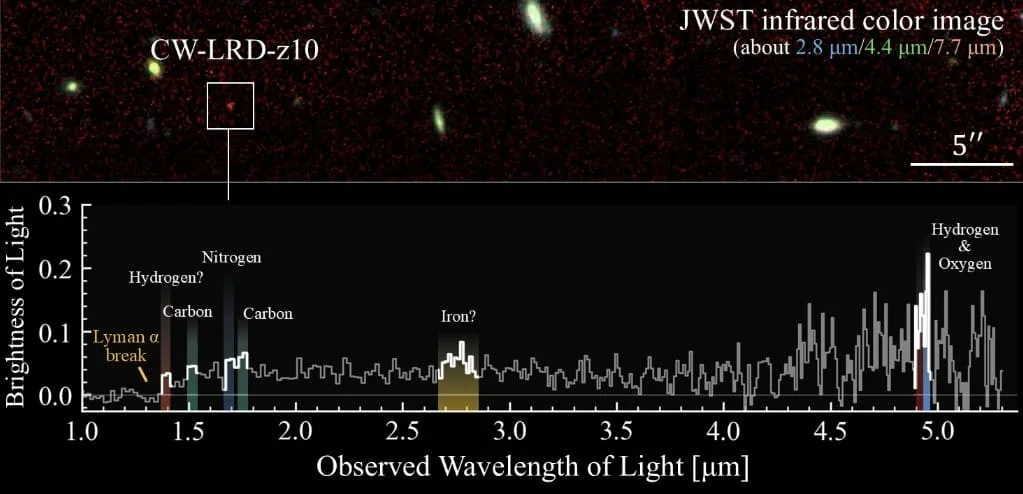
    View of the small red dot CW-LRD-z10 with the James Webb Space Telescope. (Image credit: JWST / Tanaka et al.)

    The researchers measured the object’s redshift at 10.36, indicating that its light was emitted when the universe was only about 450 million years old. They identified a sudden drop in the object’s light and interpreted it as a “Lyman-alpha break,” a feature that can help determine how far away an object is.

    Maiorino said the redshift measurement appears reliable. “The break looks relatively convincing, so we can say that the redshift determination is fairly robust,” he said.

    The object’s color provides the strongest evidence that it could be a little red dot. CW-LRD-z10 is much redder in the mid-infrared than in the near-infrared. Its spectrum also contains a V-shaped dip typical of little red dots, possible iron emission and a tentatively detected emission line whose proportions resemble those seen in other little red dots and active black holes.

    None of these features is conclusive on its own, Tanaka said, but together they support the little red dot interpretation.

    However, the spectrum does not show the broad hydrogen emission line that would provide stronger evidence for an LRD. The wavelengths where that line would appear were outside the range covered by the new observations.

    “At this stage, this should only be considered as an LRD candidate,” Maiorino said. Tanaka agreed that CW-LRD-z10 should continue to be described as a highly promising candidate rather than a confirmed little red dot.

    What else could CW-LRD-z10 be?

    One alternative is that the object’s spectrum contains a Balmer break, a sharp drop in light produced by older stars. Under that interpretation, the object would be a much closer galaxy at a redshift of about 3, or roughly 11.4 billion light-years away.

    Tanaka said the available data do not support that explanation. The colors would be difficult to produce in a galaxy of that type, and the emission lines expected at that distance were not detected.

    “The characteristics of the observed break are too strong to be explained by a normal Balmer break from a typical stellar population,” he said.
    Spectrum of the small red dot CW-LRD-z10
    Spectrum of the small red dot CW-LRD-z10, which may indicate its composition. (Image provided by Tanaka et al.)

    A normal star-forming galaxy at a redshift of 10.36 could, in principle, also produce an extremely red color. However, it would require unusually strong characteristic spectral lines. Those lines fall outside the current spectrum, so future observations will be needed to test this possibility.

    CW-LRD-z10’s light also appears to contain iron emission. Such emission is thought to come from gas close to actively feeding black holes, including quasars, rather than from ordinary star-forming galaxies.

    “If confirmed, this would support the existence of actively accreting black holes and suggest that gas containing heavy elements was already present in the black hole’s potential environment,” Tanaka said.

    Possible seeds of supermassive black holes

    The nature of little red dots remains under debate. One leading theory is that they contain rapidly growing black holes surrounded by dense gas. Other proposed explanations include growing black holes, a supermassive star, a black hole star or a dense star cluster.

    Tanaka stressed that CW-LRD-z10 cannot yet provide firm conclusions about how supermassive black holes first formed. The true nature of little red dots, and their role in black hole evolution, remains uncertain.

    If CW-LRD-z10 does host an accreting black hole, its properties could help distinguish among different black-hole seeding scenarios, Maiorino said.

    JWST’s mid-infrared instrument is scheduled to observe the object’s spectrum in 2027. Those observations are designed to detect hydrogen and oxygen emission lines as well as the underlying continuum. The data should help researchers determine whether the object’s red appearance reflects its true color or is instead caused by strong emission lines.

    “I’m really looking forward to seeing the data,” Tanaka said.

    Source: www.livescience.com

    Share. Facebook Twitter Pinterest LinkedIn WhatsApp
    Previous ArticleWindows Server 2028 Removes the WSUS Server Role: What Microsoft’s Change Means

    Related Posts

    Science

    Postcard from the Grave: Exploring Nature’s Haunting Beauty

    Science

    Why the Next U.S. Congress Should Ban Self-Improving AI Development

    Science

    Natural Floating Island Installed in Glasgow Park as a Lasting Games Legacy Project

    Science

    Extremophile Transgene Enhances Drought Resistance and Yield in Cereal Crops

    Technology

    Iranian Hacker Group Discovers New Tactics to Launch Widespread Cyberattacks

    Science

    Black Friday 2026 Telescope Deals: Smart Telescopes and Binoculars

    Technology

    Volvo’s Big Battery Powers the New 2028 Plug-In Hybrid

    Science

    NASA Science: Imbued with Sivrich

    Add A Comment
    Leave A Reply Cancel Reply

    Stay In Touch
    • Facebook
    • Twitter
    • Instagram
    • Pinterest
    Top Picks
    Technology

    Google’s Motion Assist Anti-Nausea Feature Finally Rolls Out to Android

    People who experience motion sickness often feel nauseous when using a phone or reading in…

    Teenage Sex and Death at Camp Miasma Review: A Slasher That Struggles to Satisfy Horror Fans

    How the Brain Eliminates Billions of Mutant Neurons Before Birth

    Quest for a Habitable World – Sciworthy

    Ukraine’s Navy Drone Sinks Russian Kamikaze Drone Ship in Major Military Milestone

    Most Popular
    Science

    AI Water Consumption: How Solar and Wind Power Can Reduce Environmental Impact

    Science

    Chocolate Scent May Help Men Complete More Repetitions With Less Fatigue

    Categories
    • AI (9)
    • Gadgets (6)
    • Science (3,614)
    • Space (3)
    • Technology (3,045)
    • Wheels (3)
    Our Picks
    Science

    The Arrival of Killer Robots: Time to Decide Our Acceptance

    Technology

    Digger Review: Features, Performance, and Verdict

    © 2026 Hitechub.
    • Home
    • About Us
    • Privacy Policy
    • Terms & Conditions

    Type above and press Enter to search. Press Esc to cancel.

    GDPR Cookie Banner

    We are using cookies to give you the best experience on our website.

    You can find out more about which cookies we are using or switch them off in .

    Ad Blocker Enabled!
    Ad Blocker Enabled!
    Our website is made possible by displaying online advertisements to our visitors. Please support us by disabling your Ad Blocker.