


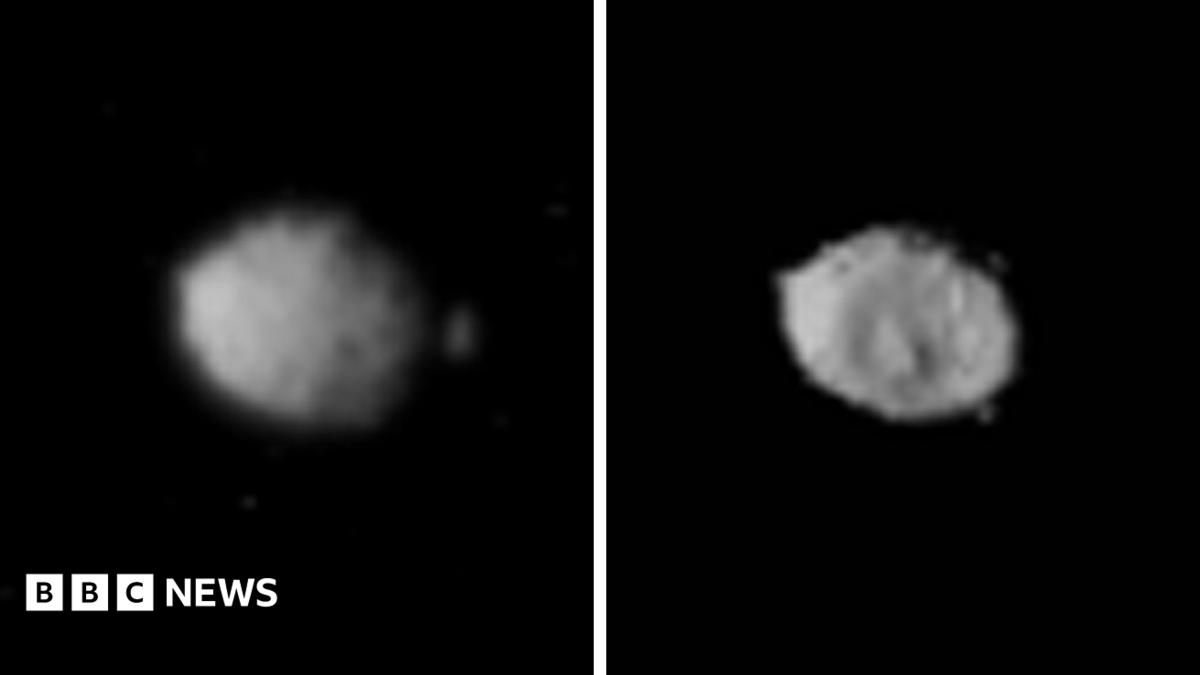
ESA’s Hera mission is studying the asteroid system Didymos and its moonlet Dimorphos to determine how much the moonlet’s motion was changed by an earlier spacecraft impact. Measuring Dimorphos’ mass will help scientists assess the effectiveness of the deflection and improve plans for protecting Earth from a potentially hazardous asteroid.
“It will help us predict what would happen if we had to hit another asteroid,” said Professor Simon Green, a planetary scientist on Hera’s science team.
“We could measure that characteristic and say, ‘It would take this number of spacecraft, traveling this fast and at this speed, to change its direction enough to avoid hitting Earth.’”
Dimorphos is still tumbling after the impact
Hera’s arrival is also helping scientists answer broader questions about the collision. The impact changed not only Dimorphos’ shape, but also the way it moves.
“Before the DART impact, Dimorphos was similar to our Moon, so it always showed the same face to Didymos and rotated very smoothly,” explained Raducan.
“It’s very chaotic and tumbling right now. Imagine throwing a barrel down the stairs and watching it roll and move. That’s basically what Dimorphos is doing around Didymos right now.”
Images reveal Didymos’ rocky surface
Hera has also captured detailed images of Didymos, revealing its surface in unprecedented detail.
“Gravity on Didymos’ surface is about 40,000 times weaker than Earth’s gravity,” said Naomi Murdoch of the Hera mission team.
“We can already see some fascinating and complex geology. We can also see areas of exposed rock.
“The smallest details visible in these images are about 3 metres across. That means every rock you can see is at least 3 metres long, with some as large as 10 metres. We are looking at rocks the size of cars or buses sitting in a world with almost no gravity.”
Source: www.bbc.co.uk