


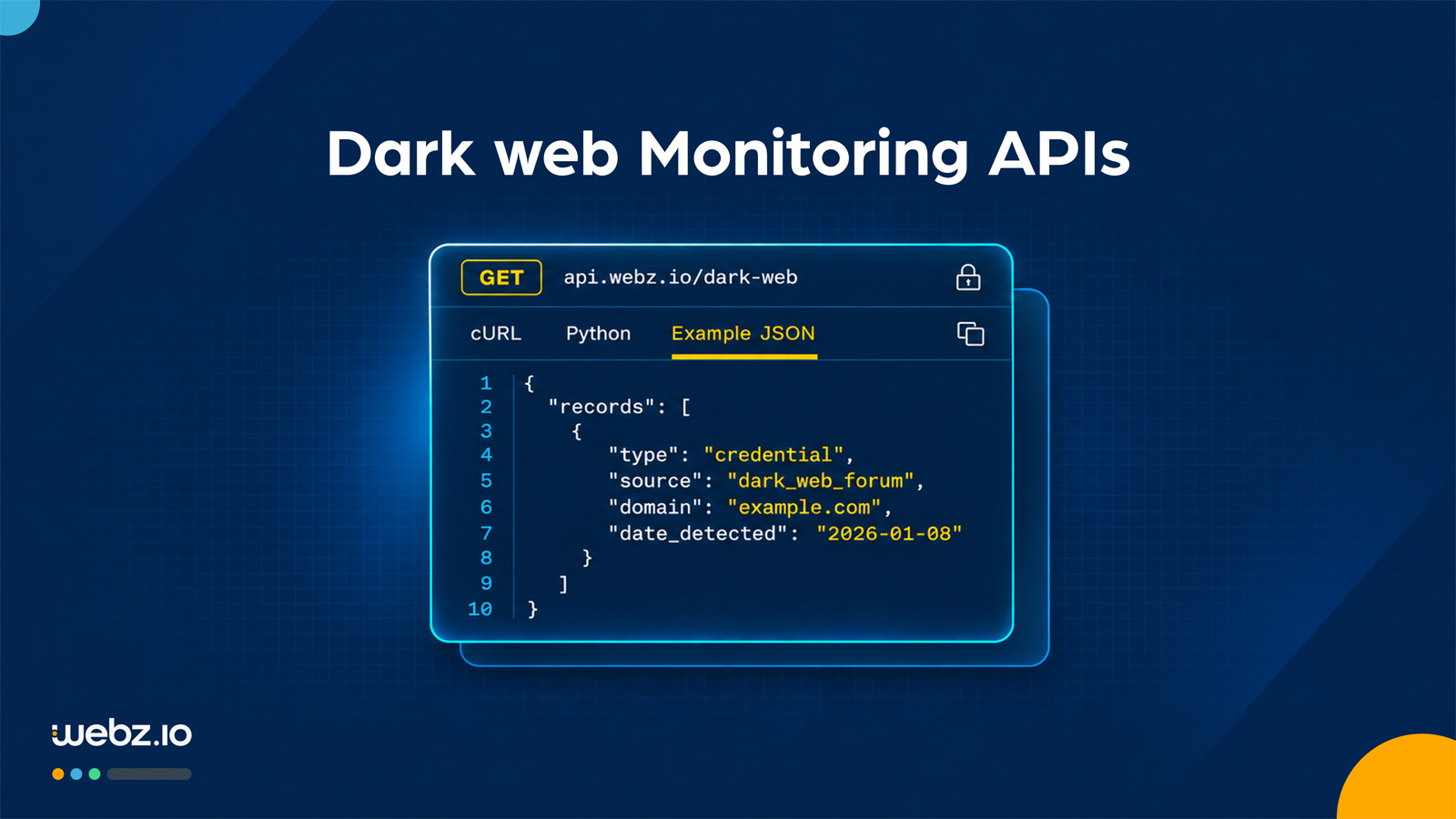
Strong passwords and multifactor authentication do not eliminate the risk of account takeover. Infostealer malware can capture reusable session cookies, API keys, cloud credentials and other secrets from an infected device, while changing a password may leave separately managed tokens untouched. Webz.io’s self-service Cyber APIs help organizations search for these exposures, monitor dark web activity linked to verified domains and investigate findings through structured, cited data.
The five APIs cover compromised accounts, stolen authentication sessions, non-human identities, dark web domain mentions and question-based dark web research. Security teams can use them to add targeted checks to existing tools while Webz.io handles data collection and structuring.
Each account includes $5 in free API credits every month, with additional usage available on a pay-as-you-go basis.
Find exposed accounts and the services behind them
The Data Breach Monitoring API searches compromised databases, credential combo lists and infostealer logs for records associated with verified domains.
Organizations can search by email domain, login domain or both. An email-domain search can identify accounts using a company email address, while a login-domain search identifies credentials used to access an application. This distinction can help separate work addresses exposed through a third-party service breach from credentials stolen while accessing corporate systems.
Results are returned as structured JSON and may include login URLs, exposure types, timestamps and compromise or device context. Analysts can use these details to determine which accounts need attention, but a matching work email alone does not prove that the organization’s own systems were compromised.
Find exposed accounts, stolen sessions, leaked secrets and dark web references associated with verified domains, or ask questions and receive cited answers.
No credit card is required, and accounts start with $5 in free API credits each month.
Find stolen browser sessions
The MFA Bypass Monitoring API focuses on authentication and session cookies obtained by infostealer malware. Depending on an application’s session controls, a reusable stolen cookie may provide access without triggering a new multifactor authentication challenge.
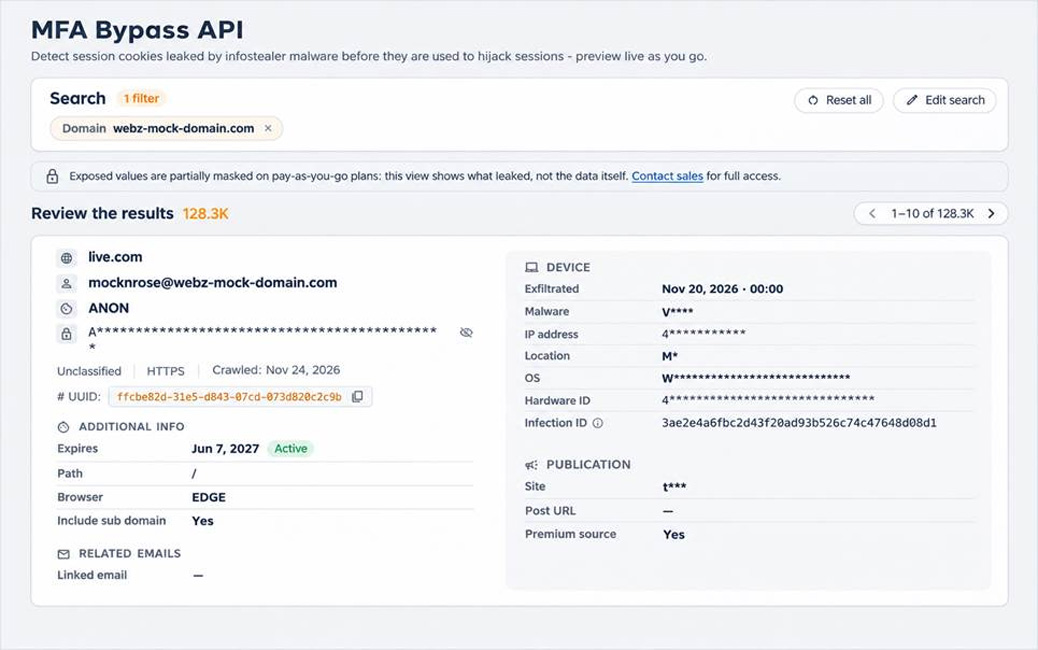
Records may identify the service host, browser, cookie type and expiration details, together with available infection and device context. Security teams can compare these findings with identity and application logs when assessing risk.
An expiration date does not prove that a session remains active. The data helps identify exposed session material and provides evidence for investigation. Session cancellation and requirements for a new sign-in must be handled through the customer’s identity provider or application.
Find secrets stolen from developer machines
Infostealer malware can retrieve API keys from local configuration files even when those keys have never been committed to a repository. Some keys and tokens have lifecycles independent of a user’s password, meaning they may remain available after the password is changed.
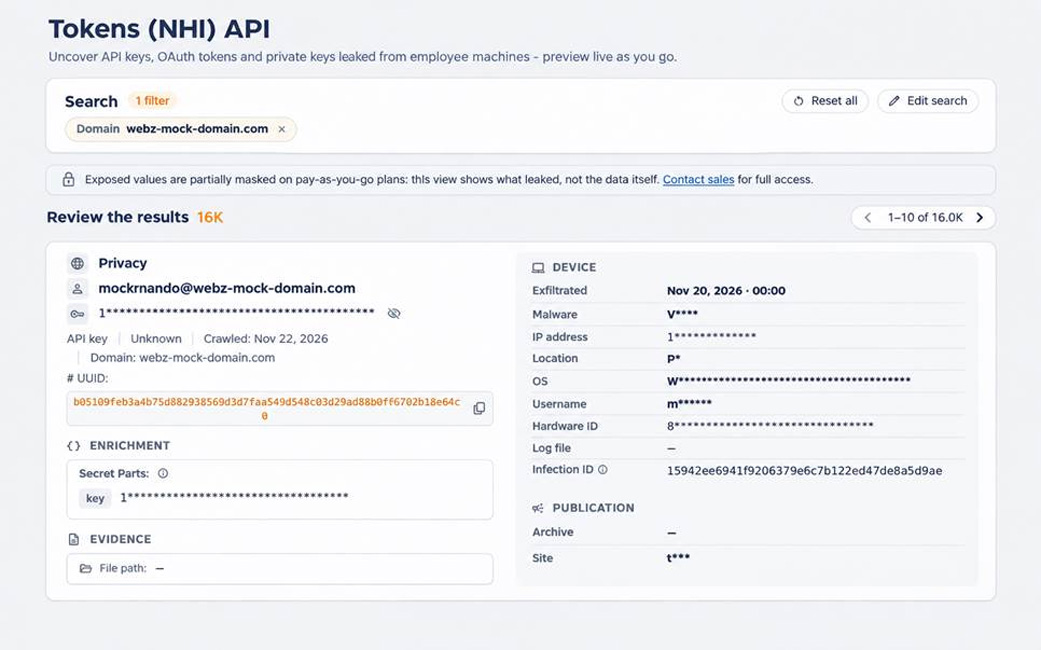
The Non-Human Identity (NHI) API is designed to find exposed machine credentials across supported cloud, development and AI services. Its scope includes API keys, OAuth and personal access tokens, refresh tokens, cloud access keys, session tokens and private keys.
Available evidence may include the detected service, source files and infected devices. Where validation is supported, results can indicate whether a credential was active at the time of the check. This is a current discovery and does not guarantee that the credential remains usable.
Secret values are masked by default. Viewing unmasked values or surrounding raw log content requires appropriate permissions, and source-file information varies by plan.
Monitor dark web mentions of your domain
The Dark Web Monitoring API retrieves posts referencing verified domains from collected hacking forums, underground marketplaces, ransomware and leak sites, and Telegram.
Results may reveal posts advertising access to an organization or claiming to sell its data. The API returns available source and thread details, timestamps, author information and extracted entities, giving analysts context to compare with internal findings.
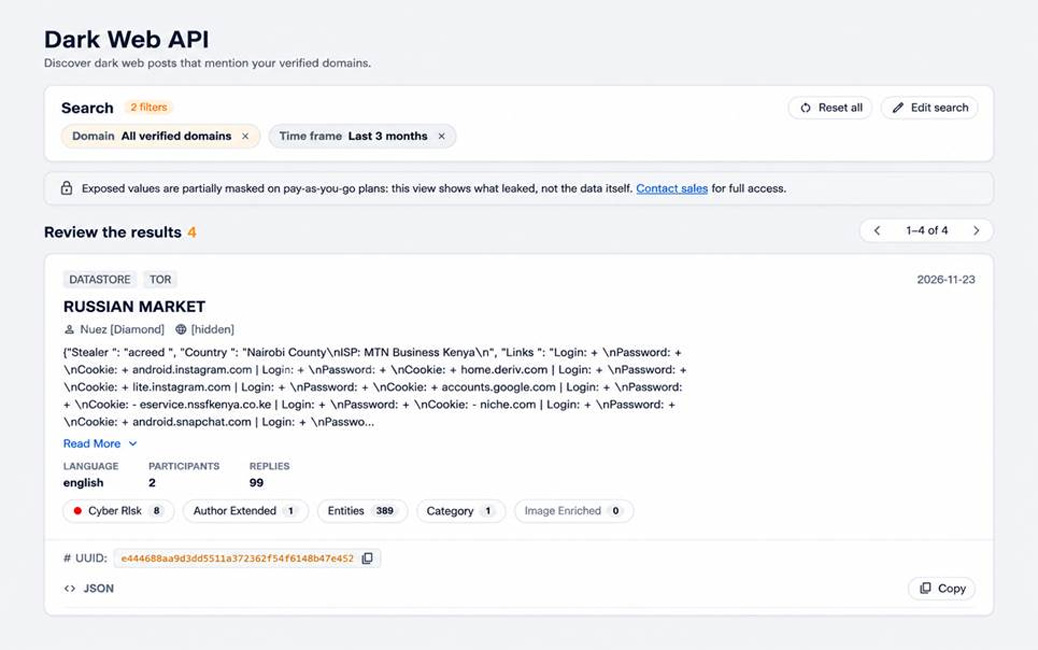
Developers query Webz.io over HTTPS and receive structured results, without needing to run the Tor browser or maintain crawling infrastructure. Applications can schedule requests and route related posts to a security information and event management system or case-management platform.
Results vary according to the content collected and the source access enabled for an account.
Ask questions and examine the evidence
The Dark Web Answers API lets users ask questions in everyday language and receive reports that cite supporting dark web posts. Users do not need cyber threat intelligence experience or specialized query syntax to begin.
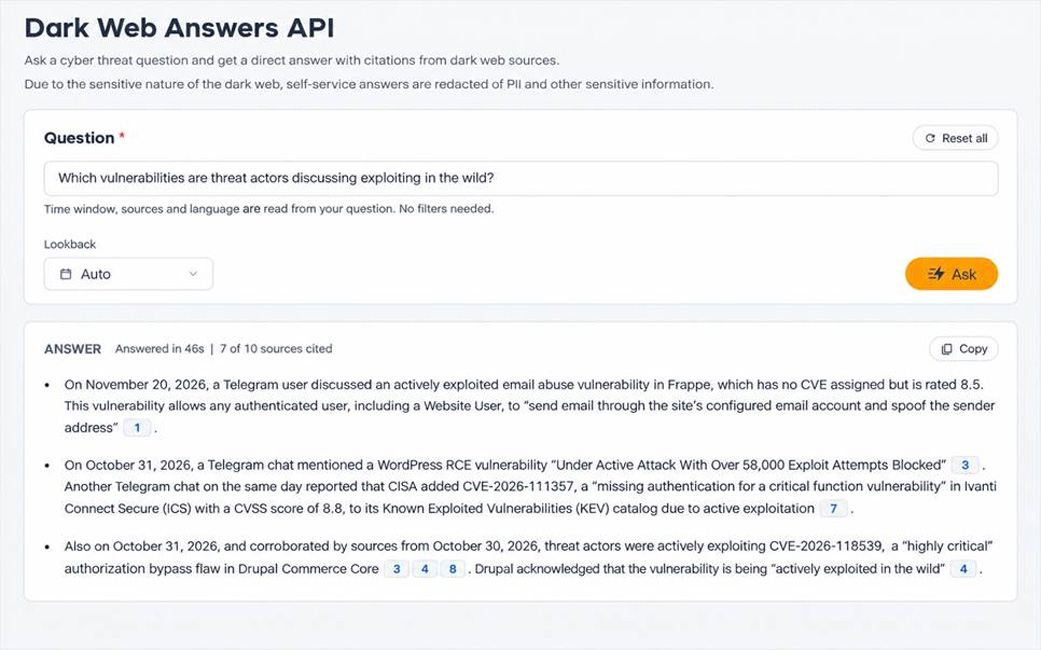
For example, a user can ask what a post says about a company and then review the material behind the answer. The API connects to an assistant or agent through the Model Context Protocol (MCP) and supports conversational follow-up research.
The difference between a cited claim and a confirmed incident remains important. Citations identify the post behind a statement, but analysts must assess whether the underlying claims are reliable. Searches for compromised accounts, cookies and secrets are separate from the discussion-based research provided by Answers.
Sensitive data is censored, and the answers service is secured and self-service on a pay-as-you-go basis. Cybersecurity companies can contact Webz.io about full access. Access options affect how sensitive information is handled, not the length of an answer.
Integrate checks into existing workflows
An initial integration can check accounts published on authenticated corporate domains and send relevant findings to an existing security investigation queue. Organizations can expand the workflow to check for stolen sessions and secrets.
When available, a shared infection identifier can link stolen secrets with related cookies and credentials from the same machine, allowing analysts to investigate connected results together.
Customer applications determine when queries run and which findings are escalated. Approved response actions, including credential rotation, remain in the organization’s existing security systems.
Start with free monthly credits
Create a Webz.io account without a credit card to receive $5 in free API credits each month. Teams can replenish their balance when they need additional usage.
Organizations should verify ownership of each domain before querying monitoring data. Available fields and sensitive values vary by source, plan and account permissions.
Teams developing broader security products or seeking expanded access can discuss their requirements with Webz.io.
Sponsored and written by Webz.io.
Source: www.bleepingcomputer.com