


The colossal soft-bodied cephalopod, reaching lengths of up to 19 meters (62 feet), once rivaled the most ferocious reptiles of the Cretaceous seas and was likely preyed upon, according to a groundbreaking study led by paleontologists at Hokkaido University.
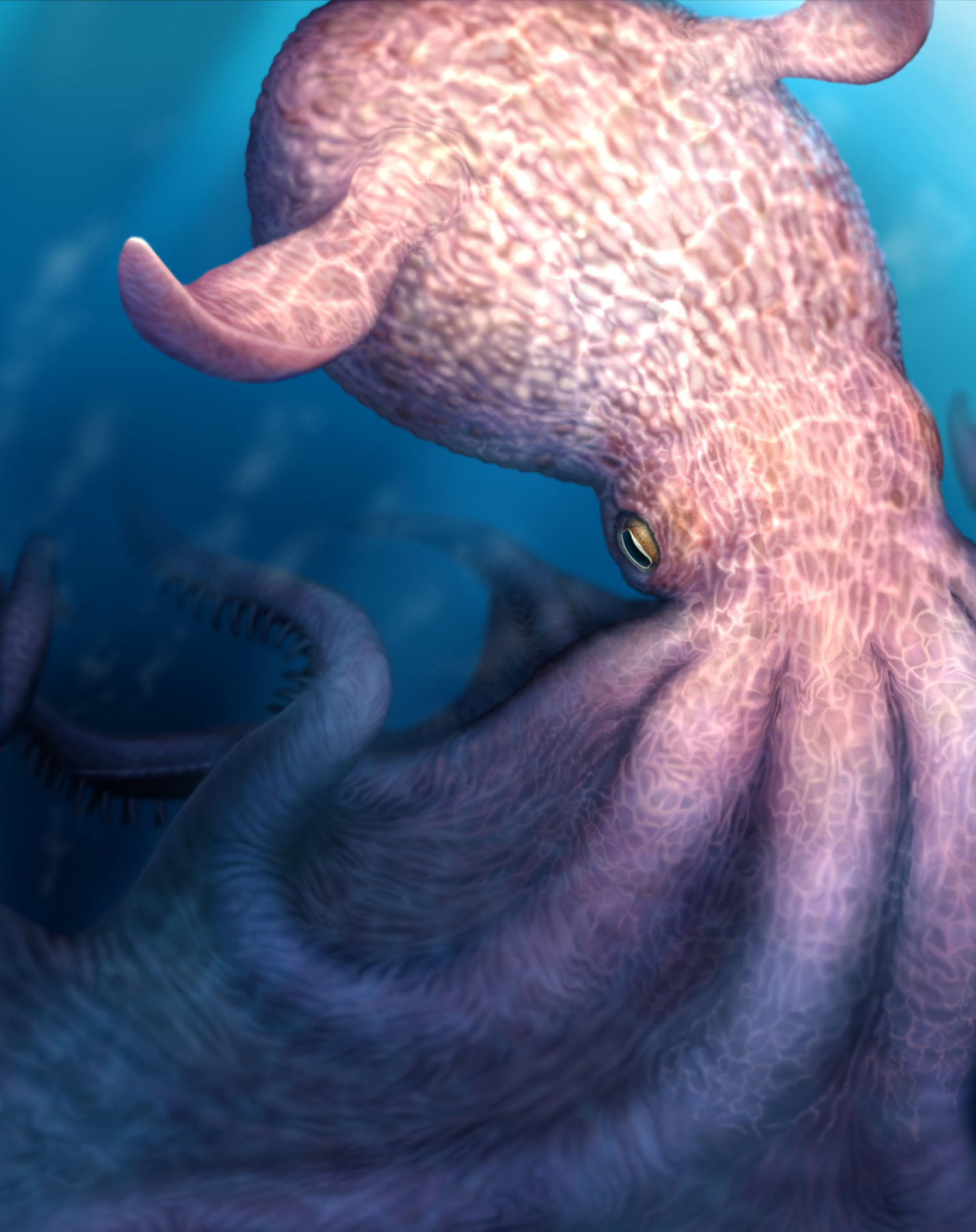
Artist’s impression of an ancient giant octopus. Image provided by: Yohei Utsugi, Hokkaido University
For hundreds of millions of years, it was believed that marine ecosystems were dominated by large vertebrate apex predators, relegating invertebrates to minor prey roles.
However, unlike their shelled counterparts, octopuses have carved out a unique evolutionary path.
These fascinating creatures have evolved soft bodies, which allow for remarkable mobility, vision, and intelligence.
Some octopus species have grown to enormous sizes, serving as apex predators, yet their precise ecological roles have remained unclear due to limited fossil records.
“Our discoveries suggest that the earliest octopuses were giant predators at the apex of the marine food chain during the Cretaceous period,” stated paleontologist Professor Yasuhiro Iba from Hokkaido University.
“Based on exceptionally preserved jaw fossils, we determined that these animals may have reached nearly 19 meters in total length, surpassing the size of modern large marine reptiles.”
“The most astonishing finding was the extent of wear on the jaws.”
This wear, indicative of biting into hard prey, leaves distinctive marks similar to those found in contemporary shell-crushing cephalopods. Measurements of octopus jaws can also estimate the overall body size.
In the study, Professor Iba and colleagues documented evident signs of wear on 15 large jaw fossils of ancient octopus relatives previously collected from Cretaceous deposits in Japan and Vancouver Island.
Moreover, through digital fossil mining techniques, they uncovered 12 flat-tailed octopus jaws entrapped in Cretaceous rocks in Japan.
The analysis categorized two major species: Nanaimoteti Zeretsky and Nanaimoteutis hagarti.
This finned octopus, Nanaimoteutis hagarti, remarkably grows to exceptional sizes ranging from 7 to 19 meters (23 to 62 feet), comparable to contemporary giant marine reptiles, and may represent the largest described invertebrates to date.
Additionally, the jaws of the largest specimens exhibit considerable wear, with the once sharp features of smaller juveniles dulled and rounded over time.
The wear patterns indicate that these creatures were active carnivores, routinely crushing hard shells and bones with powerful bites.
They used their long, flexible arms to capture prey while skillfully dissecting it with their strong beaks—behaviors associated with advanced intelligence.
“This study presents the first direct evidence that invertebrates can evolve into large, intelligent apex predators in an ecosystem largely dominated by vertebrates for approximately 400 million years,” Professor Iba noted.
“Our findings indicate that robust jaws and the absence of a superficial skeleton, a characteristic common to both octopuses and marine vertebrates, were crucial for their evolution into large, intelligent marine predators.”
These findings were published in the Online Journal on April 23, 2026, in Science.
_____
Arata Ikegami et al. 2026. The earliest octopuses were giant top predators of the Cretaceous oceans. Science 392 (6796): 406-410; doi: 10.1126/science.aea6285
Source: www.sci.news