


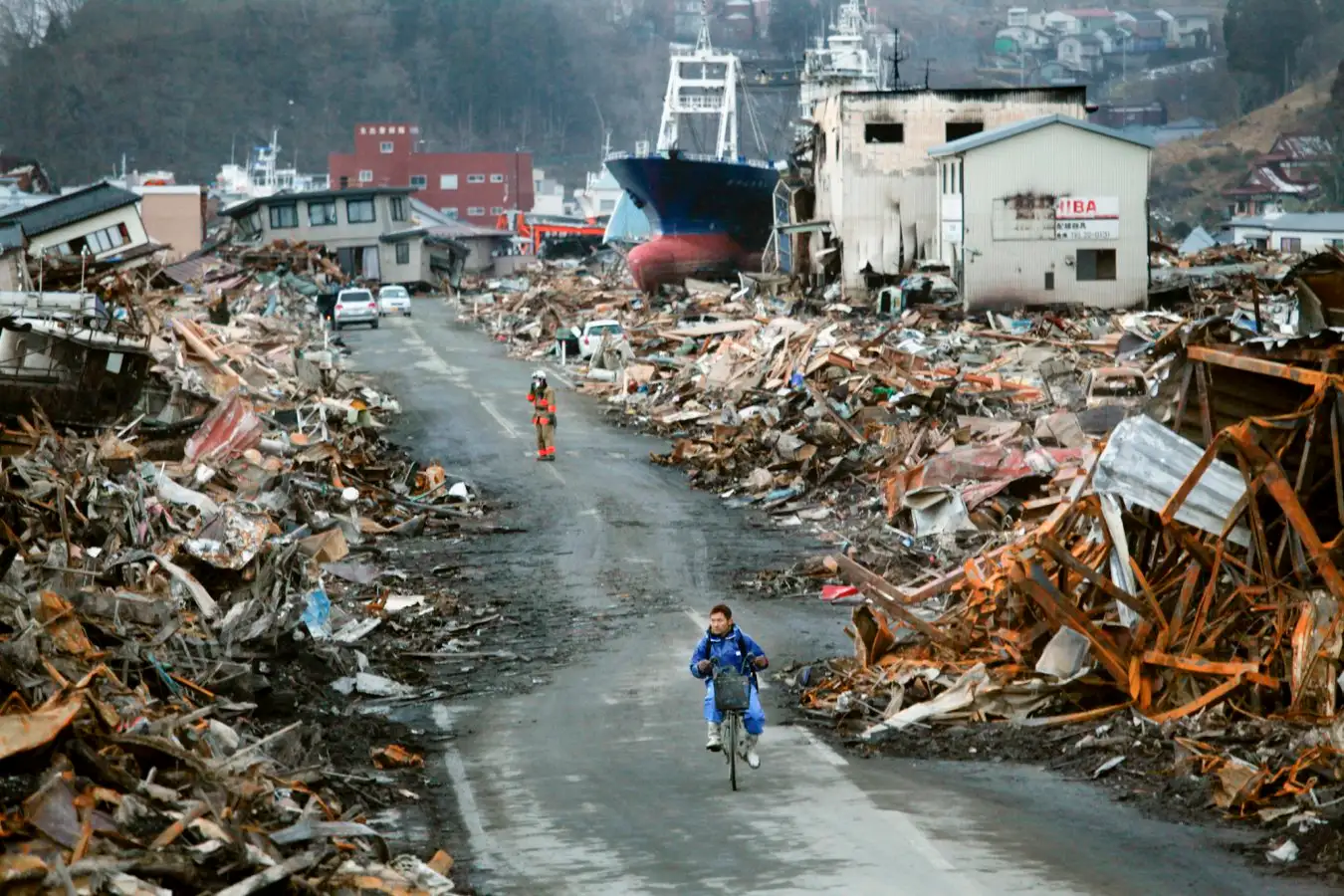
Kesennuma Fishing Port After the 2011 Tohoku Earthquake
Credit: Carolyn Cole/Los Angeles Times via Getty Images
Just 15 minutes after the magnitude 9 Tohoku earthquake struck on March 11, 2011, nearly all of Japan shifted half a centimeter eastward. The powerful seismic waves traveled 5,800 kilometers to the Earth’s core and returned to the surface, causing this displacement.
While a 5-millimeter shift may seem trivial given the destruction, including the local land movement that resulted in the Fukushima Daiichi nuclear disaster and a 40-meter tsunami, it is significant in its breadth, impacting an area over 3,000 kilometers long—almost seven times the length of the earthquake’s main rupture.
According to Park Sun Young at the University of Chicago, this case stands out due to its unique timing and pattern. “At that moment, no ordinary earthquakes occurred, and a similar 5-millimeter eastward shift happened almost simultaneously across Japan,” he explained.
The effect of this displacement was unprecedented, spanning north to south across Japan and even reaching the oceans beyond.
“It’s not just a local ‘edge’ moving,” Park elaborated. “This eastward movement is widespread across Japan, where GPS stations are located. With more offshore instruments, we could better assess the scope of this movement at sea, but the changes are evident almost everywhere on land in Japan.”
Through extensive analysis of GPS and seismic data from the disaster, Park and his team have unraveled the causes of these astounding large-scale movements and the reasons behind the rupture occurring shortly after the primary quake.
Earthquakes usually generate waves that penetrate deep into the Earth’s interior and bounce off the core. However, these waves typically weaken by the time they reach the surface. In the case of Tohoku, the main shock was so immense that the returning waves retained sufficient strength, resulting in widespread shaking as four adjacent tectonic plates shifted together.
“We suspect that the substantial shaking from the initial Tohoku quake weakened the plate boundaries, making them more prone to movement when reflection waves emerged,” explains Professor Park.
This situation highlights a previously overlooked post-earthquake rupture mechanism, suggesting we must recognize potential seismic hazards arising from deeper waves following significant earthquakes, which could lead to additional quakes.
Further research is essential to understand the implications of such phenomena in regions worldwide facing similar challenges, notes Robin Lee from the University of Canterbury, New Zealand.
“This indicates that large earthquakes can initiate widespread delayed faulting within minutes and over a much broader area than anticipated,” Lee concluded.
Topic:
Source: www.newscientist.com