


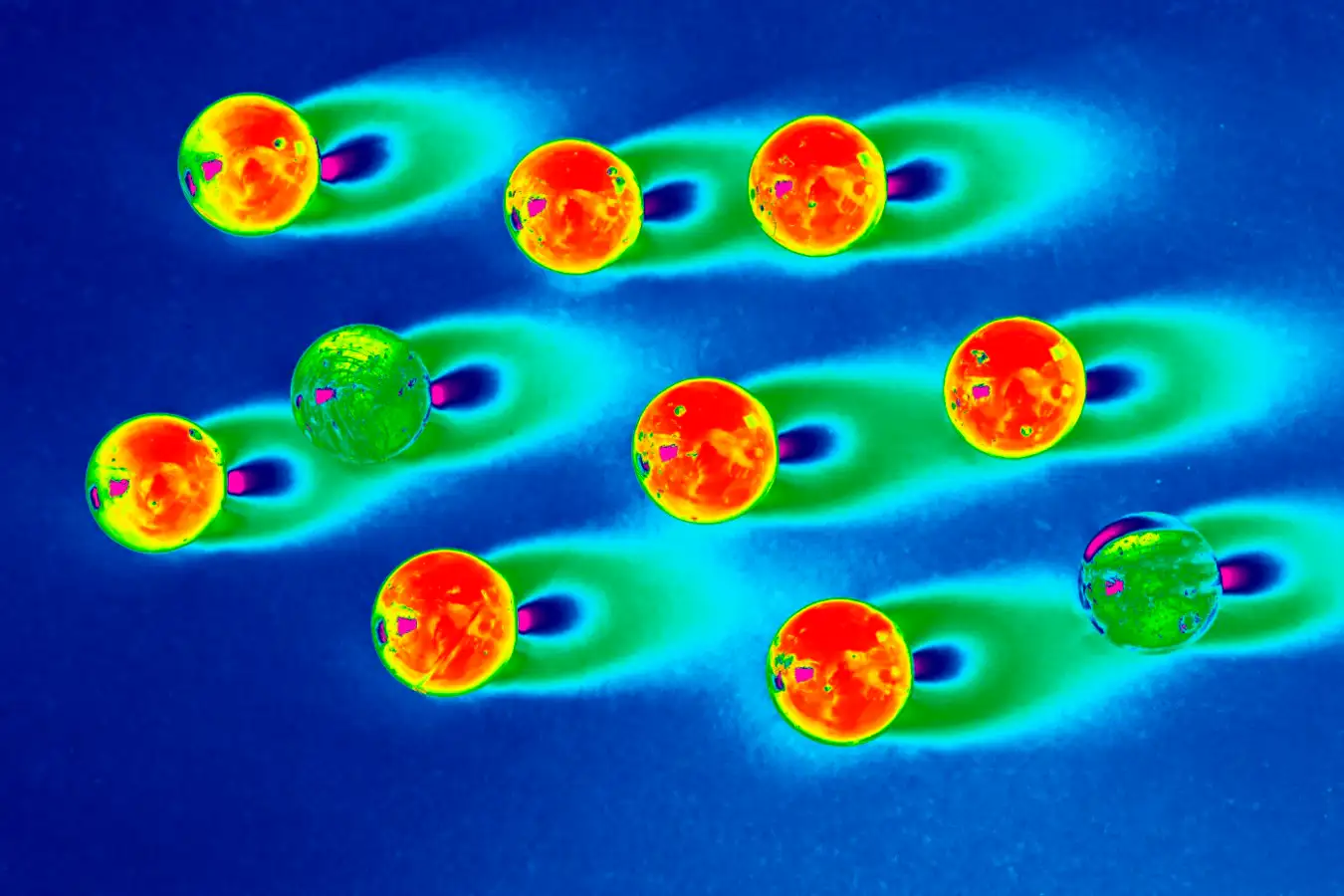

New insights emerge from comparing thermodynamics to marbles and their shadows.
Priscilla Zambot/Getty Images
The theory of thermodynamics has played a crucial role in understanding devices like engines for over 200 years, yet its mathematical foundation has often been seen as imprecise. Researchers are now grounding this renowned theory in more robust mathematical principles, leveraging geometry and quantum fields.
Among all physics domains, thermodynamics is particularly relevant to daily life, as its evolution was partly motivated by engineers aiming to enhance the efficiency of heat engines. These idealized devices mimic various technologies, such as car engines and refrigerators.
Despite its success, thermodynamics historically lacked mathematical rigor. Brian Roberts from the London School of Economics has initiated efforts to reconstruct the theory using innovative mathematical concepts rooted in geometry and quantum field theory, diverging from traditional pedagogical methods.
Roberts’ initiative centers on “gauge theory,” which examines properties of objects that are typically unobservable or unmanageable.
An illustrative example is a marble rolling on a surface. While the outer appearance may be identical, each marble conceals a unique internal color.
Gauge theory defines two mathematical spaces: an “observable” space representing the marbles’ movements, and an unobservable “bundle” space containing information about the internal colors of each marble.
These spaces are intricately linked, with the observable space acting as a shadow of the concealed bundle space. Roberts draws a parallel between this concept and the process of illuminating an object, suggesting that even when an object is hidden, its properties may still be inferred through its shadow.
This perspective offers a fresh lens for studying thermodynamics, recognizing that the theory encompasses both observable and hidden quantities.
“Thermodynamics operates on two levels,” he explains. “One level is easily accessible, enabling work extraction and manipulation, like pistons in an engine, while the other level is less accessible — the internal heat that fluctuates within the system and is not directly alterable.” He describes this internal heat as a hidden contributor to energy.
In conventional thermodynamics, this distinction is typically unrecognized. Both “work” and “heat” are regarded equally, their sum elucidating total energy changes. However, Roberts’ work pivots toward mapping thermodynamics within gauge theory’s framework by placing it in bundle space.
This approach allows leveraging prior validations in gauge theory from other physics areas to enrich our understanding of thermodynamics.
For instance, temperature and entropy—two core thermodynamic concepts—can be reformulated as specific projections from bundle space to observable space. Roberts asserts this provides a more geometric interpretation of entropy, facilitating applications to a variety of systems, including engines and black holes.
Moreover, gauge structures have been associated with experimental advancements in quantum electromagnetic fields. Roberts anticipates similar breakthroughs within thermodynamics, including preliminary experiments suggesting a thermodynamic variant of the Aharonov-Bohm effect, where charged particles yield evidence of a concealed magnetic field.
Roberts presented his findings at the Basics of Physics conference on June 16th in Irvine, California.
Lucas Cerelli, a professor at the Federal University of Goiás in Brazil, praises Roberts’ theory as a complementary approach that could enhance our understanding of thermodynamics within the quantum landscape.
Cerelli remarks that the clarity of thermodynamics diminishes when applied to quantum objects, citing numerous definitions of heat and work as a hurdle. He believes that integrating Roberts’ mathematical framework could yield a consistent and unique understanding.
Both he and his team are exploring gauge theory’s potential, successfully replicating key outcomes of standard quantum thermodynamics thus far.
One major challenge ahead for both quantum and classical thermodynamics lies in merging with Albert Einstein’s special theory of relativity, but Cerelli suggests that gauge mathematics might outperform traditional methodologies in this endeavor.
Topics:
Source: www.newscientist.com