


Key Takeaways
Moscow’s new obsession revolves around a war game focused on uncovering nuclear launch codes.
Officials in Russia stoke fears as they plan extensive nuclear preparedness drills.
“Attention! Attention!” a voice crackled through the loudspeaker. “A nuclear missile will be launched within the hour!”
Inside a mock Soviet-era nuclear bunker, players urgently compete to thwart an imagined nuclear strike on the United States.
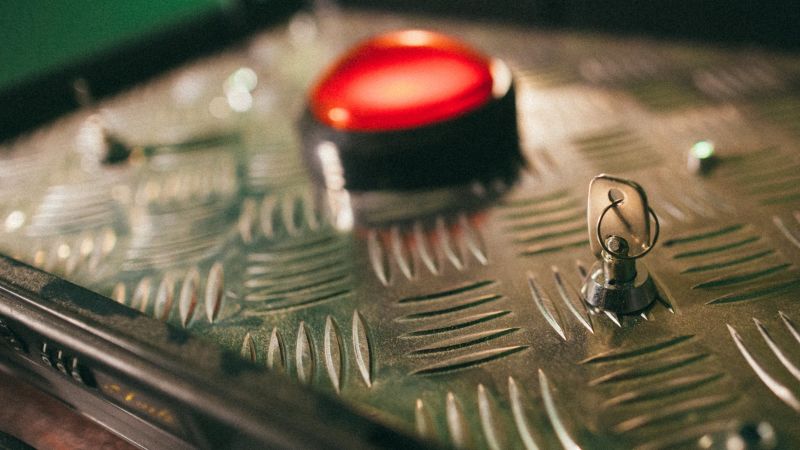
The goal of this game—recently gaining popularity in Moscow—is to locate the nuclear launch codes and disable a concealed red button that a crazed Russian general has already activated.
This is merely a simulated scenario, akin to other interactive games. It unfolds within a structure in the heart of Moscow’s past industrial zone, echoing the fears of the Cold War era.
Yet, given the current geopolitical tensions with Russia, where the prospect of a nuclear confrontation with the West looms large, I can’t help but feel a sense of unease.
Maxim Motin, a participant in the Red Button Quest, shared his worry: “The information coming from both sides is quite alarming.”
“I understand that regular individuals worldwide do not desire war,” he added.
Nonetheless, Russian authorities are gearing the nation up for potential conflict, stirring ongoing worries about a confrontation with the West, seen as their historic adversary from the Cold War.
State-run media in Russia showcases a vast training exercise, mobilizing as many as 40 million citizens. Officials assert it’s aimed at preparing for potential chemical or nuclear aggression.

Video footage showcases emergency personnel in hazmat suits and gas masks conducting the most extensive civil defense rehearsal since the Soviet Union’s dissolution, indicating the Kremlin’s desire for the populace to take the threat of conflict seriously.
Fortunately, the likelihood of a full-scale war between Russia and the West remains minimal.
Experts assert that the principle of mutually assured destruction (MAD) continues to deter aggression, much as it did throughout the Cold War.
However, with intensifying tensions concerning Syria, Ukraine, and the Baltic states, experts warn that the slight chance of miscommunication or misunderstandings between nuclear powers has become quite tangible.
“I believe the odds of a nuclear conflict are low,” states Fyodor Lukyanov, editor of the magazine Russia in World Affairs.
“Yet, when nuclear superpowers operate their military forces in close proximity, without proper coordination, unexpected incidents can occur,” he warned in an interview with CNN.
The Kremlin seems keen to amplify this risk narrative, as state media have increasingly addressed it in recent weeks.
On his flagship news program, Dmitry Kiseliev, the top broadcaster for state-run media and often referred to as the Kremlin’s propaganda chief, issued a grave warning that encounters between Russian and U.S. forces in Syria could escalate into a world war.
“Any aggressive act against Russia may bear nuclear implications,” he declared.
Additionally, the Ministry of Defense of Russia revealed information regarding their latest intercontinental ballistic missile set to strengthen their nuclear armament.
Known as Satan 2, this weapon is poised to become the most formidable weapon globally, ensuring Russia’s position as a leading nuclear force.
This apocalyptic threat adds a layer of reality to the fictional quests being undertaken by gamers in Moscow.
“I know that in Russian schools, we now teach children to view the United States as our primary adversary,” commented Alisa Sokoleva, another participant in the game.
“This idea seems ridiculous to me, and I firmly believe that war is not an option,” she concluded.

Russian gamers engage in a fictional Cold War scenario, racing against time to decode launch sequences and thwart the impending missile strike. Once again, the United States seems spared from this simulated Russian nuclear threat.
Let us hope the actual world can also navigate these turbulent waters and avert such destructive conflicts.
Source: www.cnn.com