


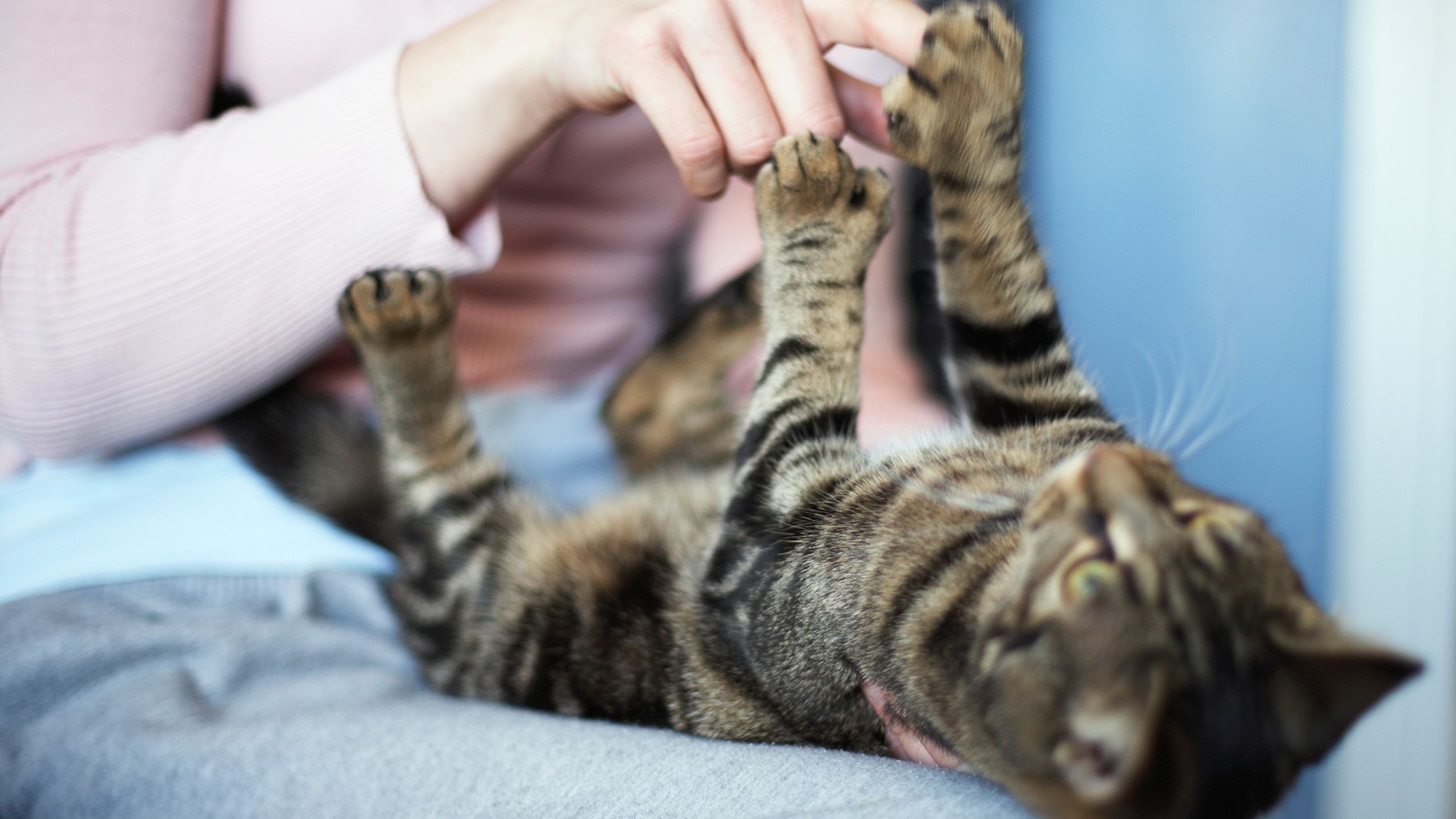
Most cats dislike having their bellies, paws or tails touched because these areas are vulnerable, essential for escape or unusually sensitive. Animal behavior experts say cats’ reactions may reflect their evolution as both predators and prey, although there is little formal research on the subject. Individual preferences vary, so owners should watch their cats’ body language and let the animals determine where they are comfortable being petted.
Dogs often roll onto their backs for belly rubs, but cats commonly respond differently. When a cat is uncomfortable with touch, it may look quickly at the person’s hand, turn its head, move away or struggle to escape, said Mikel Delgado, a cat behaviorist and senior research fellow at Purdue University.
“If these early warning signs are ignored, they can escalate to biting, hissing, and scratching,” Delgado told Live Science by email.
Why a cat’s belly is often off-limits
“Cats are both predators and prey, so they are very protective of areas that are particularly vulnerable during attacks, such as their abdomens,” said Sarah Ellis, head of cat mental health and behavior at the cat welfare charity International Cat Care.
A cat’s abdomen contains vital organs including the liver, stomach and intestines. Unlike the heart and lungs, which are protected by the rib cage, these organs have less bony protection. Cats do have a feature called a primitive pouch—a flap of loose skin and fat that provides some additional padding during a fight—but many still feel threatened when their bellies are rubbed.
Dogs have similar anatomy, but they generally face less risk from larger predators. Cats, by contrast, can be hunted by dogs, urban coyotes and birds such as hawks and owls, making it natural for them to protect their bellies.
Why cats may resist tail and paw touching
A cat’s tail is also vulnerable. “When cats are chased by other animals, including other cats, the tail is often the most sensitive part of the cat’s body, so there is a high risk of being bitten at the base of the tail,” Ellis said. As a result, a cat may be wary of having its tail stroked.
There are at least two possible explanations for cats’ dislike of paw rubbing. First, paws are essential during dangerous situations. Running away is a favored survival strategy for cats, Ellis explained, and they depend on their paws to escape. If escape is impossible, cats may swipe or scratch to repel a threat, so “they need to free their paws to do so.” For this reason, “they tend not to like having their feet restricted in any way,” she said.
Second, cats’ paws are highly sensitive. They have sensory hairs on their wrists, known as carpal trichomes, as well as sensitive toe pads. Cats can detect many types of stimuli, including pressure and heat, so “it’s no surprise that many cats are sensitive to having their paws touched,” Delgado said.
Where cats usually like to be petted
Many cats prefer being stroked at the base of the ears, around the cheeks and beneath the chin. These areas contain scent glands, Delgado explained, and cats often rub them against other cats. Cats may enjoy being petted there because “they treat us like any other cat,” he said.
There are exceptions. “A few of them enjoyed having their bellies rubbed,” Delgado said. Ellis added that some cats enjoy having their tails petted and show their pleasure “by pressing their tails against their owners’ hands and lifting their tails into the air.” The source describes this behavior as sometimes being called “elevator hitting.”
These varied preferences can seem puzzling to people, but they demonstrate that “each cat is unique,” Delgado said. A positive response to touching the belly, legs or tail may also indicate a close bond between a cat and its owner, Ellis said.
Her advice is to “always put your cat in charge, learn what each cat likes and dislikes, and respect those preferences.”
Topics: life’s little mysteries
Source: www.livescience.com