


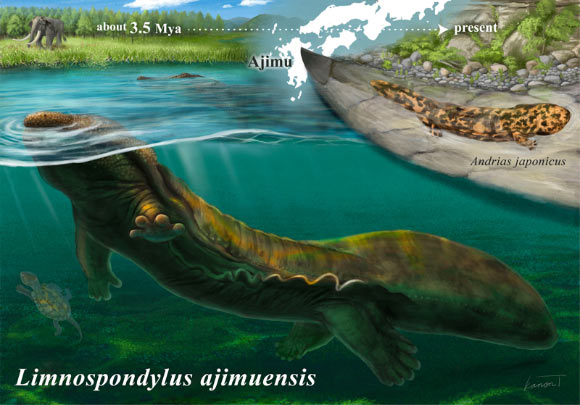
A newly identified genus and species of cryptobranchial salamander, which thrived in Japanese lakes around 3.5 million years ago, has been discovered from three fossil vertebrae. This significant find fills a crucial gap in the fossil record of one of the world’s oldest amphibian lineages.
The Cryptodactylidae family includes giant, fully aquatic salamanders found in the United States, Japan, and China. This family features the largest living amphibian, which can reach lengths of up to 1.8 meters (6 feet).
Currently, two extant genera are recognized: Andrias, which includes the Giant Salamander (Andrias japonicus) and four species from China; and Cryptobranchoides, represented by the Hellbender (Cryptobranchoides alleganiensis) found in eastern North America.
This family dates back over 60 million years, although its fossil record in East Asia remains limited.
The newly identified species, Limnospondylus azimuensis, inhabited a freshwater lake environment in what is now Japan during the Pliocene epoch, approximately 3.5 million years ago.
Estimated to have reached about 1.1 meters (3.6 feet) in length, the amphibian’s three vertebrae were collected from the Tsubusu River Formation on Kyushu Island, Japan, between 1995 and 1997.
Initially classified as a member of the modern giant salamander genus Andrias, further examination by Dr. Masahiro Noda and his team at Kyoto University revealed that these fossils belonged to an entirely new genus and species.
According to the researchers, “The Tsubusu Formation yields an incredibly rich collection of vertebrate and invertebrate fossils, forming the Ajimu fauna.”
“This site is unique in that it contains fossils of both giant salamanders and existing genera,” they added.
Paleontologists employed microcomputed tomography and geometric morphometric analysis to investigate the fossils, noting distinctive characteristics not found in previously known giant salamanders.
These fossils also provide vital insights into the ecosystem that once enveloped western Japan, which featured a vast freshwater lake surrounded by wetland forests.
Approximately 3.5 million years ago, the Ajimu region supported a diverse subtropical ecosystem, including crocodiles, turtles, rhinos, elephants, and various bird and fish species.
In contrast to contemporary giant salamanders, which inhabit fast-flowing rivers, Limnospondylus azimuensis primarily occupied lake environments, indicating that extinct members of this family may have thrived in broader habitats than their modern counterparts.
Researchers speculate that a cooling climate around 2.6 million years ago and diminishing freshwater habitats led to the extinction of these lake-dwelling salamanders, whereas Japan’s giant salamander had already adapted to river systems, giving it a survival advantage during environmental changes.
“Currently, Japan’s native giant salamanders face challenges like hybridization with non-native species and habitat destruction,” states Dr. Noda. “This study reinforces the necessity of preserving existing species for the future.”
The team’s research has been documented in a paper published in the online journal PeerJ.
_____
Masato Noda et al. 2026. A new genus of giant salamander from the Pliocene of Japan (Squamata, Epibranchidae). PeerJ 14: e21362; doi: 10.7717/peerj.21362
Source: www.sci.news