James Webb Space Telescope Reveals a Cosmic “Treasure Chest” Filled With Newborn Stars
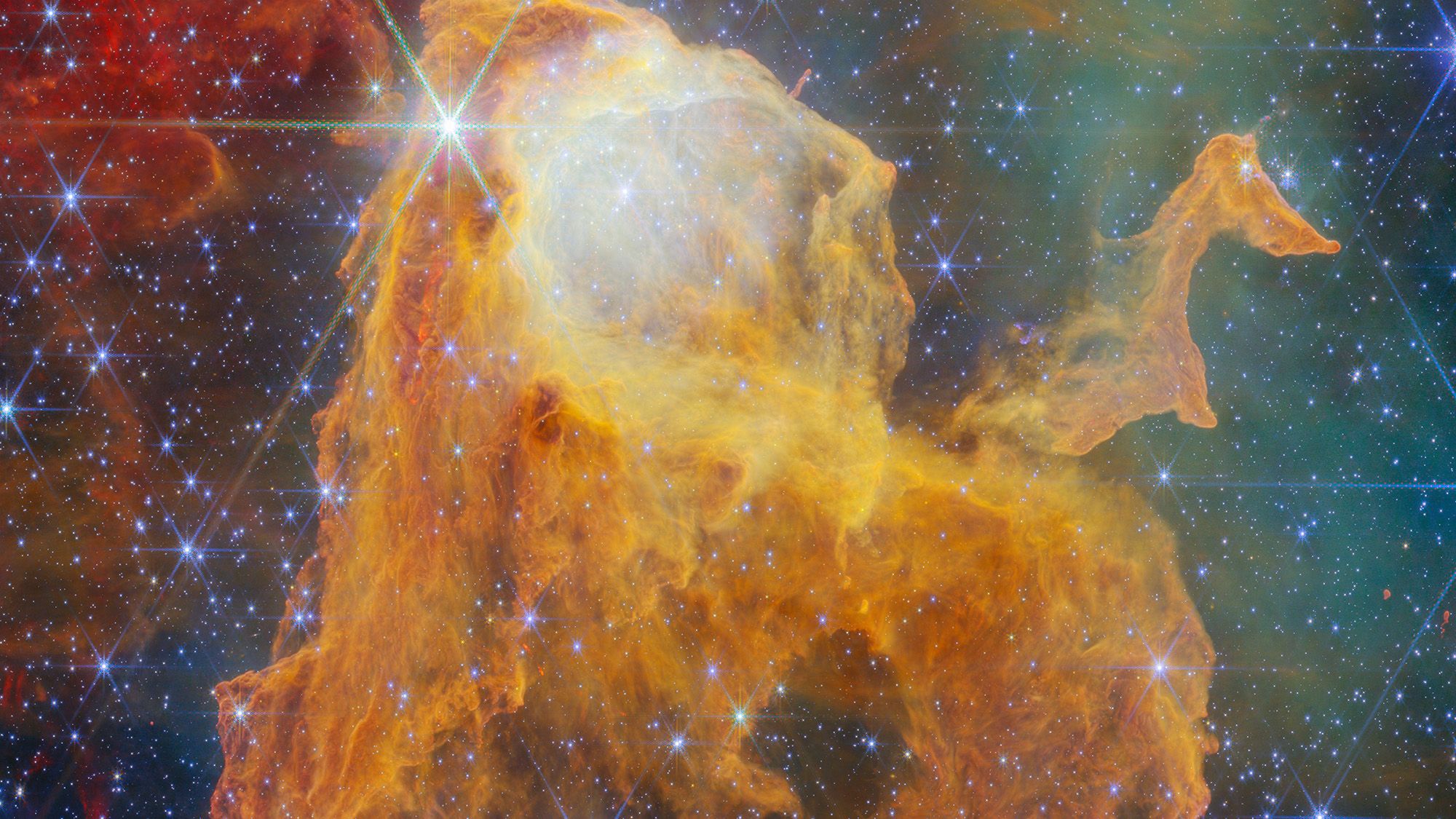
NASA’s James Webb Space Telescope captured the “Treasure Chest,” a cometary globule in the star-forming Carina Nebula, on August 6, 2026.
(Image credit: ESA/Webb, NASA & CSA, M. Reiter; acknowledgment: MH Özsaraç)
Quick facts
What is it: The “Treasure Chest,” a cometary globule containing a cluster of young stars.
Where is it: Approximately 7,500 light-years away in the constellation Carina.
When it was shared: August 21, 2026
A stellar treasure chest in the Carina Nebula
It resembles a giant treasure chest floating among the stars. Instead of gold and jewels, however, this remarkable cosmic structure contains a cluster of newborn suns. In a striking new image, the James Webb Space Telescope (JWST) has revealed the “Treasure Chest,” a glowing cloud of gas and dust located in the Carina Nebula, one of the Milky Way’s most active star-forming regions.
The Carina Nebula lies about 7,500 light-years from Earth in the southern constellation Carina. Stretching roughly 260 light-years across, it is home to some of the galaxy’s most massive stars and tens of thousands of young protostars. The region also contains the famous “Cosmic Cliffs,” featured in the James Webb Space Telescope’s first collection of scientific images released in 2022.
What is the Treasure Chest?
The Treasure Chest is a cometary globule—an isolated cloud of gas and dust with a dense, dark head and an extended tail. These structures are named for their resemblance to comets, although this object appears more like a wooden chest with its lid open and light shining from within.
Latest videos fromLive Science
JWST finds dozens of young stars inside the cloud
Using its near-infrared vision, JWST detected the source of the Treasure Chest’s glow: a compact cluster of approximately 70 young stars hidden within the surrounding dust. The group includes rare O-type stars, which are extremely massive, luminous and short-lived. One of the stars is estimated to be about 19 times more massive than the sun.
Astronomers estimate that the stellar cluster is around 1.3 million years old. Many of its stars remain wrapped in the gas and dust from which they formed. As the stars mature, their radiation and powerful stellar winds will gradually clear away this material, revealing more of the cluster’s hidden members.
How massive stars sculpt the cosmic structure
The Treasure Chest’s distinctive shape is being influenced by powerful stars nearby. Roughly 39 light-years away in the sky is Eta Carinae, one of the brightest and most famous objects in the Carina Nebula. Eta Carinae underwent a dramatic eruption in the 19th century, briefly making it one of the brightest stars in the night sky. The system contains at least two stars, including one estimated to be about 100 times more massive and 5 million times more luminous than the sun. Along with the nearby Trumpler 16 star cluster, Eta Carinae’s intense radiation and stellar winds help remove less-dense gas from the cometary globule and shape its unusual appearance.
The Treasure Chest will not remain unchanged forever. Radiation from the young stars inside the cloud, combined with the effects of nearby massive stars, will gradually erode its remaining gas and dust. Eventually, the cosmic chest will fade away, leaving the young stars that formed within it exposed—like jewels finally revealed after the box disappears.
Get the world’s most fascinating discoveries delivered straight to your inbox.