


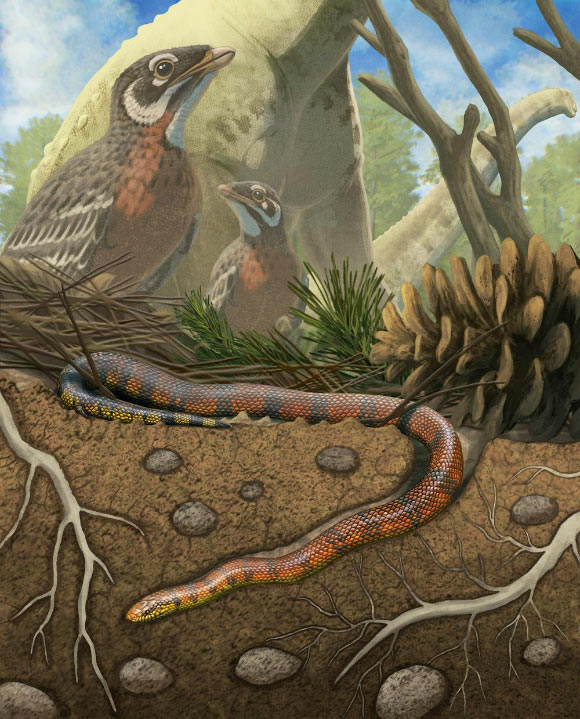
A groundbreaking discovery by paleontologists in Brazil has revealed an exceptionally well-preserved snake fossil, reshaping our understanding of how early snakes lived. This finding complicates the longstanding debate regarding whether their ancestors burrowed, swam, or crawled.
According to Dr. Roy Ebell, co-author and researcher at Museums Victoria Research Institute, “Snakes are essentially highly modified lizards.”
He explained that during the Dinosaur Era, one lineage of lizards evolved to lose their limbs and elongate their bodies, raising the critical question: Why?
For over a century, several theories have emerged:
- Early snakes colonized water bodies with elongated, limbless bodies adapted for swimming, akin to eels.
- Some lived on the surface amidst vegetation, where reduced limbs aided in movement.
- Another theory posits that they adapted to a burrowing lifestyle, much like modern blind snakes.
However, concrete evidence has been limited, with fewer than ten early snake skeletons identified.
In their study, Dr. Ebell and his team analyzed the highly preserved skull and post-skull remains of a newly discovered species, Tametaramirimu, which inhabited what is now Brazil during the Late Cretaceous, approximately 85 to 75 million years ago.
Unearthed in 2020 near Presidente Prudente, São Paulo, this specimen represents the first articulated snake fossil found in Brazil and one of the few three-dimensionally preserved Mesozoic snake fossils globally.
What sets Tametaramirimu apart is the remarkable detail preserved in its skull.
Paleontologists employed high-resolution CT scans to reconstruct the animal’s brain, cranial nerves, and inner ear, providing the most comprehensive view of an early snake’s brain anatomy to date.
These reconstructions reveal a brain shape distinct from other early snakes and contemporary species, indicating greater changes in brain structure and sensory capabilities throughout snake evolution than previously understood.
Combining data from brain analysis with fossil bone microstructure revealed insights into Tametaramirimu‘s lifestyle, pointing towards a burrowing habit.
Dr. Ebell noted, “Burrowing animals develop denser, thicker bone in their skull roofs to withstand the stress of digging.”
Tametaramirimu exhibits this specific combination of characteristics, highlighting its specialization as a burrowing reptile, unlike many snakes that pursue different lifestyles.
The skull roof wasn’t the only point of interest; the digital reconstruction of its brain cavity confirmed similarities to living burrowing species.
The reduced visual center and simplified forebrain structure further supported its underground lifestyle.
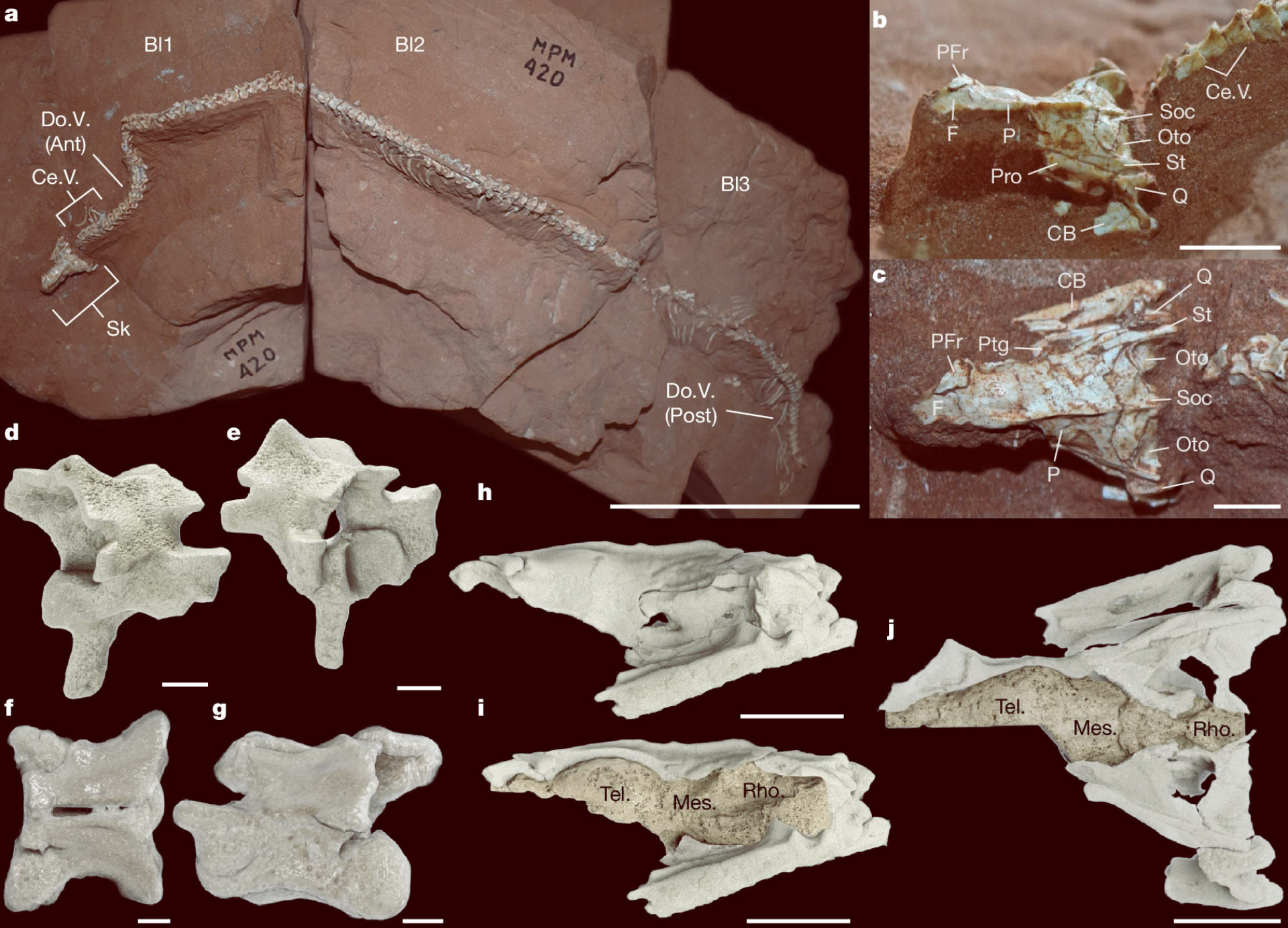
Holotype of Tametaramirim. Image credit: Simões et al., doi: 10.1038/s41586-026-10809-9.
The research contrasts sharply with studies of Dinilisia patagonica, an Argentinian stalked snake that appears to have been a surface dweller. Together, these fossils suggest that early snake lineages exhibited ecological diversity rather than evolving from a single sedentary ancestor.
This indicates a complex evolutionary history with branches adapting to burrowing, terrestrial, and even aquatic environments, leading to the diversity of over 4,200 extant snake species.
“The two earliest snakes we studied exhibited brain differences greater than many modern snake lineages,” Dr. Ebell stated, highlighting their unique adaptations to different habitats.
The findings contribute to the understanding of how lizard-like ancestors transitioned to the elongated, limbless forms seen in today’s snake species, adding to the growing catalog of well-preserved Cretaceous snake fossils that researchers utilize to unravel this significant evolutionary puzzle.
Their study was published in the Journal Nature on July 22, 2026.
_____
TR Simones et al. Extraordinary brain and ecological diversity in early snakes. Nature published online on July 22, 2025. doi: 10.1038/s41586-026-10809-9
Source: www.sci.news