


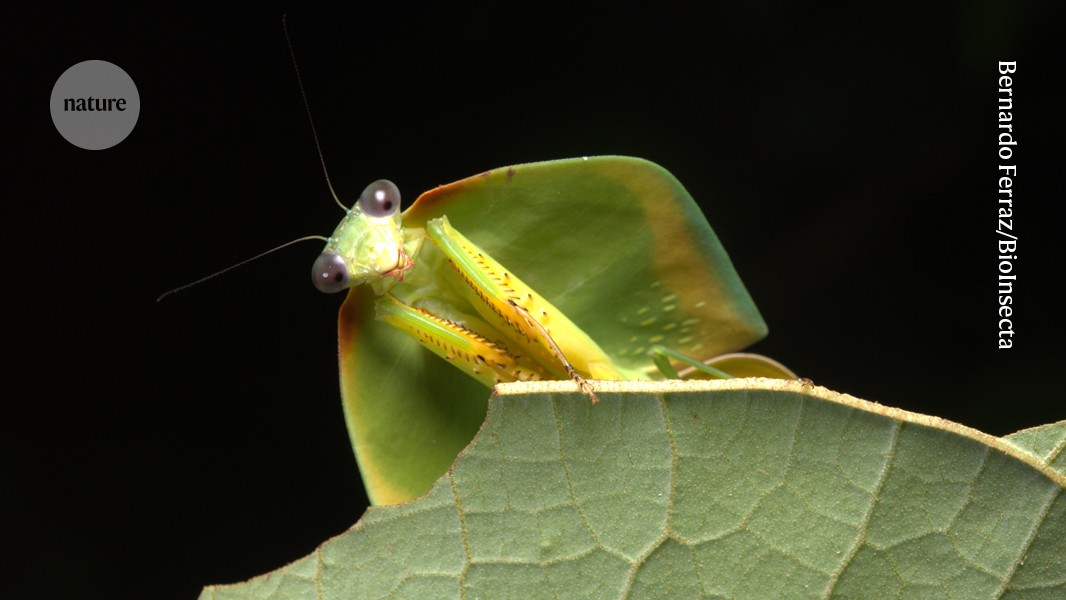
A juvenile female of the mantid species Choeradodis rhomboidea was collected during a major effort to document insect biodiversity in the Amazon rainforest.
Credit: Bernardo Ferraz/BioInsecta
The Amazon rainforest is home to an extraordinary hidden world of insects, most of which remain unknown to science. Now, hundreds of Brazilian scientists are working together to document every insect species in a single region of the Amazon — in what could become the largest insect-biodiversity survey ever conducted from the forest floor to the canopy.
Early findings indicate that the site could contain more than 40,000 insect species. That number represents almost 0.7% of the widely accepted estimate of 6 million living insect species worldwide — and it comes from just one Amazonian location. “If we start sampling other parts of the forest, the number of new species will likely increase almost exponentially,” says José Rafael, an entomologist at the National Institute for Amazonian Research (INPA) in Manaus, Brazil, and one of the project’s scientific leaders.

Unpicking the rhythms of the Amazon rainforest
The project stands out because it is sampling insects high above the ground, including forest layers that have received little scientific attention, says Rudolf Meier, an entomologist at the Museum of Natural History in Berlin. The study is also among the largest insect surveys to use DNA barcoding. This technique identifies species using a short section of DNA, allowing researchers to analyze genetic material from thousands of specimens efficiently.
An overview of the Amazon insect survey was presented in a video poster during the online programme of the annual meeting of the Brazilian Society for the Advancement of Science in Niterói last week.
Vertical insect traps survey the Amazon rainforest
To capture insects across different rainforest habitats, scientists have installed three arrays of traps. Each array contains five mesh traps arranged vertically: one on the forest floor, one suspended approximately 30 metres above the ground — about the height of a 10-storey building — and three positioned between them. Flying insects enter the traps and are directed into collecting bottles, where ethanol preserves their bodies and DNA for laboratory analysis.

Researchers are using five-level trap systems to document insects from the Amazon forest floor to the treetops.
Credit: Larissa Queiroz/BioInsecta
The vertical trap systems cover a 10,000-hectare area of the central Amazon in northern Brazil and have operated continuously for 14 months. To find species that might evade standard traps, the team also held an insect-collecting “blitz” last November using approximately 50 additional collection techniques. These included rotting meat to attract carrion-feeding flies and beetles, along with light traps for sampling nocturnal insects.
The campaign produced 5.5 million insect specimens. Researchers plan to sequence sections of DNA from around 600,000 of them. A network of nearly 400 taxonomists will combine DNA barcoding with detailed studies of physical characteristics to identify the insects and formally describe and name any species new to science.
“Coming up with names for all of the new species is going to be a lot of work,” says Dalton Amorim, an entomologist at the University of São Paulo in Ribeirão Preto and one of the project’s leaders. Scientists could draw on words from Amazonian Indigenous languages, as well as the names of local rivers and important regional historical figures, he says.

Female Choeroparnops katydids collected during the Amazon insect-biodiversity survey.
Credit: Larissa Queiroz/BioInsecta
Source: www.nature.com