


AI Drone Beats World Champion Pilots in Autonomous Race at 63 mph
An artificial intelligence (AI)-powered drone has completed a championship race course faster than some of the world’s best human drone pilots.
In a study published Oct. 14 in Science Robotics, researchers described an autonomous quadcopter that can fly through a demanding course at speeds above 60 mph (100 km/h) using only a single forward-facing camera, an inertial measurement unit and a small onboard computer.
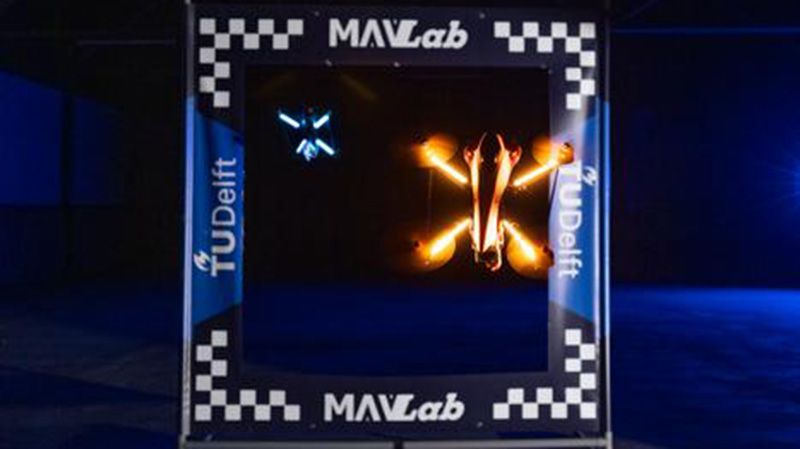
Called MonoRace, the system won the 2025 Abu Dhabi Autonomous Racing League drone-racing competition. It outperformed every other autonomous team and recorded a faster time than three former human world champion drone pilots.
MonoRace achieved this without GPS, external motion-capture systems, stereo cameras or preloaded course maps. Researchers at the Micro Air Vehicle Laboratory at Delft University of Technology in the Netherlands developed the system as an autonomous, in-flight AI model.
The name “MonoRace” refers to its monocular vision system. The drone uses a single rolling-shutter camera to see the course and an internal measurement unit (IMU) to track acceleration and rotation.
How MonoRace flies at 63 mph
The drone’s limited sensor package feeds information to neural networks, machine-learning models that identify patterns in data. The system detects racing gates, estimates the drone’s position and movement, and generates commands for its motors.
Those commands are sent through the flight controller to the drone’s four propellers 500 times per second.
The complete system fits on a drone weighing just 966 grams (2.13 pounds) and measuring approximately 11.8 by 11 by 3.9 inches (30 by 28 by 10 centimeters). Its compact size, low weight and computational efficiency allowed the researchers to mount and operate all of the hardware onboard.
During the Abu Dhabi competition, MonoRace completed two laps through 11 gates in 16.56 seconds and reached a top speed of approximately 63 mph (102 km/h).
A recently released video shows the drone’s development and competition performance, including real flight footage of it banking sharply, accelerating through gates and navigating the course without human assistance.
Some sequences in the video are computer-generated. Study co-author Guido de Croon, a professor at Delft University of Technology, said the visual effects were intentional. The only fully simulated image appears at approximately the two-minute mark and shows the training process.
“We show the gate here in a visual simulator for the video, but the actual training was done in a stripped-down pure physics simulator that runs very fast,” de Croon told Live Science in an email. “Simulation of vision was not performed during training, as the control neural network receives as input estimated states resulting from different perceptual and state estimation processes.”
The rest of the footage is real, although some shots include overlays showing how the drone interprets camera data. Convolutional neural networks segment the white racing gates, which may appear red in the video. A small circle marks the detected gate corner, a red line shows the gate’s edge and a blue overlay indicates where the drone expects to find the next gate.
How the AI learned to race
Scientists trained MonoRace using reinforcement learning, a machine-learning technique in which an agent repeatedly attempts a task and receives feedback based on its success or failure.
“Reinforcement learning was performed in simulation because it requires a lot of trial and error, including millions of trials,” de Croon said. “It’s actually learning to fly from scratch.”
The neural network learned to translate the drone’s position, speed and direction on the track directly into motor commands. Early training focused on basic tasks such as avoiding collisions and reaching the first gate. As training progressed, the system learned to travel farther through the course and fly faster.
The researchers did not train the AI on only one aircraft. They varied factors including weight, voltage, drag, sensor noise and propeller health, helping the model cope with real-world differences and imperfections.
“This will allow a trained network to control a variety of drones,” de Croon said.
Could AI drone racing help humans?
MonoRace could eventually become a training tool for human drone pilots, “similar to how powerful chess programs inspired human gameplay,” de Croon said.
The system also demonstrates advances in physics AI—the ability of robots to perceive, decide and act at high speed despite limited sensing and computing power.
Because the control network runs on microcontroller-class chips, advanced autonomous control does not require a large computer. De Croon noted that similarly sized networks could be optimized to reduce energy use rather than minimize lap times.
Energy-efficient neural control could ultimately lower power consumption in everyday robots, many of which rely on small processors and traditional controllers.
Study details
Bahnam, S.A., Ferede, R., Blaha, T.M., Lang, A.E., Lucassen, E., Missinne, Q., Verraest, A.E.C., De Wagter, C. and De Croon, G.C.H.E. (2026). “MonoRace: Robust monocular AI for champion-level drone racing.” Science Robotics, 11(119).
Source: www.livescience.com