


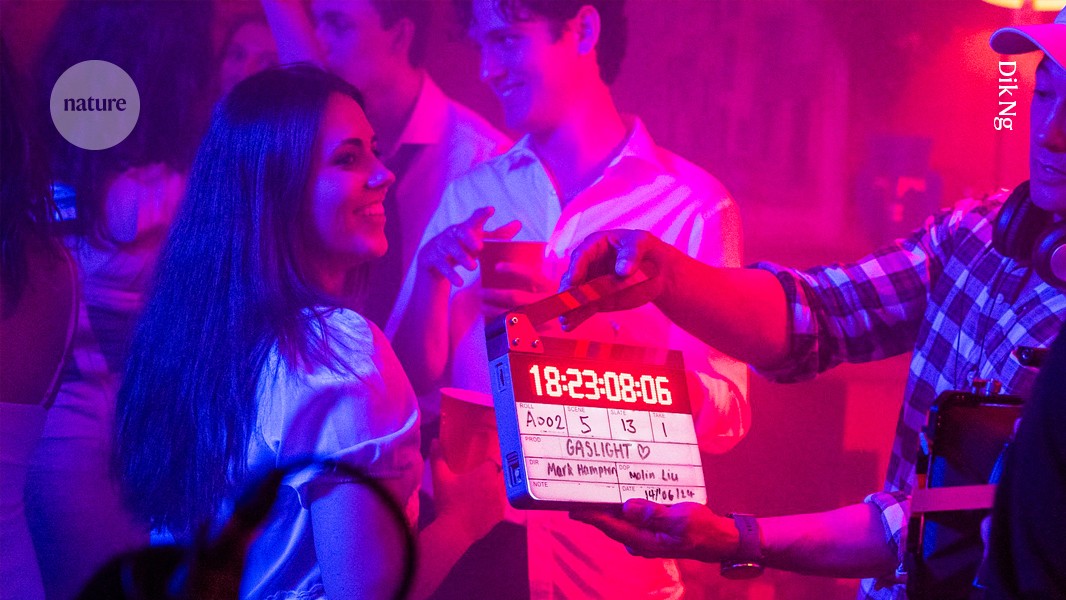
Shaira Berg smiles during a take for her short film, Gaslight.
Credit: Dik Ng
Shaira Berg is developing a career at the intersection of neuroscience, psychology and creative storytelling. During her PhD in behavioural neuroscience at the University of Cambridge, UK, Berg partnered with the local video-game studio Ninja Theory to investigate how threat influences goal-directed learning and maladaptive habit formation in obsessive–compulsive disorder (OCD) using virtual reality (VR).
Berg is also open about the way personal experience has influenced her scientific career. After surviving a traumatic event during her doctoral studies, she began questioning whether established research methods could fully capture how trauma affects the brain. Instead of separating her lived experience from her academic work, Berg explored how scientific research and creative expression could work together.
Alongside her studies, Berg wrote and starred in Gaslight, a play inspired by her experience. The production was nominated for an award before being adapted into a short film. It is now being developed as a feature film, allowing Berg to explore how film and theatre can communicate psychological experiences that scientific data alone may not fully convey.
Now a postdoctoral researcher at the University of Texas at Austin, Berg continues to use immersive technologies to study trauma and post-traumatic stress disorder (PTSD). Here, she explains to Nature how creativity can strengthen scientific research and what researchers can learn from taking unconventional career paths.
How do you describe your work across behavioural neuroscience, virtual reality, theatre and film?
I describe myself as a cinematic neuroscientist. My tagline is that I completed a PhD in collaboration with a game studio specializing in immersive horror, where I studied maladaptive behaviour.
I used a behavioural test called Pavlovian-instrumental transfer to examine how environmental cues associated with rewards or threats can influence later behaviour. For example, if someone learns that a blue symbol predicts a reward, seeing that colour during another task may trigger a positive response, such as moving faster or putting in more effort.
For my research, I created custom VR scenarios that allowed us to study how learned cues influence behaviour in realistic virtual environments. We published the results this year in Frontiers in Behavioral Neuroscience1. The study showed that immersion strengthened the more habitual form of this behavioural effect, while the goal-directed response remained stable across different levels of immersion.
This finding is particularly relevant to OCD, in which habitual responses can override goal-directed behaviour. My current research extends this work to fear conditioning and PTSD. I continue to combine neuroscience and filmmaking through a collaboration with a film studio.
Everything I write or direct has a foundation in neuroscience. Creative work gives me a way to examine human behaviour honestly and portray it with accuracy and sensitivity. Conditions such as PTSD and OCD are often represented in ways that do not reflect what they actually feel like. I wanted to address both the scientific and human sides of these conditions.
How did neuroscience influence the way you processed your own trauma?
Lived experience can be extremely important in neuroscience. Many researchers who study a particular condition have a personal connection to it. Neuroscience appealed to me because it offered a way to understand my own brain more deeply. Studying trauma in detail helped me process my experiences while contributing to research that could eventually support treatments for others.
Clinical language can become difficult for people outside the field to understand, particularly at the PhD level. That communication gap was one reason I wrote Gaslight. I wanted audiences to experience, even vicariously, what it can mean to live through trauma. Art offered a way to communicate the human experience behind the science.
What can theatre and film communicate that a research paper cannot?
A research paper can describe a psychological condition, whereas a play or film can place an audience inside that experience. The overall structure is not entirely different: a paper has a beginning, middle and end, and so does a play. The difference is perspective. Creative writing allows me to work from the viewpoint of the person living through the experience.
I have acted on stage and in film since I was 12. What has always fascinated me about acting is the opportunity to experience emotions I may not have felt myself and portray them truthfully. It creates a more human connection than writing in a strictly scientific context.

Everything she writes or directs is grounded in neuroscience, says Shaira Berg.
Credit: Courtesy of Shaira Berg
How has creating Gaslight influenced your neuroscience research?
It has influenced my research considerably. During my PhD and in my current work, I have created fictional scenes to simulate threat-related behaviour. These scenes provide an effective way to generate experimental data without triggering symptoms or distressing participants.
Immersive VR environments can elicit behaviours that are difficult to observe using conventional laboratory tasks. We found that responses were more measurable under immersive conditions1.
Source: www.nature.com