


Ancient Scandinavian Bones Reveal Violence Hidden in Homes, Wells and Gardens
Archaeologists have found evidence that men, women and children suffered violence in Iron Age and Viking Age Scandinavia—and that some victims were buried in unusually intimate places, including pits, wells, houses and family gardens.
During the Scandinavian Iron Age and Viking Age, spanning approximately 500 B.C. to A.D. 1050, violent encounters between individuals and communities increased. Archaeological evidence has traditionally focused on elite warriors’ burials and mass graves linked to battles. A new study offers a different perspective by examining people buried within settlements.
Evidence of violence in ancient Scandinavian communities
Researchers analyzed 192 human bones from people buried in settlements across modern-day Denmark, Norway and Sweden. The remains came from places that were not conventional cemeteries, including postholes, pits, floors, wells, houses, gardens and banquet halls.
At least 12 people suffered severe trauma shortly before death. Half had head injuries, while four had multiple injuries. Most of the victims were adult men, but the sample also included two women and a child.
“In reality, not all remains ended up in the monumental burial mounds of the Iron Age and Viking Age, or even in the more humble urns and graveyards,” the researchers wrote in a study published in the Journal of Archaeological Method and Theory on September 28.
A child’s skull was placed on a house floor
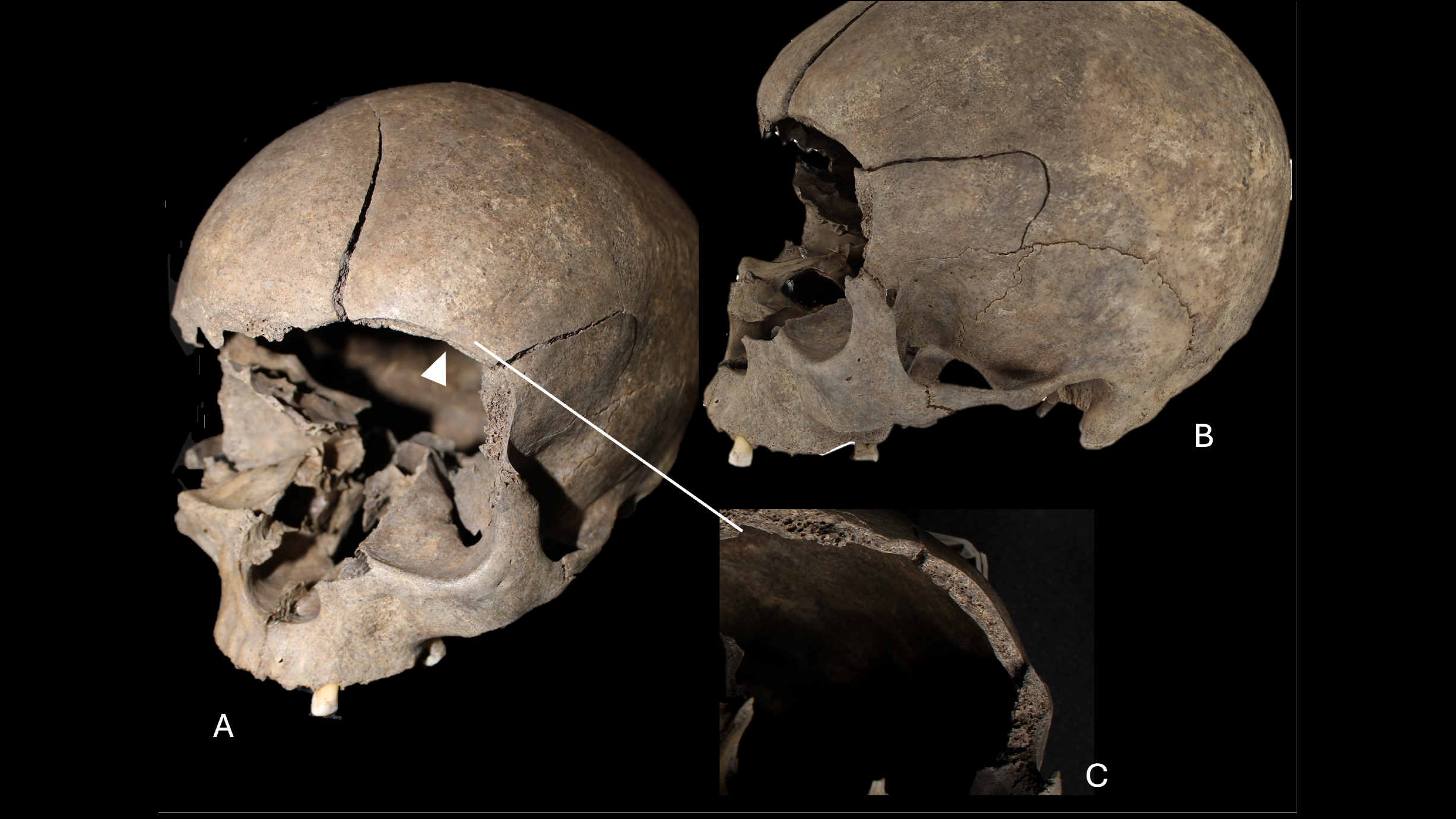
In an Iron Age house in Denmark built between 500 B.C. and 1 B.C., archaeologists discovered the frontal bone of a child who died between the ages of 2 and 4.
Skull of a 2- to 4-year-old child from Aalborg, viewed from different angles and showing cuts from a sword. The skull was later placed on the floor of a house.
Image source: National Museum of Denmark
DNA analysis revealed that the person cut with a sword was a small boy, according to lead author Marianne Hem Eriksen, an archaeologist at the National Museum of Denmark.
“The child’s skull was placed on the floor of a house where people continued to live,” Eriksen said in a translated statement. “This means someone was walking over the child’s skull day in and day out.”
Radiocarbon dating indicated that the child’s skull was about two centuries older than the house itself. This suggests the bones may have been stored for some time before being placed on the floor.
A woman’s skull was found in a Viking Age well
At a Viking Age site dating from approximately A.D. 750 to 1050, archaeologists found the skull of a young woman in a well near a cluster of four small houses.
The skull showed traces of a blow. The woman may have been struck with a sword or an axe, and her bones may also have been kept for a considerable period before being buried in the well, Eriksen said.
“This glimpse into past life shows how different people had interesting ideas about life and death,” she said.
Violence at the site associated with Beowulf
At the Viking-era ruins of Gammel Lejre, a royal banquet hall that many experts believe inspired the Old English epic Beowulf, archaeologists discovered the skeleton of a man with numerous blunt-force injuries.
Some of the injuries had healed, indicating that he had survived earlier trauma. His skeleton was found just south of the banquet hall.
Why were the victims buried in unusual places?
The researchers cannot yet determine exactly why these people were victims of violence or why their remains were placed in such unusual locations. One possibility is that they died during violent encounters within the home rather than in warfare.
The deaths may also have resulted from socially accepted corporal punishment or another form of aggression within the community. As social inequality and violence widened during the Iron Age and Viking Age, the researchers suspect that people from unstable communities may have been particularly vulnerable.
Studying these remains “opens up a whole new understanding of Iron Age societies, the occurrence of violence, and the treatment of the dead,” Eriksen said. The findings suggest that everyday life and beliefs during this period were more complex than is often assumed.
“Not all lives were mourned and commemorated in the same way during the Scandinavian Iron Age and Viking Ages,” the researchers wrote. “One might wonder if some lives were already considered disposable.”
Find out how much you know about the ancient Norse people: Take the Viking quiz.
Source: www.livescience.com