


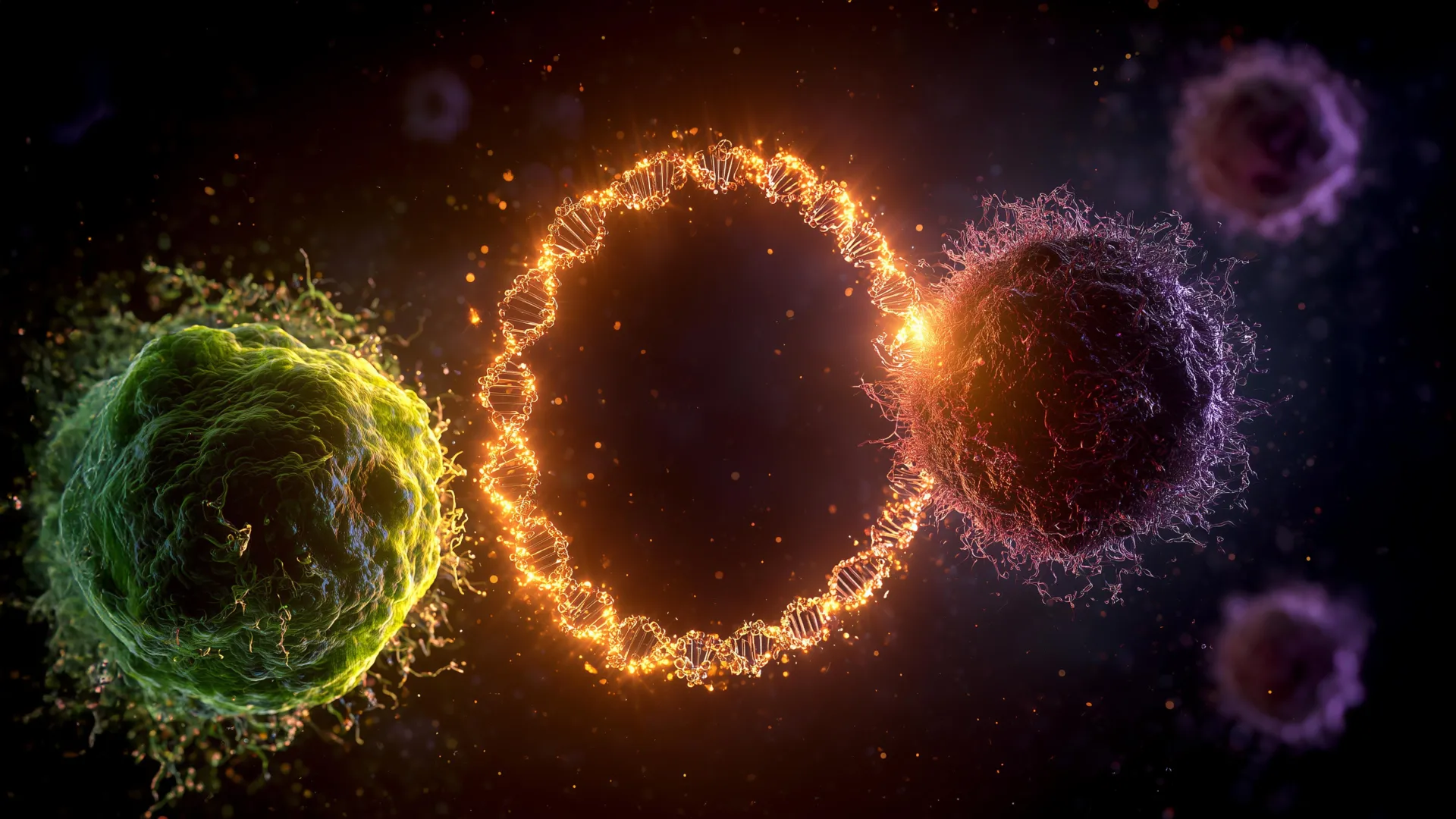
Jumping genes are genetic parasites found in bacteria, plants, animals, and humans. Also called mobile genetic elements, they can exist as small RNA molecules and use specialized mechanisms to insert themselves into new positions within a genome. These genetic movements may give cells new traits, making jumping genes an important driver of evolution and genetic diversity.
Some jumping genes can remove themselves from RNA with the help of an RNA-based enzyme. Known as ribozymes or self-splicing introns, these elements represent a unique class of mobile genes capable of moving between genetic locations.
Moving within a single cell is relatively straightforward. Transferring genetic material to another cell—or even to a different species—is much more challenging. Genetic family-tree analyses show that these transfers have occurred, but scientists have generally believed that jumping genes moved between organisms as passengers inside plasmids or viruses.
Jens Harder and his colleagues have now observed an unexpected process that suggests another possible pathway for horizontal gene transfer.
A Methane-Producing Microbial Community
The researchers studied a slow-growing microbial enrichment containing bacteria and archaea that produce methane, also known as biogas. The community was dominated by an unusually small predatory bacterium.
Candidatus Velamenicoccus archaeovorus feeds on microorganisms that convert limonene—the compound responsible for the scent of oranges—into methane and carbon dioxide. Inside filaments of Methanothrix soehngenii, one of the world’s most important methane-producing microorganisms, the researchers observed that individual cells had died.
They suspected that Ca. Velamenicoccus archaeovorus was responsible. To test this theory, the team searched for molecules from the predator inside the dead prey cells.
Searching for a Mobile Intron
While analyzing the genome of Ca. Velamenicoccus archaeovorus, Jens Harder identified an intron that functions as a jumping gene. Because intron RNA had never previously been detected outside a cell, the researchers were especially interested in determining whether it could be found inside the bacterium’s prey.
Scientists at the Max Planck Institute for Marine Microbiology had developed highly sensitive techniques for detecting tiny amounts of RNA inside bacterial cells. Using specially designed nucleic acid probes, the team created microscopic images that revealed intron RNA in living cells of Ca. Velamenicoccus archaeovorus and in dead cells of Methanothrix soehngenii.
The researchers had effectively captured the intron during an attempted replication event. However, Ca. Velamenicoccus archaeovorus had already killed the new host cell. As a result, the gene transfer ended with the intron entering an empty cell.
Why the RNA Survived
Ribonucleic acid, or RNA, acts as a messenger inside living cells. These long-chain molecules carry genetic instructions from DNA to the cell’s protein-making machinery. RNA is normally degraded rapidly, beginning at its exposed ends.
As a result, dead cells typically contain little or no intact RNA.
The intron RNA survived because it formed a circular molecule without exposed ends. This ring-shaped structure protected it from enzymes that would normally break the RNA apart.
“The stability of intron RNA in its ring form is a distinctive feature. In humans, circular RNA molecules influence many metabolic processes, and their role in tumor development is currently the subject of intensive research. Applications in RNA vaccines, including vaccines against COVID-19 and certain forms of cancer, are also being developed. Our study shows that, in microorganisms, jumping genes can be transferred to other species through circular RNA,” says Jens Harder.
Source: www.sciencedaily.com