


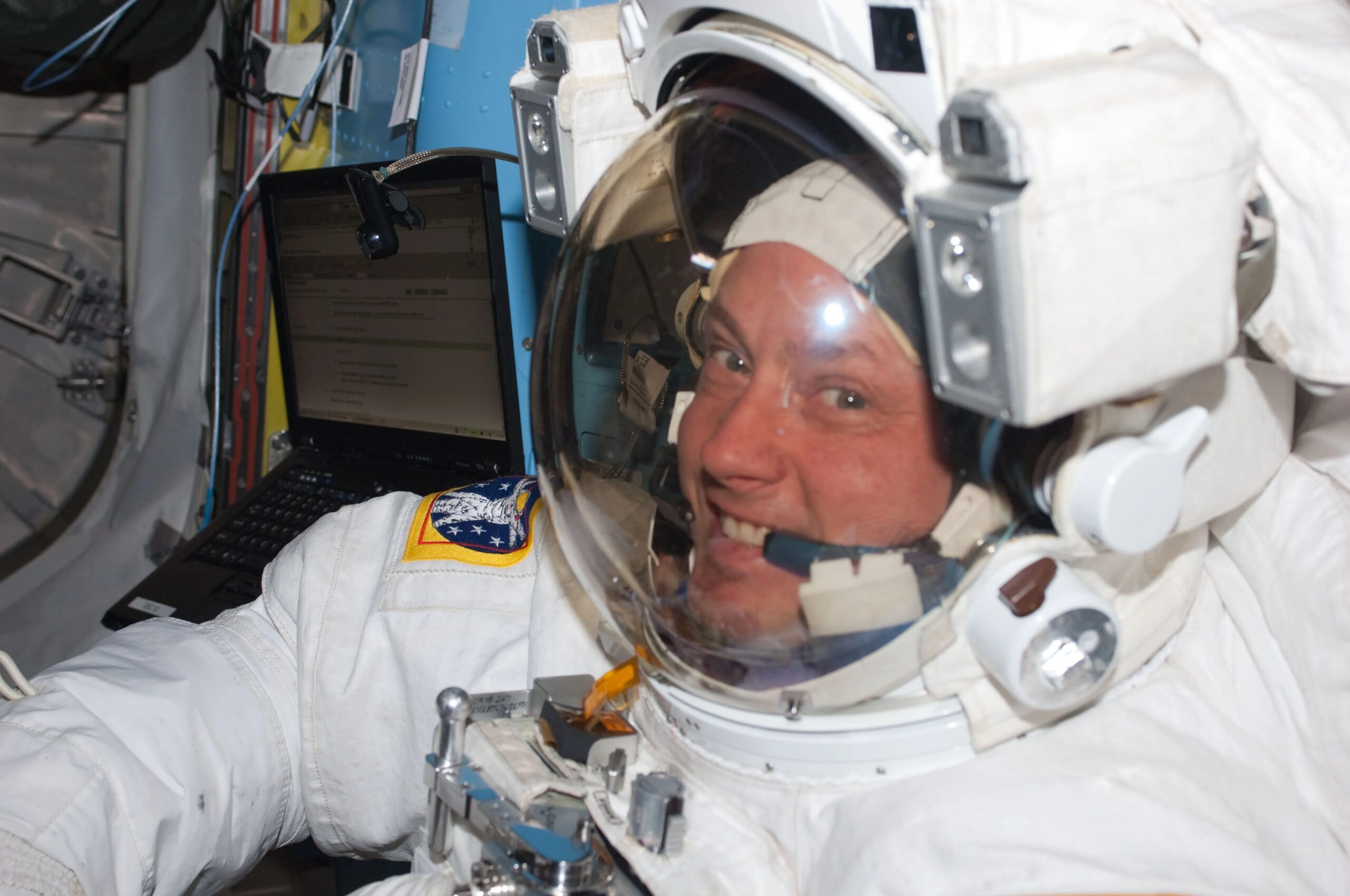
NASA astronaut Mike Finke will retire from NASA on Wednesday after an extraordinary 30-year career in human spaceflight. During his service, Finke completed four missions supporting the International Space Station, spent 549 days in orbit, and performed nine spacewalks.
“Few people have had the opportunity to shape NASA history like Mike Finke,” said NASA Administrator Jared Isaacman. “Throughout his remarkable career, Mike served our country as a pilot, engineer, astronaut, and leader. From long-duration missions aboard the International Space Station to preparing the next generation of Artemis explorers, his contributions have helped position NASA for the future. NASA’s achievements today are possible because of people like Mike, who dedicated their careers to advancing human spaceflight and inspiring the next generation. I congratulate Mike on an incredible career and thank him for his decades of service to NASA, our country, and the many people who learned from and flew alongside him.”
Finke ranks fourth among NASA astronauts for total time spent in space. He also completed 48 hours and 37 minutes of spacewalks. Most recently, he piloted NASA’s SpaceX Crew-11 mission, which launched in August 2025 and returned to Earth in January. During the mission, he served as flight engineer for Expedition 73 and commander of Expedition 74 aboard the International Space Station.
Finke joined NASA’s 16th astronaut class in 1996 and made his first spaceflight in 2004 aboard Soyuz TMA-4 as part of the International Space Station’s Expedition 9 crew. He served as a science officer and aeronautical engineer, helped maintain station systems, and completed four spacewalks. In 2008, he returned to space as commander of Expedition 18 aboard Soyuz TMA-13. That mission helped prepare the space station for its transition to a six-person crew and included two additional spacewalks.
In 2011, Finke flew aboard STS-134, the final mission of Space Shuttle Endeavour. As a mission specialist and robotic arm operator, he completed three spacewalks and helped deliver and install the Alpha Magnetic Spectrometer on the International Space Station.
“Mike’s remarkable career reflects 30 years of dedication to NASA’s mission and the advancement of human spaceflight,” said Vanessa Wich, director of NASA’s Johnson Space Center in Houston. “From his time aboard the International Space Station to his commitment to mentoring future astronauts and engineers, Mike has made an immeasurable impact across NASA. His dedication to service, leadership, and exploration will continue to inspire generations.”
Throughout his NASA career, Finke connected spacecraft development, flight testing, astronaut training, and mission operations. During the early development of the International Space Station, he helped test and integrate several of the station’s first modules before launch. His flight experience includes two Soyuz missions, one Space Shuttle mission, and a later flight aboard SpaceX’s Dragon spacecraft.
Finke was also a key contributor to NASA’s Commercial Crew Program. As head of the Astronaut Office’s Commercial Crew Division, he helped ensure that astronaut experience, crew safety, and operational requirements were incorporated into the development of the next generation of human-rated spacecraft. For five years, he supported Boeing’s crew flight test program as a crew member and backup pilot, contributing to flight software, systems integration, testing, and spacecraft interfaces.
He also supported International Space Station operations from the ground as a member of the Russian Crew Test Support Team, spacecraft communicator, or Capcom, and Crew Procedures Team leader. In these roles, Finke translated complex engineering and operational requirements into clear instructions for astronauts working in orbit. His experience in spacecraft development, mission integration, flight operations, and long-duration mission support gave him a comprehensive understanding of space station assembly and operations.
“Mike approached every mission with experience, humility, and an unwavering focus on the mission,” said Scott Tingle, director of NASA’s Johnson Astronaut Office. “Whether he was flying aboard the space station, supporting astronauts from the ground, or helping develop spacecraft for future crews, he consistently strengthened our team. His legacy is woven into the way NASA conducts human spaceflight today.”
A native of Emsworth, Pennsylvania, Finke earned bachelor’s degrees in aeronautics and astronautics and in earth, atmospheric, and planetary science from the Massachusetts Institute of Technology. He also studied in the Soviet Union through an exchange program with Moscow Aviation University. He later earned a master’s degree in aeronautics and astronautics from Stanford University and a master’s degree in planetary geology from the University of Houston-Clear Lake.
Finke is a retired U.S. Air Force colonel and a distinguished graduate of the U.S. Air Force Test Pilot School. He served as a space systems engineer and flight test engineer at Edwards Air Force Base and Eglin Air Force Base. He later became the U.S. flight test liaison for the U.S.-Japan XF-2 fighter program at Gifu Air Force Base in Japan. Throughout his aviation career, he logged more than 2,000 flight hours in over 30 types of aircraft.
“After exactly 30 years, I will be leaving NASA, but I remain passionate about the work of exploration,” Finke said. “NASA has given me the unique privilege of serving alongside outstanding people, supporting spacecraft development and operations, and contributing to the International Space Station from its early days through in-orbit command. I am deeply grateful to the crews, ground teams, international partners, and family members who made this work possible. We are excited to apply these lessons as we help develop the next generation of engineers, explorers, and leaders. Together, we will return humanity to the Moon, travel to Mars, and explore beyond Earth while protecting the most beautiful planet in our solar system.”
Learn more about NASA astronauts, the International Space Station, Artemis missions, commercial crew spacecraft, and the future of human space exploration below.
-end-
Jimi Russell
Headquarters, Washington
202-358-1100
[email protected]
Anna Schneider
Johnson Space Center, Houston
281-483-5111
[email protected]
Source: www.nasa.gov