


Webb Helps Identify the Most Distant Fast Radio Burst Ever Detected
Fast radio burst FRB 20240304B traveled through space for more than 10 billion years to reach Earth, making it the most distant FRB ever detected.
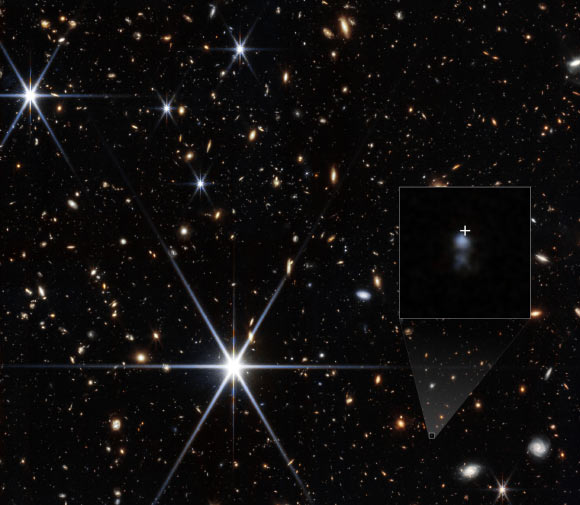
This James Webb Space Telescope image shows the host galaxy of FRB 20240304B, indicated by a white cross. Image credit: NASA/ESA/CSA/STScI/Themiya Nanayakkara, USYD/Joseph DePasquale, STScI.
What are fast radio bursts?
Fast radio bursts (FRBs) are among the most mysterious phenomena in astronomy. These powerful events last only a few milliseconds while releasing enormous amounts of energy, but their exact origins remain unknown.
Theories range from highly magnetized neutron stars affected by streams of gas near supermassive black holes to other proposed sources whose outburst characteristics resemble the signatures of technology developed by an advanced civilization.
“What’s interesting about fast radio bursts is that we don’t know what causes them,” said Dr Manisha Caleb, an astronomer at the University of Sydney.
“There are theories about what kind of objects produce them, but no conclusive evidence.”
FRB 20240304B is the most distant FRB on record
FRB 20240304B was detected on March 4, 2024, by the MeerTRAP project using the MeerKAT radio telescope in South Africa.
The burst occurred when the universe was only about 3 billion years old. It traveled for more than 10 billion years before reaching Earth and more than doubled the previous distance record.
James Webb Space Telescope identifies the host galaxy
To locate the source of the burst, the research team used NIRCam, the near-infrared camera aboard the NASA/ESA/CSA James Webb Space Telescope.
Although the host galaxy could not be seen with the largest ground-based telescopes, Webb pinpointed it and measured its distance. The galaxy is small, metal-poor and actively forming stars.
These characteristics are consistent with the idea that at least some fast radio bursts originate from young magnetars: highly magnetized neutron stars born in supernova explosions.
“Our study suggests that it is highly unlikely that this FRB was produced by the merger of two neutron stars,” Dr Caleb said.
Clues to the origins of fast radio bursts
Studying distant FRBs could help astronomers understand the environments in which these brief but powerful bursts occur and reveal more about the early universe.
“The next step is to push this frontier further and see how close we can get to the first generation of stars,” said Professor Ben Stappers from the University of Manchester, principal investigator of the MeerTRAP project on the MeerKAT telescope.
“These results further demonstrate the Webb Space Telescope’s incredible ability to push boundaries beyond what was previously possible,” said Dr Temmiya Nanayakkara, an astronomer at the University of Sydney.
The findings appear in the journal Science.
_____
Manisha Caleb et al. A few billion years after the Big Bang, there was a burst of high-speed radio waves at redshift. Science, published online October 8, 2026. doi: 10.1126/science.adz2675
Source: www.sci.news