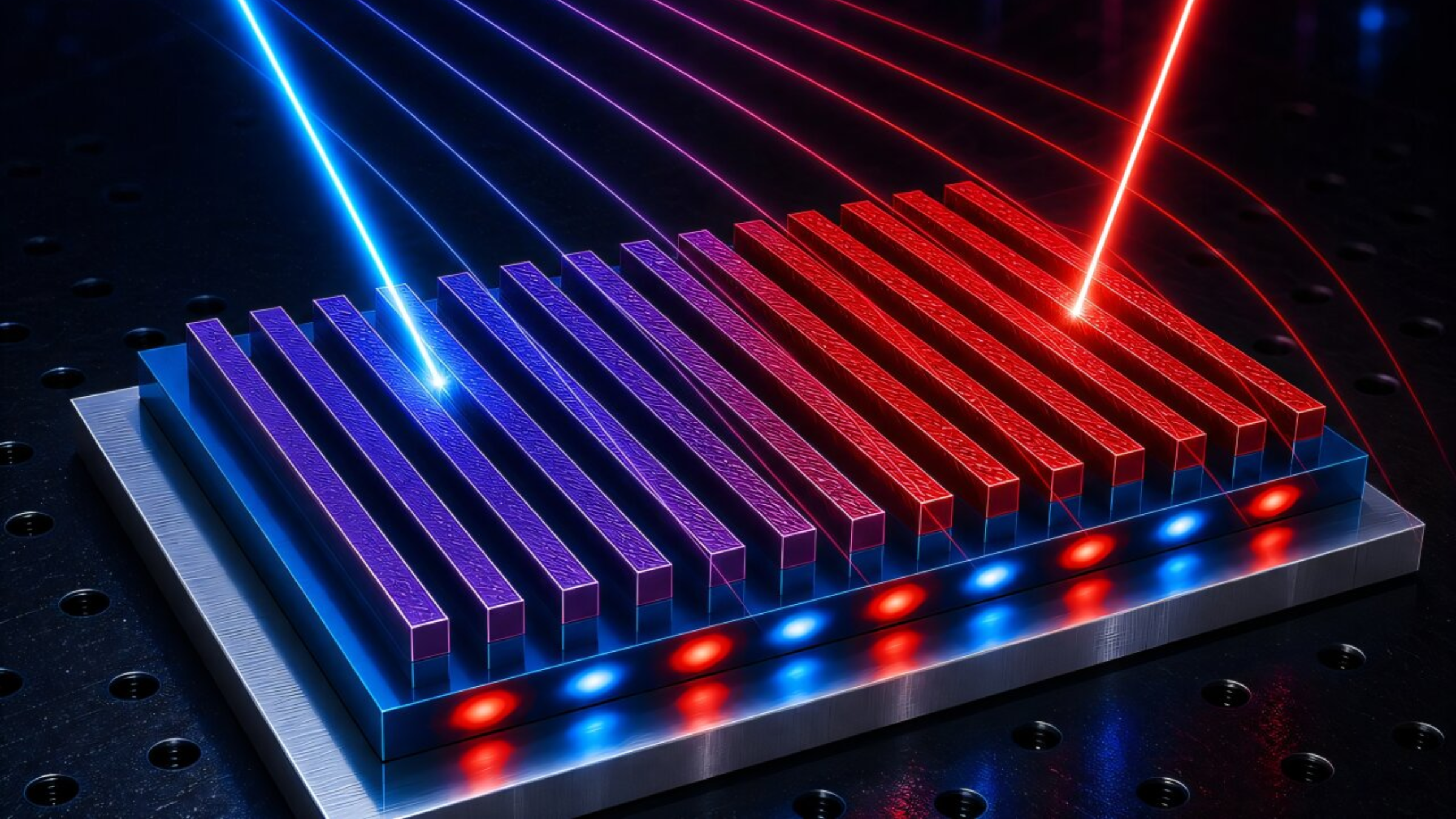
Scientists have developed a theoretical material system that can be programmed to control how it absorbs and emits heat. The breakthrough could lead to more efficient thermal-management technologies, advanced infrared sensors and, in the future, information-storage devices that use heat rather than electrical signals.
The concept, detailed in a June 25 study published in Laser & Photonics Reviews, challenges a fundamental principle that has governed thermal radiation for nearly 160 years. Under normal conditions, a material that efficiently absorbs heat from a particular direction also emits heat efficiently in that same direction.
This relationship, known as thermal reciprocity, was first described by physicist Gustav Kirchhoff in the 19th century. Because of it, engineers have traditionally struggled to control incoming and outgoing heat independently.
The newly proposed device could direct thermal radiation in different directions and retain its chosen setting even after its power supply is turned off. This gives the system a programmable, nonvolatile way to control heat radiation.
The design combines two materials with very different properties. First, the researchers used a magnetic field to break the natural symmetry of indium arsenide, a material that interacts with infrared light. This magneto-optical effect causes infrared radiation traveling in one direction to behave differently from radiation traveling in the opposite direction.
The indium arsenide layer is topped with a grating made from germanium-antimony-tellurium, or GST. This phase-change material can switch between amorphous and crystalline structures. After being changed, GST remains in its new state until it is deliberately switched again.
When the GST grating is programmed, it preserves the device’s directional response without requiring continuous power. In effect, the system can be set to control the direction of heat radiation and then remember that setting, similar to the way nonvolatile computer memory retains information after a device is switched off.
“I was impressed by the elegant combination of magneto-optical nonreciprocity with a nonvolatile phase-change material,” Juejun Hu, a professor of materials science and engineering at MIT who was not involved in the research, told Live Science in an email.
Hu said the approach is especially notable because earlier efforts to achieve directional control of thermal radiation generally worked only at steep angles. By contrast, the proposed device is designed to operate when radiation arrives just 3 degrees from a straight-on path, making it more compatible with practical optical and infrared systems.
Although the researchers compare the system with computer memory, it does not store heat itself. Instead, the GST layer stores a physical material state. Its amorphous or crystalline structure remains stable without an external power source, preserving the device’s programmed thermal response.
The programmable heat-radiation device currently exists only as a theoretical design and has not yet been manufactured or tested. Hu said the concept appears feasible because it relies on established materials and fabrication techniques. However, the GST layer is relatively thick, which could make repeated switching difficult. Developing thinner or alternative phase-change materials may help overcome this limitation.
If engineers can resolve that challenge, the technology’s first practical application could be infrared sensing. Compact sensors capable of selectively absorbing heat from a specific direction could improve thermal imaging, optical communications and other systems that require precise control over infrared radiation.
Qing, Y. M., Shen, Y., Wu, J., Murai, S., Dong, Z., & Okamoto, K. (2026). Reconfigurable giant nonreciprocity at Near‐Normal incidence via Phase‐Change Magneto‐Optical metagratings. Laser & Photonics Review.