


Meet the NASA Photographers Capturing the Future of Human Spaceflight
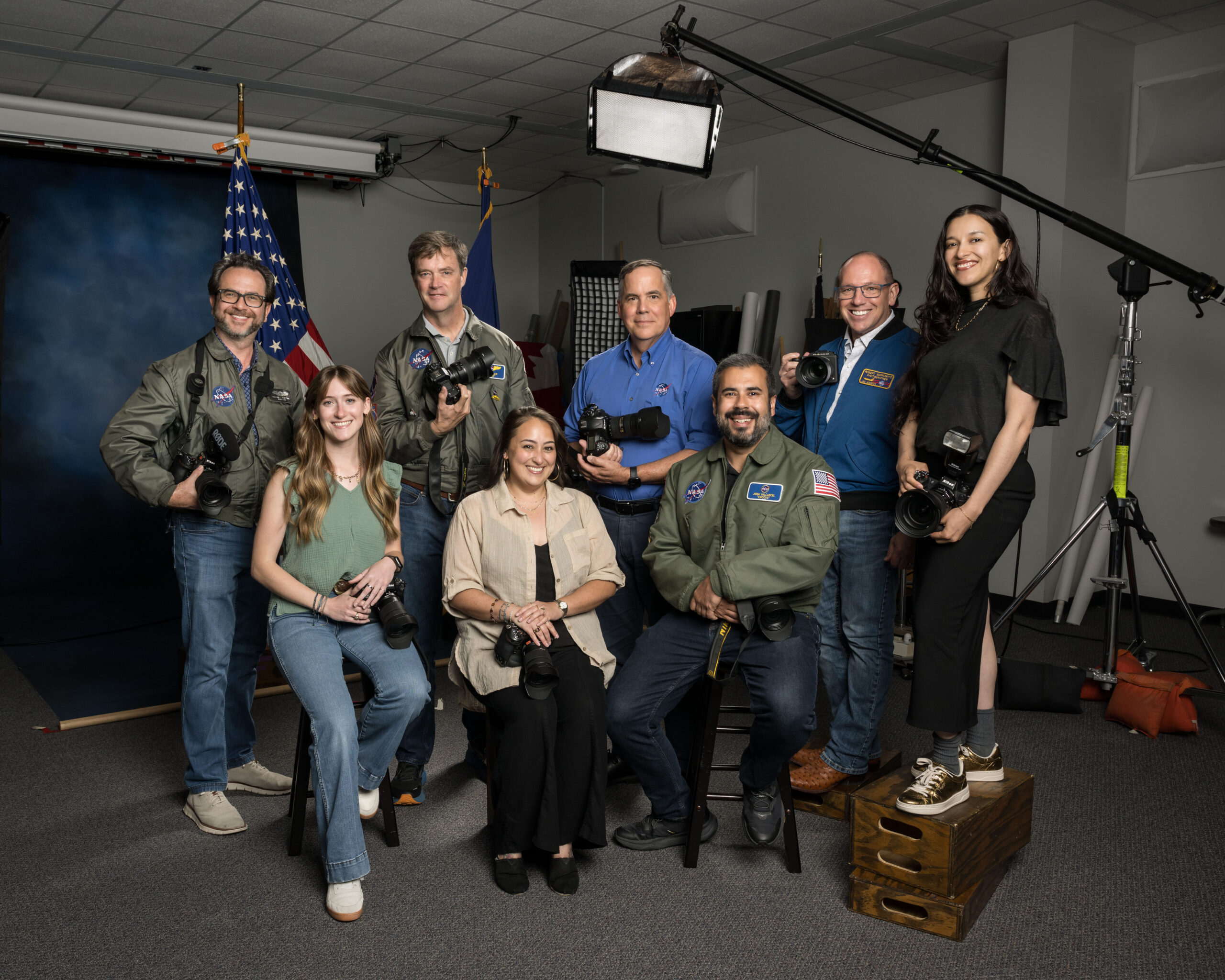
Photographers at NASA’s Johnson Space Center in Houston document the people, technology, and milestones defining human spaceflight.
From astronaut training and spacecraft testing to mission control operations and major celebrations, their photographs preserve NASA’s history while showing the teams preparing for the next era of exploration.
Meet the NASA photographers behind the lens and discover the stories behind the images that help share NASA’s human spaceflight missions with the world.
Robert Markowitz
NASA photographer
Robert Markowitz: Documenting Decades of Human Spaceflight
For more than 30 years, NASA photographer Robert Markowitz has captured the people and milestones that shaped the agency’s human spaceflight program. His career includes the Space Shuttle Program, 25 years of continuous human presence aboard the International Space Station, and NASA’s Artemis II mission.
“What I love most about this job is the scope of the assignments I take on and the people I get to work with every day,” Markowitz said.
One of Markowitz’s early career highlights came during the filming of Apollo 13. He served as the behind-the-scenes still photographer for nearly all of the KC-135 parabolic flights used to create the film’s zero-gravity scenes.
“Looking back as a 25-year-old photographer at Johnson, I don’t think I fully appreciated what a unique opportunity it was to be there capturing that moment,” he said.
Markowitz said the work has helped him grow as both a photographer and a communicator. From taking dozens of individual portraits in a day to coordinating a group photo of 300 people, every assignment has strengthened his ability to adapt, collaborate, and connect with others.
“This work has shaped not only my career, but my life,” he said. “Being part of the team that records and preserves the story of human spaceflight remains one of the great honors of my time at Johnson.”

Bill Stafford
NASA photographer
Bill Stafford: Combining Photography and Problem-Solving
NASA photographer Bill Stafford first learned about an opportunity at Johnson Space Center during his senior year of college. A friend completing a photography internship at the center told him about an opening on the photography team.
With a long-standing interest in science and technology, Stafford saw the position as an opportunity to combine photography with work in extraordinary aerospace environments.
Stafford approaches every assignment as both a technical challenge and a storytelling opportunity. Even when working with limitations involving lighting, timing, or access, he uses composition, visual psychology, and an understanding of how viewers move through an image to create an effective photograph.
“My favorite part of the job is the problem solving that comes with it,” Stafford said.
His work at Johnson has sharpened his instincts for photographing spacecraft, aerospace hardware, astronauts, and the people supporting NASA’s human spaceflight missions.
“Many of the subjects I photograph have weight and history, and I want that to be reflected in the images,” he said.
James Blair
NASA photographer
James Blair: Bringing Photojournalism to NASA Exploration
NASA photographer James Blair began his photojournalism career as a photographer and photo editor for newspapers across the United States and publications in Ecuador. His work has taken him around the world, and that experience continues at Johnson through assignments ranging from astronaut training to geology field training in Iceland.
“Ever since I was young, I’ve always been fascinated by spaceflight and the technology required to reach beyond Earth’s atmosphere,” Blair said.
At Johnson, Blair combines his passion for space with his photojournalism background to document the people and technologies shaping NASA’s next era of exploration.
“I enjoy documenting the new hardware being developed to take us back to the Moon,” he said. “From spacesuits and rovers to lunar habitats, we are able to show the world what NASA has in store for the future of human spaceflight.”

Helen Arase Vargas
NASA photographer
Helen Arase Vargas: Sharing NASA’s Mission With the Public
NASA photographer Helen Arase Vargas began her career in photojournalism and reporting in Southern California before joining Boeing’s science photography team in El Segundo. Her experience in aerospace photography sparked an interest that eventually led her to Johnson Space Center.
“The best thing about this job is my coworkers. It’s cheesy, but I learn a lot from everyone,” Arase Vargas said. “Our core team has so much knowledge. They are all quick to help and are great human beings.”
Much of Arase Vargas’ work at Johnson reflects the journalistic ethics she developed early in her career and her commitment to serving the public interest.
The variety and volume of assignments have also helped her become more comfortable working in different environments while continuing to strengthen her photography skills.
For Arase Vargas, documenting the Artemis II crew’s return to Houston’s Ellington Field carried an added sense of responsibility.
“All such images must be removed from the lab quickly because the world is watching,” she said. “Your photo could be on any news site, and you don’t want to miss out on the joy and celebration that moment deserves.”
Luna Posadas Nava
NASA photographer
Luna Posadas Nava: Inspiring Future Explorers Through Photography
NASA photographer Luna Posadas Nava’s career at Johnson Space Center is rooted in emerging technologies, optics, imaging systems, and the work of photographic artists across the East Coast. Her approach is driven by a desire to visualize new ideas and expand the limits of what is possible.
Joining Johnson shortly before NASA’s Artemis II mission, one of Posadas Nava’s first experiences involved helping share “Moon Joy” with the world. She documented scientists in the Science Evaluation Office as they worked together to conduct real-time lunar science observations during the mission’s flight around the Moon.
Posadas Nava said it was inspiring to witness the team’s work and especially meaningful to see so many women contributing to the mission’s science.
After seeing the reactions of women and girls in person and online, Posadas Nava recognized the power of representation through photography.
“When we see ourselves in stories, we imagine new futures,” she said. “I hope my work helps more people see themselves in stories of exploration, because what we see shapes what we believe is possible.”

David DeHoyos
NASA photographer
David DeHoyos: Preserving the Human Side of NASA
Growing up in Houston during the Apollo era, NASA photographer David DeHoyos knew from an early age that he wanted to work in the space industry. His interest in photography began with his mother’s Kodak Instamatic camera, continued through school, and led to 10 years working in a photo lab.
In 1991, that path brought him to Johnson Space Center’s photo lab and eventually to a career as a NASA photographer.
After more than 30 years at Johnson, DeHoyos says connecting with people remains one of his favorite parts of the job. He enjoys learning about the people he photographs, sharing NASA’s story with visitors and new employees, and encouraging the next generation of explorers.
“I stock my camera bag with NASA merchandise,” DeHoyos said. “There’s no greater joy than giving a pin or sticker to a child and seeing their little faces light up. It warms my heart to encourage young people to work hard and pursue their dreams, because that’s how I got here.”
For DeHoyos, NASA photography is also a way to preserve moments that gain greater meaning over time.
“I love the process of figuring out the technical details and creating an image that makes someone say, ‘Wow, that’s a cool shot. How did you make it?’” he said.
Capturing NASA’s Next Era of Exploration
Together, these NASA photographers provide a visual record of human spaceflight—from the Space Shuttle Program and the International Space Station to Artemis and future missions to the Moon. Their images capture more than spacecraft and hardware; they preserve the teamwork, determination, and human stories behind NASA’s exploration achievements.
Source: www.nasa.gov