


NASA Chandra Galaxy Gallery Reveals the Violent Beauty of the Universe
Galaxies are among the universe’s most remarkable structures. Each one has a distinct size, shape, history, and environment. A new gallery from NASA’s Chandra X-ray Observatory and a collection of other powerful telescopes showcases this extraordinary diversity through 16 detailed galaxy images.
The images reveal galaxies in different stages of evolution, from actively forming stars to those shaped by collisions, black hole activity, and extreme gravitational forces. Together, they offer astronomers new ways to study how galaxies form, change, and interact across cosmic time.
Explore NASA’s Galaxy Image Gallery
Astronomers generally classify galaxies into three broad types: spiral, elliptical, and irregular. Spiral galaxies, including the Milky Way, feature sweeping arms that extend from a central region. Elliptical galaxies are typically older and may form after major mergers. Irregular galaxies have less defined shapes and can display a wide variety of unusual features.
Studying galaxies beyond the Milky Way helps scientists better understand our own cosmic home. By comparing galaxies with different shapes, ages, and environments, researchers can investigate the Milky Way’s past and gain insight into its future.
Each image in the gallery combines X-ray observations collected by Chandra over decades with data from ground-based and space-based observatories. These sources include NASA’s James Webb Space Telescope, Hubble Space Telescope, Imaging X-ray Polarimeter, Neil Gehrels Swift Observatory, and Nuclear Spectroscopic Telescope Array, also known as NuSTAR.
Why X-Ray Observations Matter
X-rays provide a unique view of galactic environments that cannot be seen in visible light. NASA’s Chandra X-ray Observatory detects gas heated to millions of degrees by winds from massive stars, explosions of supernovae, and outflows from supermassive black holes.
This superheated gas contains elements that are essential to planets and life, including material found in the air we breathe, the ground beneath us, and our own bodies. When Chandra’s X-ray data is combined with observations at other wavelengths, scientists can create a more complete picture of how galaxies grow, interact, and evolve.
Star Formation Across Spiral Galaxies
Face-on spiral galaxies such as Messier 33 and NGC 3938 provide clear views of energetic stellar systems and cosmic explosions along their spiral arms. These regions help astronomers study the birth and death of stars, as well as the powerful processes that shape galactic environments.
Barred spiral galaxies, including NGC 1672 and NGC 1385, contain a central bar of stars, gas, and dust. This structure can direct material toward the galaxy’s center, fueling activity and triggering bursts of star formation. NGC 4725 provides evidence of how earlier interactions with neighboring galaxies can also stimulate new stars.
Edge-on galaxies such as NGC 4631, often called the Whale Galaxy, and Messier 82, known as the Cigar Galaxy, reveal vast halos and superwinds of multimillion-degree gas. These winds can travel thousands of light-years into space, carrying elements produced by stellar explosions into the surrounding intergalactic environment.
Supermassive Black Holes Shape Their Host Galaxies
A growing supermassive black hole at the center of a galaxy can create an active galactic nucleus. These powerful regions release energy through outbursts and jets that can influence the galaxy far beyond its central core.
In Centaurus A, observations from Chandra and the Imaging X-ray Polarimeter revealed a jet of high-energy particles extending tens of thousands of light-years from the galaxy’s central black hole. In Messier 106, jets from the supermassive black hole heat surrounding gas and produce unusual spiral features.
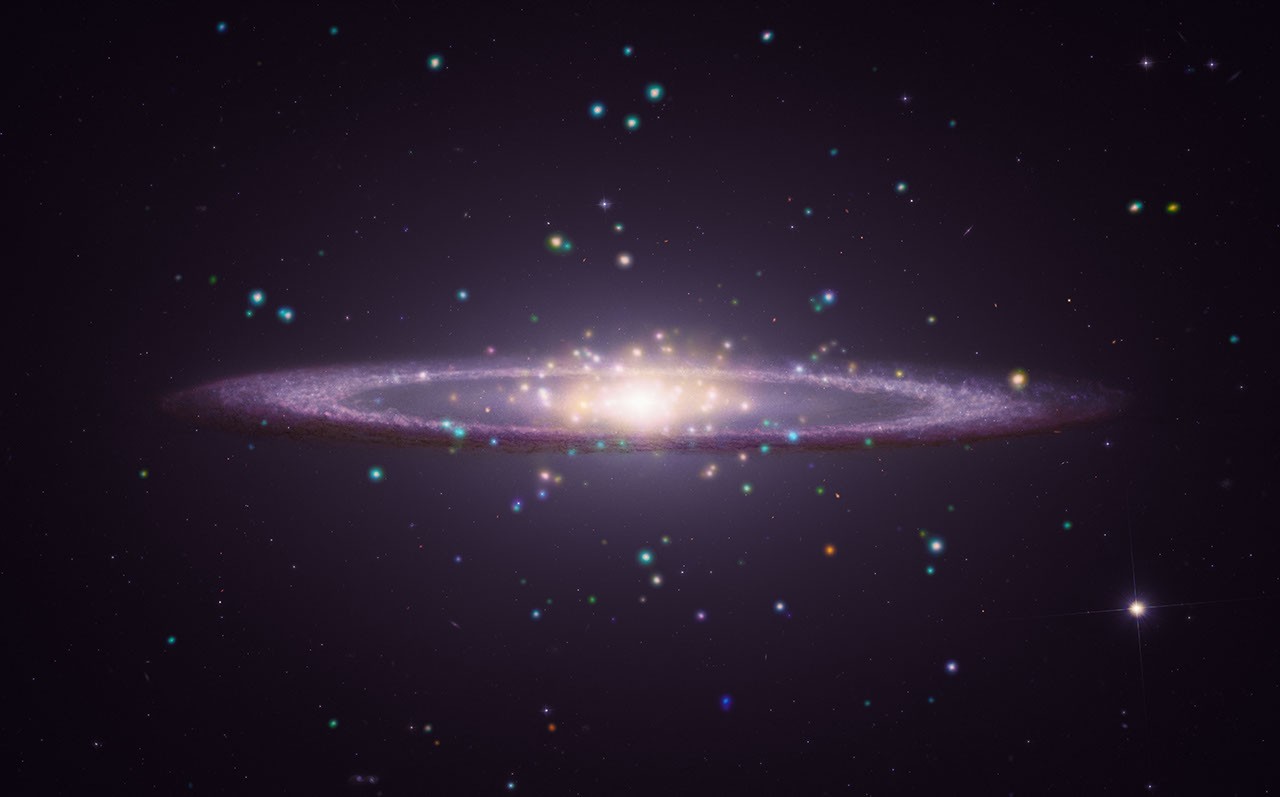
The Sombrero Galaxy, or Messier 104, offers another view of black hole activity. Its central supermassive black hole is embedded within a large stellar bulge, while Chandra’s X-ray observations map a diffuse halo of multimillion-degree gas and hot stellar debris around the galaxy’s prominent dust lanes.
Galactic Collisions and Extreme Environments
The gallery also highlights galaxies undergoing dramatic gravitational changes. In Arp 143, a direct galactic impact created an expanding ring and triggered a wave of new star formation. Galaxies such as NGC 3256 and the dusty starburst galaxy II Zw 096 show the chaotic results of mergers—events that were especially common in the early universe.
These collisions also provide a glimpse into the distant future, when the Milky Way is expected to merge with the nearby Andromeda Galaxy. Other featured objects offer equally unusual perspectives. NGC 1569 serves as a nearby laboratory for studying intense star formation, while NGC 660 contains a rare polar ring of stars orbiting above and below its main disk.
Messier 90 shows a spiral galaxy moving rapidly through the Virgo Cluster. As it travels through the cluster, pressure strips away gas needed to form new stars, transforming the galaxy’s future.
NASA Chandra Galaxy Research
NASA’s Marshall Space Flight Center manages the Chandra program. The Smithsonian Astrophysical Observatory’s Chandra X-ray Center manages scientific operations from Cambridge, Massachusetts, and flight operations from Burlington, Massachusetts.
Read more from NASA’s Chandra X-ray Observatory
For more information about Chandra, please visit:
detail
Marshall Space Flight Center
keep exploring
Discover more topics from NASA
Source: science.nasa.gov