


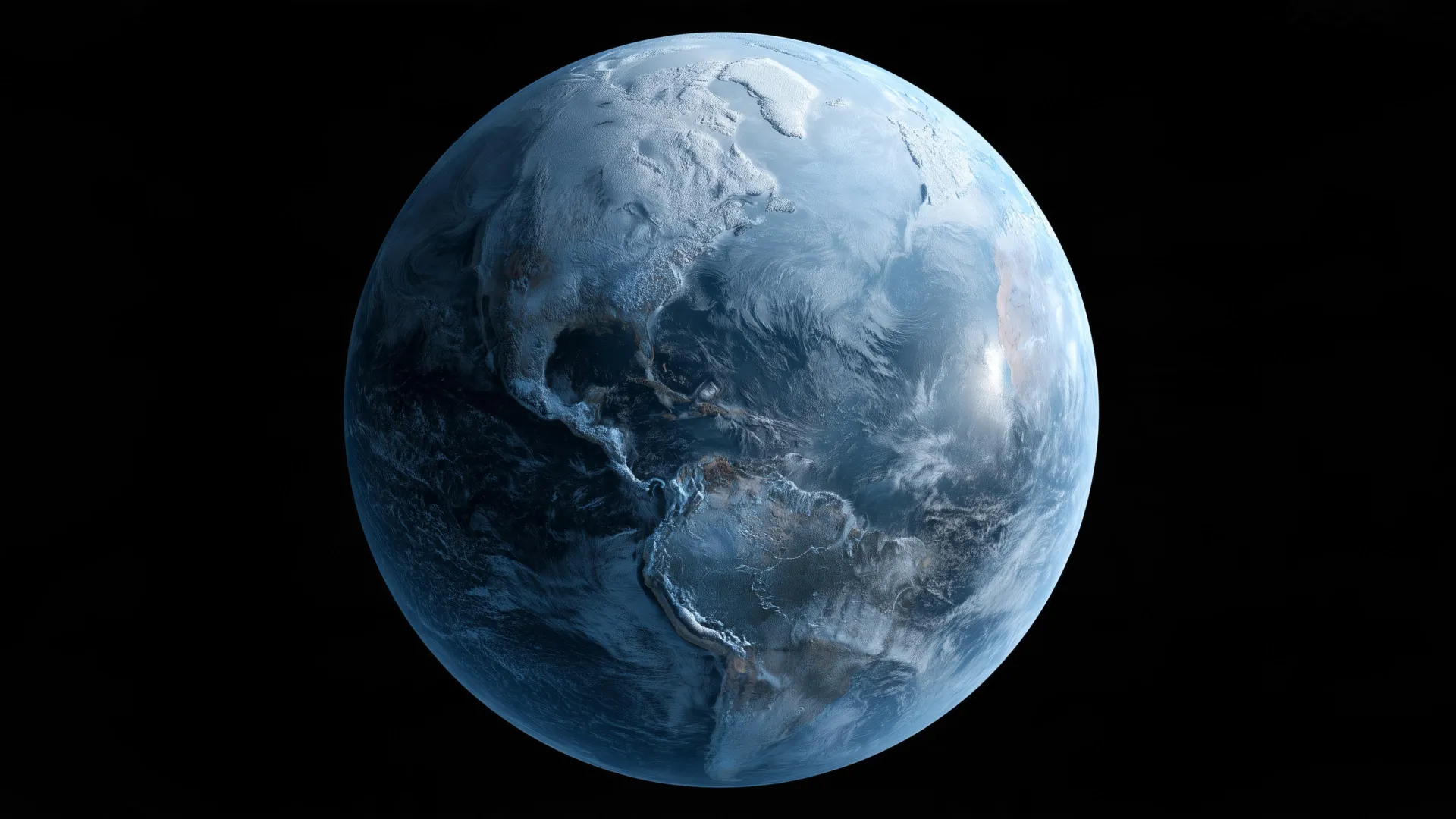
Scientists at the University of St Andrews have identified a previously unknown process that may help explain how Earth entered past ice ages. Their findings suggest that the growth of Northern Hemisphere ice sheets could have altered ocean circulation near Antarctica, increasing the Southern Ocean’s ability to remove carbon dioxide (CO2) from the atmosphere and triggering further global cooling.
The research offers a possible explanation for how the expansion of Northern Hemisphere ice sheets affected ocean circulation and Southern Hemisphere sea ice. These southern changes are known to contribute to lower atmospheric CO2, an important factor in the development of ice ages. Until now, scientists have struggled to explain how processes occurring on opposite sides of the planet could be so closely connected.
One of the main factors supporting Earth’s past ice ages was a decrease in atmospheric CO2, as more carbon was stored in the ocean. Much of this process was controlled by changes in the Southern Ocean surrounding Antarctica. However, a key question remained: how could the growth of Northern Hemisphere ice sheets, initially caused by natural fluctuations in Earth’s orbit, cause the distant Southern Ocean to absorb more CO2?
How northern ice sheets could affect Antarctica
The researchers propose that the answer lies in the movement of seawater between the hemispheres. When large ice sheets spread across northern regions, they cool nearby waters in the North Atlantic Ocean. Over time, these colder waters circulate southward and eventually reach the Southern Ocean.
If the cooling is strong enough, it could alter ocean circulation around Antarctica, causing more carbon to be stored below the surface. As atmospheric CO2 levels fall, the planet could cool further and the ice age could intensify.
To investigate this possibility, the research team used computer simulations of ocean circulation. Rather than lowering temperatures across the entire planet, they cooled only the northernmost latitudes to mimic the effects of large ice sheets and then examined how the Southern Ocean responded.
The simulations found that cooling the far north alone produced 74% more CO2 drawdown than a simulation in which the entire planet was cooled. This suggests that temperature changes in the Northern Hemisphere could have a major effect on the Southern Ocean and its capacity to store carbon.
A possible missing link in the ice-age puzzle
The simulations support the proposed connection between the expansion of Northern Hemisphere ice sheets and changes in Southern Ocean circulation. They suggest that colder water originating in the North Atlantic could eventually influence circulation around Antarctica, helping remove CO2 from the atmosphere and contributing to the global cooling associated with past ice ages.
For decades, much research into ice-age climate change has focused on the Southern Ocean because of its important role in regulating atmospheric CO2. Scientists have only recently begun to recognize how changes in distant ocean regions can influence these processes.
Lead author Dr Madison Shankle, from the School of Earth and Environmental Sciences at the University of St Andrews, explained the significance of the findings:
“Essentially, we have presented evidence of a plausible mechanism that connects two distant pieces of the puzzle: northern hemisphere ice sheets and southern hemisphere ocean circulation changes that drive CO2 drawdown. This has been difficult to explain in theories about Earth’s past ice ages. In our research, we have taken the step of actually demonstrating that they work in model simulations, which is a major step forward for the field.”
What ancient ice ages reveal about today’s climate
Understanding how past ice ages developed gives scientists a way to study Earth’s natural carbon cycle. These periods reveal how carbon moves between the atmosphere and the ocean, and how changes in that balance affect global temperatures.
By identifying additional mechanisms that may have contributed to reductions in atmospheric CO2, studies of ancient ice ages can help researchers build a more complete picture of how Earth’s climate system works.
This knowledge is especially important today, as scientists seek to understand how the oceans and other natural systems will respond to the additional carbon dioxide entering the Earth system.
Source: www.sciencedaily.com